

 Login
Login
Articles
Stop Press
Sub Title : Indian Navy Charts a New Maritime Vision - Key Takeaways from Admiral Tripathi’s Briefing
Issues Details : Vol 19 Issue 5 Nov – Dec 2025
Author :
Page No. : 12
Category : Military Affairs
: December 5, 2025
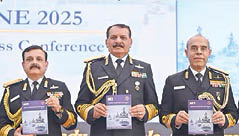
On 2 December 2025, India’s Chief of Naval Staff, Admiral Dinesh K. Tripathi, delivered a wide-ranging press briefing ahead of Navy Day, presenting both a performance review and a forward-looking strategic vision that underlines the evolving role of the Indian Navy (IN) in a rapidly changing maritime environment. The briefing underscored a clear message – the Navy is shifting from traditional platform-centric thinking to a fully integrated, network-centric force capable of countering multi-domain threats.
Central to the address was the release of the new Indian Maritime Doctrine 2025, which codifies this shift. The doctrine reflects India’s changing strategic maritime environment with emphasis on jointness, interoperability and the integration of cyber, electronic, space and unmanned domains alongside traditional naval capabilities. It recognizes grey-zone, hybrid and irregular warfare as part of the future threat spectrum, and underlines the role of uncrewed and autonomous platforms.
During the brief, Adm Tripathi reviewed the Navy’s operational achievements over the past year, nearly 11,000 ship-days and 50,000 flying hours, widespread global deployments, sustained anti-piracy patrols in the Gulf of Aden, and a robust presence in the Red Sea to safeguard global merchant shipping. He specified that 40 warships are currently deployed to protect cargo worth billions of dollars, highlighting the Navy’s commitment to maritime security and safeguarding trade routes.
On the nuclear front, he announced that INS Aridaman, India’s third indigenous nuclear-powered ballistic missile submarine (SSBN), is in final trial stages and will soon be commissioned, marking a significant strengthening of India’s sea-based nuclear deterrence.
A major portion of the briefing was devoted to detailing the ongoing Operation Sindoor. Admiral Tripathi reiterated that the operation “remains in progress,” while praising the Navy’s “aggressive posturing” and readiness, which he said had effectively kept the Pakistan Navy confined to its ports or coastal regions since May 25, preventing hostile movement and sharply reducing maritime risk. The economic fallout for adversaries was also highlighted, with rising insurance costs keeping many merchant vessels away from Pakistani ports.
Addressing regional tensions and foreign naval activity, Admiral Tripathi assured that the Indian Navy is fully aware of all developments in the Indian Ocean Region, including the presence of Chinese research or surveillance vessels emphasizing that vigilant maritime domain awareness was ongoing and that “there is no need for concern.”
At the heart of the speech lay the overarching message that modern naval power must rest not just on ships and platforms but on doctrine, integration and adaptability. The 2025 Doctrine, ongoing procurement, and platforms like INS Aridaman are aimed at building a Navy that can fight across domains and threats, conventional and asymmetric. The demonstration of high-tempo readiness, sustained deployments, and force modernization all point to a maritime force realigning itself to meet 21st-century demands.
In summary, the December 02 press briefing by Admiral Tripathi laid out a coherent and ambitious roadmap for the Indian Navy to evolve from a traditional sea-faring force into a network-integrated, multi-domain maritime power. The challenge now lies in execution- transforming doctrine into action, platforms into capability, and readiness into deterrence.
