

 Login
Login
Articles
Battle for Somnath Temple
Sub Title : A detailed and well researched account of the historic battle fought 1000 years ago, and its significance on Indian history
Issues Details : Vol 19 Issue 6 Jan – Feb 2026
Author : Brig Karan Khajuria
Page No. : 63
Category : Regular Features
: January 22, 2026
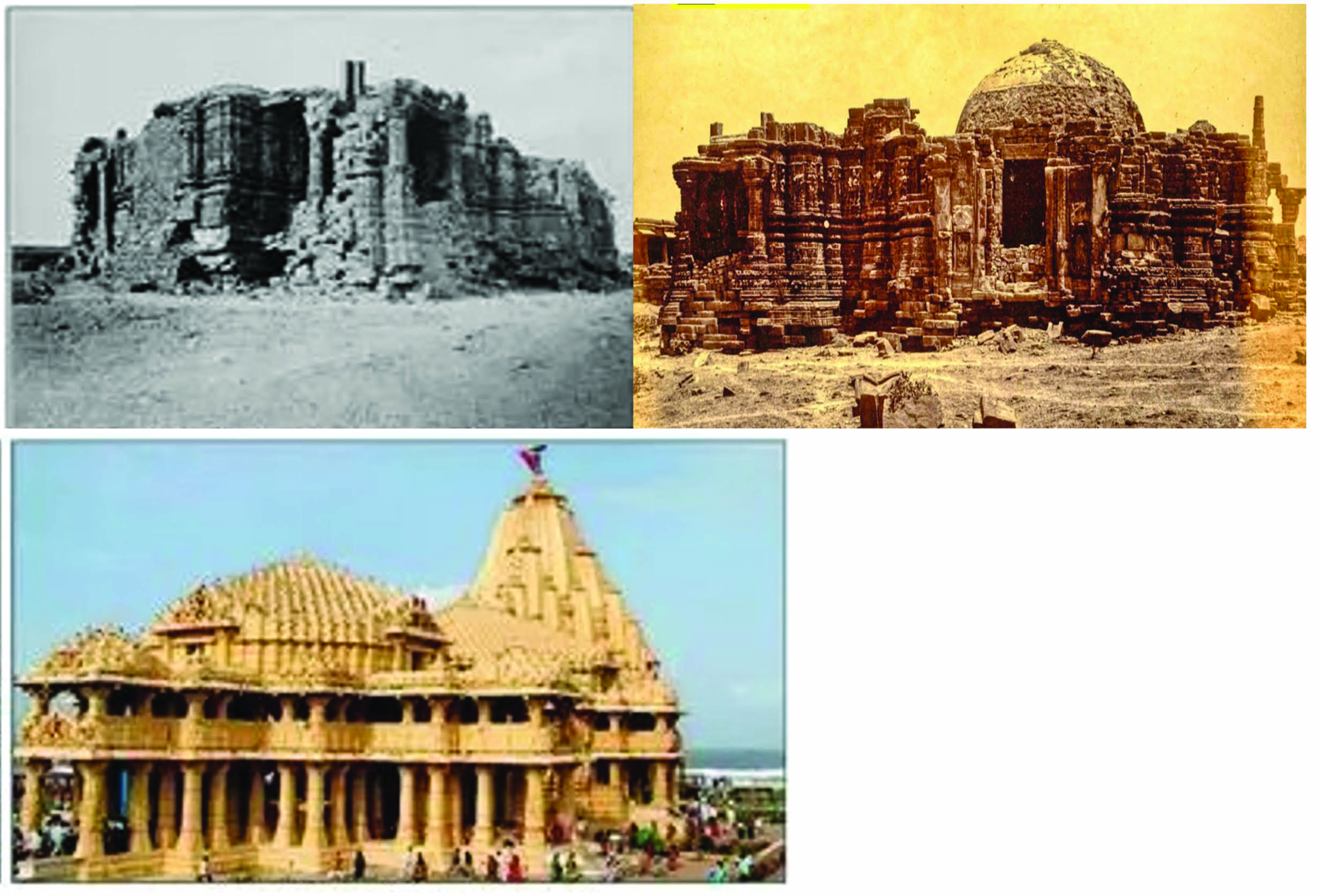
1000 years back, the epic Battle of Somnath Temple was fought by the Indian warriors against Turkic invader Mahmud Ghazni. Many of us would have heard about the destruction of Somnath Temple in Gujrat by Mahmud Ghazni, ruler of Ghazni (located in present day Afghanistan) in January 1026. However, the true significance of this battle where almost 50,000 brave hearts sacrificed their life but could not prevent physical destruction of their Deity and temple lies in a Millennium of grit and perseverance to ensure that the flame does not extinguish!
Mahmud Ghazni was a religious zealot who had carried out untold death and destruction in present day Afghanistan, Pakistan, and large parts of North India to achieve his goal of destroying Idol-worship from Indic lands and converting the inhabitants to Islam. Having totally destroyed major temple towns of Nagarkot in 1009 CE, Thanesar; near Kurukshetra in 1012 CE, Mathura and Kannauj in 1018 CE in his preceding invasions into India, Mahmud launched his major operation towards Gujarat coast in 1026 CE to destroy the famous temple of Somnath. In addition to the primary reason that Somnath was a major Centre of Hinduism, there is folklore of a secondary reason for Mahmud undertaking this deep raid into India. Arabs were idol-worshipping polytheists prior to their conversion to Islam. Three goddesses that were worshipped by these pre-Islamic Arabs were Al-Lat, Al-Uzza (Akin to Vedic Goddess Usha!) and Manat. There is a belief that Somnath also housed the idol of Arab goddess Manat, which had been shipped to Somnath by Arab devotees to prevent it’ destruction.
Mahmud Ghazni commenced his operations from Ghazni on 18 Oct 1025 CE with an army of around 30,000 regular Cavalry and thousands of volunteers. Since these campaigns were Jihad against the non-believers, they attracted thousands of volunteers who came for the twin incentives of earning the title ‘Ghazi’ for fighting against non-believers and also; for grabbing great amount of loot and plunder, which was legally sanctified under the Islamic concept of Maal-e-Ghanimat (As per the Islamic jurisprudence, if a Believer participating in Jihad killed a non-believer, the property; including women of the non-believer legally belongs to the person who has killed the non-believer, the only caveat being that one-fifth of the spoils are to be handed over to the leader). The invaders, after a short halt at Multan moved through the Thar desert, via Mt Abu and by the end of Dec 1025 had reached Patan. The army of Patan met the invaders at Mundher (modern Modhera) but were defeated. From Modhera, Mahmud marched towards Somnath and had invested the temple town by 6 Jan 1026. The epic battle took place between 6-8 Jan 1026.
According to the Islamic chroniclers, the defenders fought with unmatched heroism. On 7 Jan 1026, the Turkic army was able to scale the temple wall; but in desperate counterattacks, the defenders were able to push the invaders back. However, by 8th Jan 1026, the battle was coming to an end. The defending warriors, who comprised mostly of devotees who had grabbed whatever weapons they could muster and small body of professional soldiers from the rulers in the vicinity of Somnath fought resolutely. Band after band of defenders entered the sanctum sanctorum to take blessings of Lord Somnath and then rushed out to fight the invaders. As the third day of battle ended, around 50,000 of the defenders lay dead. Ganga Sarvajna, the Pashupatacharya (Head Priest) of the temple died in front of the Shivling, before it was shattered to pieces. However, the sacrifices had not been in vain. The pitched battle had caused large number of casualties in the Turkic army too.
Mahmud then entered the centuries old temple and broke the idol of Lord Somnath. Some portions of the idol were sent to Mecca and Baghdad and some were thrown in front of the Jama Masjid in Ghazi and his palace. The temple wealth was looted and the temple was burnt to ground.
After the battle, Mahmud realised that the Indian rulers were converging under King Paramdeo of Abu to block the return route of Mahmud Gazni. Having taken a terrible beating in the Battle of Somnath, Mahmud’ troops were not ready for another pitched battle with the Indians. So, loading their loot and plunder from the temple, Mahmud retreated along Westerly route through Kutch and Sindh. However, the Turks did not retreat unmolested. The Turks were led astray by a devotee of Lord Somnath who had offered to act as a guide, but to avenge the desecration of his deity, had intentionally brought the Army to a place in the deserts where water could not be found. It was with great difficulty and heavy losses due to thirst and lack of food that the Turks were able to navigate out of the Desert. However, as they came out of the desert, the Jats of Sindh were waiting for the Turkic invaders. Al Beruni (Court writer in the court of Mahmud Gazni) says that Sindhis were worshippers of Shiva and Somnath was the most famous (temple) of them. The Jats, living along the Indus River carried out continuous raids all along the Turkic retreat, causing a large number of casualties to the Turks. Famous Arab historian Ibn-ul-Athir writes that, “……but at last, after suffering great distress and hardship, he (Mahmud Ghazni) reached Ghazni in Apr 1026”
The effectiveness of Jat military action can be gauged from the fact that in Mar 1027 CE, Mahmud Ghazni launched an expedition specifically against the Jats of Sind who were staying along the Indus River and had harassed his army during his return march from Somnath. I am not sure if the present day Jats know of these glorious exploits of their clansmen.
Aftermath. The actual saga of a millennium of dogged perseverance begins after the battle of Somnath.
(a) Under the leadership of King Bhimdev and his son Karna, the temple was reconstructed between 1030 to 1045-50 CE. The temple was further enlarged and renovated by King Kumarpala (under the guidance of Saint Bhava Brihaspati) in 1169 CE. This was not merely restructuring of the Temple but of the complete town.
(b) In 1299/1300 CE, on orders of Alla-ud-din Khilji, Somnath temple was once again destroyed and idols broken by his general Alaf Khan Khilji (also called Ulugh Khan) but not before fighting a pitched battle with the local devotees and warriors who fell fighting. (Note. Khiljis were Hindus from the Mountainous region of Kabul-Jalalabad, who had fought alongside the Pashtun Shahi kings against Mahmud Ghazni in the period of 987 CE to 1010 CE. After the defeat of Pashtuns in the ‘Battle of Jalalabad region’ in present day Afghanistan in 990 CE, Mahmud carried out brutal destruction of Khilji’ places of worship and forcibly converted Khiljis to Islam. Two hundred years later, Bakhtiyar Khilji destroyed the University of Nalanda and killed thousands of Buddhist monks in 1193 CE and another Khilji destroyed Somnath Temple 100 years later in 1299 CE, displaying the same levels of brutality and zealot mindset which Turks under Mahmud Ghazni had shown on their ancestors). However, the temple was repaired by King Mahipaldeva (1308-1352 CE); the Chundasama King of Junagarh and his son, Ra Khangar between 1325 and 1351 CE.
(c) The temple was again destroyed in 1395 CE by Muzaffar Shah, the then governor of Gujrat. However, the temple was rebuilt by local Hindu rulers and devotees.
(d) In 1459 CE, Mahmud Begda (Mahmud Shah I), the then ruler of Gujrat attacked Somnath Temple, desecrating it and converted the temple into a mosque. But, by 1500 CE, the temple had been reclaimed and re-built.
(e) In 1669 CE Aurangzeb ordered Somnath Temple’ destruction, along with destruction of a number of other notable temples of that time. However, even after the destruction of the temple, the locals continued to worship in the temple ruins. So, in 1706 Aurangzeb ordered the local Governor to destroy the temple ruins beyond the possibility of repairs and converted the broken temple into a mosque.
(f) It was only in 1783, that the indomitable Queen Ahilyabai Holkar of Indore built a new temple at Somnath.
(g) In Dec 1812, the Gaekwads of Baroda acquired control of the Somnath temple from the Nawab of Junagarh. However, hostility of Nawabs of Junagarh ensured that no meaningful repairs could be undertaken and by 1930s the temple was in ruins with almost no repairs and other restorations having been undertaken for almost 150 years.
(h) Post-Independence, it was on 12 Nov 1947 that Sardar Vallabhbhai Patel ordered construction of a new temple at Somnath while KM Munshi oversaw the actual construction. The temple was consecrated on 11 May 1951 Dr Rajendra Prasad, the then President of India.
Impact of the Battle of Somnath. Prior to the epic battle of Somnath, Mahmud had been attacking North India with impunity, carrying out untold death and destruction. However, the Battle of Somnath caused such immense losses in his Army and so thoroughly demoralised the Turkic troops that thereafter they never undertook any further invasions into India save the expedition against the brave Jats of Sindh. Even this campaign against Jats was more of a face-saving expedition. Hereafter, Mahmud focused on Central Asia and Iran until his death in 1030 CE. The significance of Battle of Somnath in destroying the combat power of a foreign invader is similar to what the mighty Marathas achieved against Ahmed Shah Abdali in the Third Battle of Panipat. In this great historic battle, Marathas, under Sadashivrao Bhau badly decimated the Afghans. Like Mahmud, after the terrible beating suffered in the Third battle of Panipat, Abdali’ power was on the wane.
Epilogue. Today, the temple of Somnath stands tall, symbol of the Indian spirit of perseverance and doggedness, unmatched by any other civilisation in the world. In contrast, tomb of Mahmud Ghazni stands dilapidated and forgotten. While the regions of India which were attacked and destroyed by Mahmud are growing from strength to strength, the region of Ghazni is mired in poverty and strife. Is this the Theory of Karma in action?
