

 Login
Login
Articles
Interview: Chief of the Army Staff
Sub Title : A free wheeling, informative interview on a wide range of current issues with Gen Upen dra Dwivedi, Chief of the Army Staf
Issues Details : Vol 19 Issue 6 Jan – Feb 2026
Author : Editorial Team
Page No. : 26
Category : Military Affairs
: January 22, 2026
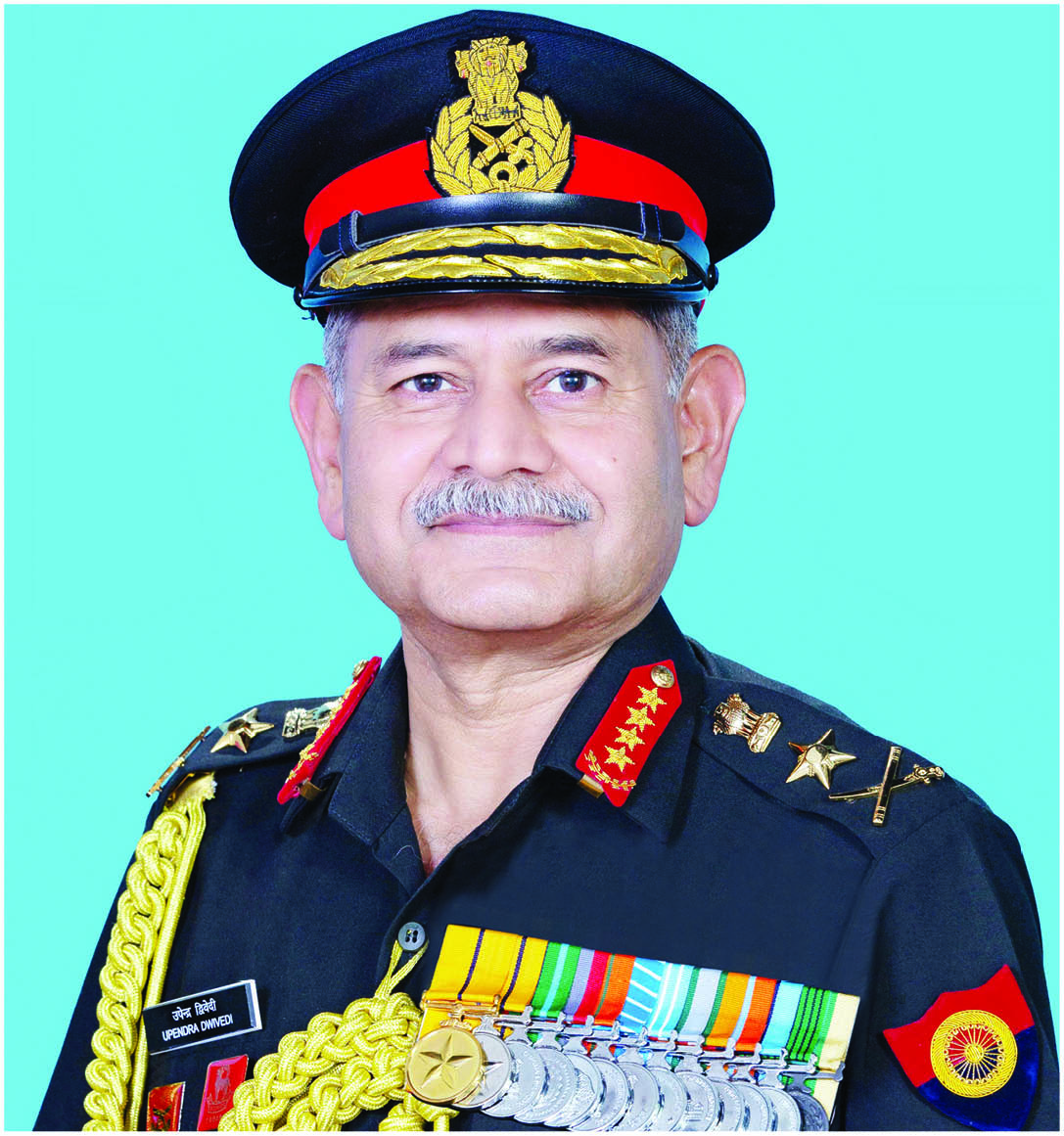
On the occasion of the 78th Army Day, South Asia Defence & Strategic Review (defstrat.com) had the privilege of conducting an engaging Q&A session with General Upendra Dwivedi, PVSM AVSM, Chief of the Army Staff, India. In this candid and comprehensive interview, the COAS shared deep insights, making this one of the most detailed exchanges we have ever presented to our readers.
Defstrat: Two-Front Challenge. India today faces a live and evolving two-front military challenge. How is the Army reshaping its operational priorities, deployment philosophy, and readiness levels to address simultaneous or hybrid threats on both borders? What is your view on the two and half front scenario/s ?
COAS: The Indian Army remains fully prepared to counter all internal and external challenges, with a technology empowered force capable of responding decisively to any contingency. Our readiness is designed to address a dynamic security environment and to retain the ability to respond rapidly and effectively whenever required.
We maintain a careful, professionally calibrated balance between internal and external security priorities. Our foremost responsibility remains safeguarding national sovereignty along the borders. For this, our deployment posture, surveillance architecture, logistics systems and operational readiness remain robust, responsive and fully prepared for any contingency. At the same time, our internal security commitments are being handled through intelligence driven operations in close coordination with CAPFs and state agencies, supported by the employment of technology enabled units.
Our approach is guided by readiness, flexibility and adaptability, anchored in a Whole of Nation framework. We remain fully capable of meeting simultaneous challenges without dilution of focus. The Indian Army is committed to ensuring that both borders remain secure and that internal stability is maintained with professionalism and resolve.
Defstrat: Recent Conflicts. Global conflicts from Ukraine to Gaza and India’s own Operation Sindoor have highlighted the rise of drones, precision fires, and information warfare. What lessons has the Indian Army drawn, and how are these shaping future doctrine and capability development?
COAS: Both Ukraine and the ongoing conflict in the Middle East have been studied very closely by us, alongside the lessons validated during Operation Sindoor. They have not changed our fundamentals, but they have sharpened our focus and accelerated our doctrinal reappraisal, particularly in technology infusion, jointness and information operations.
On technology integration, the clearest shift is from equipment centric thinking to a system of systems approach. Ukraine reinforces that sensors, shooters and shields must operate as one integrated framework to deliver precision, persistence and protection. Accordingly, we are adapting our doctrine to employ long range precision fires, counter UAS, loitering munitions and robust air defence as a combined capability rather than as standalone elements. The density of drones and electronic warfare in both theatres also underlines that survivability now depends on signature management, dispersion, camouflage and redundancy, alongside hardened communications and resilient command and control. Our tactical doctrines, field craft and training manuals are being updated accordingly. Another key takeaway is that the side which adapts technology fastest gains an edge, hence our emphasis on close partnership with industry, start-ups and DRDO to spiral in new technologies, software updates and battlefield applications in months, not years.
On joint operations, both theatres confirm that modern war is multi domain from the outset. Our doctrines now emphasise integrated targeting, common operating pictures and joint planning cells down to tactical echelons. This aligns with our movement towards Integrated Theatre Commands and is being reinforced through war gaming, joint exercises and campaign design. Ukraine has also highlighted that logistics, repair and sustainment are as decisive as the front line, driving greater attention on joint logistics nodes, common maintenance chains and shared ISR.
On information warfare, narratives and perceptions travel faster than missiles. We are treating information warfare, strategic communication and cyber defence as integral to operations, incorporating lessons on network security, misinformation, deepfakes and social media exploitation, supported by a whole of nation posture.
Defstrat: Emerging Technologies. The battlefield is shifting rapidly toward autonomous systems, AI-enabled targeting, and manned–unmanned teaming. What is the Army’s roadmap for integrating such technologies at scale, and how will they transform combined arms warfare in the Indian context?
COAS: Our roadmap for integrating emerging technologies at scale is guided by the Hon’ble Prime Minister’s directive of JAI, Jointness, Atmanirbharta and Innovation. The Indian Army is fully geared to remain on top of the curve of disruptive technologies in modern warfare, while ensuring that adoption is operationally relevant, sovereign where required and integrated within combined arms constructs.
A key feature of this roadmap is a Whole of Government approach through alignment with national missions and apex governance mechanisms. We are represented in NITI Aayog’s Frontier Tech Hubs to accelerate adoption of emerging technologies and we participate in national mission efforts through inter ministerial collaboration. This includes representation in the Defence AI Council and Defence AI Project Agency under the India AI Mission, participation in the Quantum Mission through a joint working group of MoD and ACIDS (IC&T), engagement with the Digital India Mission, Mission Pushpak on drones and the National Mission on Interdisciplinary Cyber Physical Systems, with a clear emphasis on sovereign AI capability to reduce dependence on foreign technology.
Capability development and Atmanirbharta are being advanced through structured capacity building. The Army AI Research and Incubation Centre is progressing multiple projects across operational decision support, surveillance and security, maintenance and logistics automation, war gaming and red teaming and specialised applications such as military climatology and drone based mine detection and neutralisation. This is reinforced through collaborations, including the Indian Army Internship Programme, iDEX ADITI initiatives such as Ekam AI as a Service, work towards a sovereign LLM, AI enabled analytical tools and in house capability to develop AI modules for autonomous systems.
Doctrinal integration is being pursued through doctrine review to align strategy formulation, operational planning and operational control with networking and data centricity, including revision of TTPs for tactical exploitation of AI. In sum, our focus is to move from standalone technology to integrated, secure and scalable capability that strengthens combined arms effectiveness in the Indian context.
Defstrat: Modernisation. Major modernisation programs including FRCV, light tanks, artillery systems, UAVs, and air defence are at critical stages. How is the Army balancing immediate capability needs with long-term indigenisation goals under Atmanirbhar Bharat?
Modernisation and Atmanirbhar Bharat are not competing objectives for the Indian Army. Our approach is to balance immediate operational requirements with long term goals of technology sovereignty and strategic autonomy. Capability cannot be deferred, but dependence must be reduced through a deliberate, structured pathway.
In the near term, operational continuity and resilience are ensured through a calibrated mix of indigenous and imported systems. This diversification helps keep critical technologies available even during geo political tensions and supply chain disruptions. Where bridging arrangements are required, our model of self-reliance remains nuanced, based on selective imports, technology transfer and joint ventures, with the clear purpose of absorbing critical technologies and developing indigenous capabilities.
At the execution level, we reduce strategic vulnerability through dual sourcing, avoiding overdependence while ensuring continuity of supply and support. Licensed production remains another important pathway. It allows partial indigenisation while ensuring access to spares, upgrades and lifecycle sustainment. Offset partnerships also contribute by requiring foreign vendors to reinvest a percentage of contract value into India’s defence sector, including through technology transfer, local manufacturing and R&D.
Equally, we are strengthening self-reliance through indigenous upgrades and integration, where imported platforms are integrated with Indian systems. This reduces long term dependency while retaining operational effectiveness.
Finally, we are promoting modernisation through indigenisation by strengthening partnerships and R&D, supported by government initiatives such as TDF and iDEX that promote innovation and encourage start-ups. Taken together, these measures ensure that immediate capability needs are met while the long-term trajectory remains firmly aligned with Atmanirbhar Bharat.
Defstrat: Theatre Commands. The transition toward integrated theatre commands represents the most significant structural reform in decades. What core principles will guide Army integration with the Air Force and Navy, and how do you foresee jointness evolving in the next five years?
COAS: The Indian Army is fully committed to this transformation and is an active partner in shaping it. The core principle guiding our integration with the Air Force and Navy is that Theatre Commands are being designed as joint warfighting structures, based on a whole of Services design and not as a single Service initiative. Accordingly, Indian Army officers are embedded in the core planning groups, studies and working panels examining command and control structures, areas of responsibility, logistics, communications and HR policies. This ensures jointness is built into the framework from the outset.
In parallel, we are aligning internal structures to the future theatre architecture. The Army has begun rationalising formations, streamlining operational aspects and integrating logistics and communications architectures so that, when Theatre Commands are notified, formations can plug in smoothly without needing to be rebuilt from scratch. This enables transition without compromising readiness.
A third guiding principle is the shift to a joint first approach in doctrine, training and HR. Doctrines and training syllabi at institutions such as the Army War College and DSSC have been reoriented towards joint planning, multi domain operations and integrated logistics. Key appointments, especially at higher ranks, are increasingly viewed as joint warfighting billets to prepare leaders for theatre responsibilities.
Theatre Commands will deliver unity of command and unity of effort, optimise employment of land, air, maritime, cyber and space capabilities and enable better utilisation of national combat power by pooling sensors, shooters and logistics. Over the next five years, supported by integrated networks and joint targeting processes, jointness will deepen through the ability to see together, decide together and act together.
Defstrat: Leadership and the Changing Character of War. With warfare becoming more technological, dispersed, and information-driven, traditional styles of battlefield leadership are being challenged. How is the Army preparing for this new environment?
COAS: Warfare is becoming more technological, dispersed and information driven. Recent years have seen a sharp escalation in the number and intensity of armed conflicts and we are witnessing the simultaneous presence of all five generations of warfare. Future conflict will be shaped by the democratisation of technology, diffusion of conflict and the changing demography of conflict. It will not remain confined to a single domain, but will be fought simultaneously across land, air, sea, space, cyber, the electronic spectrum and the cognitive sphere within an integrated, network enabled battlespace. In response, the Indian Army is advancing on a path of comprehensive transformation aligned with a Whole of the Nation approach.
From a leadership and warfighting perspective, we are preparing for a battlespace where survivability and success depend as much on information, autonomy, precision targeting, electronic warfare and counter UAS capabilities as on armour and firepower. The combat space has expanded both horizontally and vertically and combat commanders must be able to effectively control the air littoral space. Our operational mindset is geared to dominate at longer ranges and across multiple domains, delivering effects before contact. The driving principle is clear: see first, decide first and act first.
Having reorganised our structures, we are now focusing on transforming our platforms by embedding unmanned systems and networked precision capabilities. Resilient networks and reforms in data architecture planned under the Year of Networking and Data Centricity (2026) will enable shorter kill chain execution.
A key step is integrating unmanned systems with upgraded combat platforms as the first move towards manned unmanned teaming. We are also raising specialised UAS troops and platoons within mechanised forces to provide organic long range persistent surveillance, deep reconnaissance and precision strike capability, while enhancing survivability. In Army Aviation, integrating UAS with helicopters will extend horizon surveillance, enable strike without exposing crewed platforms and link ISR, precision fires and manoeuvre as one network.
