

 Login
Login
Articles
Pinaka’s Next Leap
Sub Title : Reviewing PINAKA MBRL’s highly successful evolution and its future trajectory
Issues Details : Vol 19 Issue 6 Jan – Feb 2026
Author : Dr Amit Sharma
Page No. : 56
Category : Military Technology
: January 22, 2026
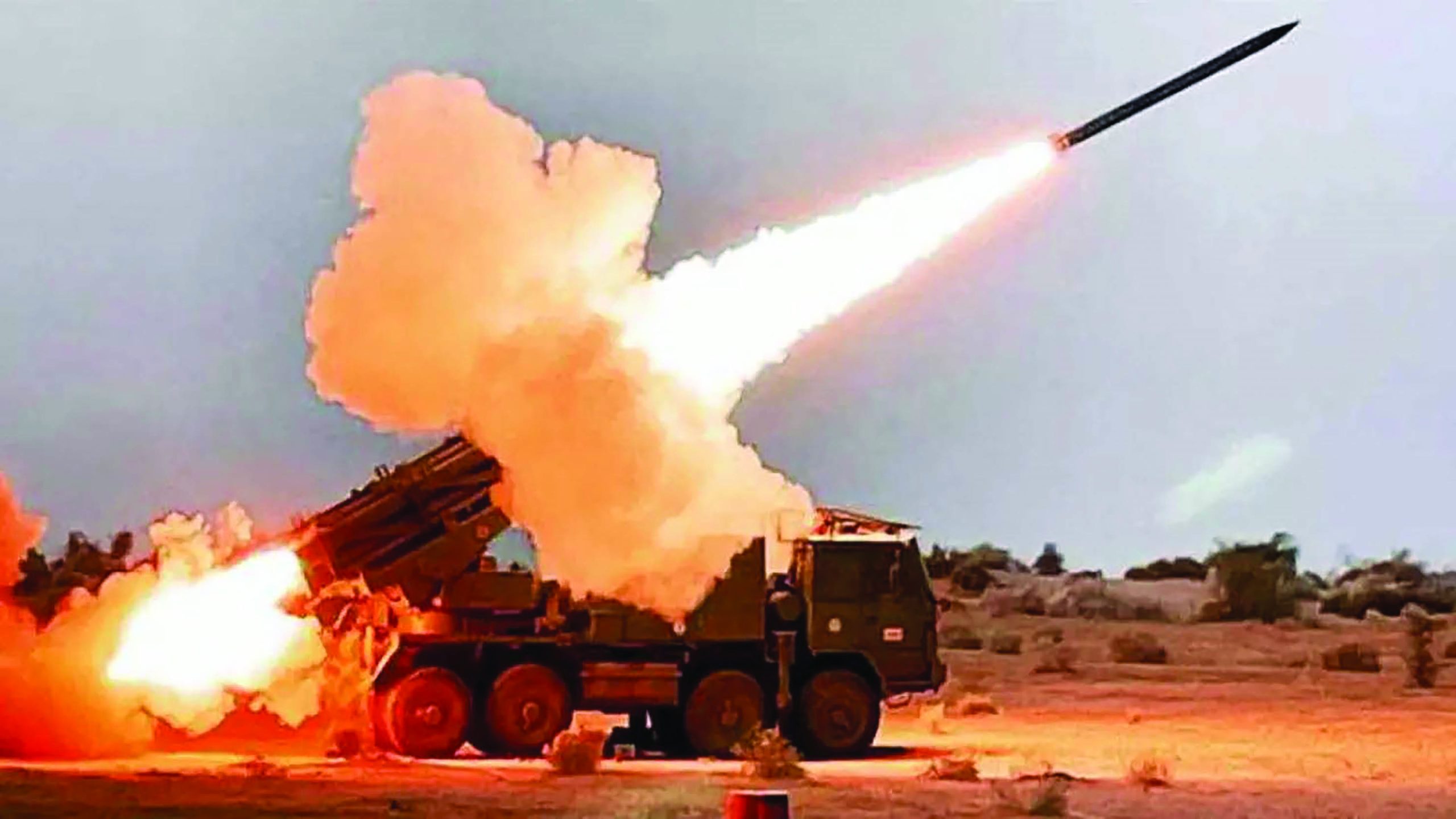
By early February, satellite imagery and long-endurance UAV feeds had begun to tell a familiar story unfolding in an unfamiliar geopolitical moment. Buoyed by what its leadership once again misread as a shifting global balance and distracted great powers, the Pakistan Army quietly began probing the Line of Control in the Kargil sector – calibrated artillery harassment, intermittent skirmishes, and small-unit movement between Matayen and Kargil, eerily echoing the early rhythms of 1999. What unsettled Indian planners was not the firing itself but the patterns supporting it. Persistent ISR detected renewed logistics movement and camouflage activity around Gultari and Oldingthang in Pakistan-occupied Kashmir, the same rear areas that had fed men, ammunition and artillery support during the original Kargil conflict. Signals intercepts hinted at dormant command networks being reactivated.
In 1999, Indian commanders had wanted to neutralise precisely these rear nodes but were constrained by political direction and the absence of credible deep-strike options. In 2026, the equation looked very different.
East of Sankoo, climbing beyond 15,000 feet near the small village of Mangalpur, elements of the 38 Medium Rocket Regiment equipped with Pinaka-II had quietly occupied a pre-surveyed hide position along a secondary road axis that allowed rapid displacement toward Sapi in the opposite direction. The battery commander, Lieutenant Colonel Arvind Malik, had spent the previous winter rehearsing precisely this mission profile with his fire direction officer, Major Ritu Deshpande – fast alignment drills, compressed firing cycles, strict emission control, and disciplined dispersal under simulated counter-battery pressure.
The launch vehicles were deliberately positioned not on dominant ridgelines but within terrain folds that broke line-of-sight from likely enemy UAV corridors. Overhead, a Heron UAV maintained wide-area persistence over the Gultari bowl, while a tactical quadcopter launched from a forward observation post monitored convoy behaviour along the feeder routes from Astore.
Inside the battery command shelter, no one waited for perfect intelligence. A coordinated fire plan was cleared through brigade headquarters. The first ripple of Pinaka Mk-II guided rockets was programmed against the suspected command-and-control cluster and the primary logistics choke point entering Gultari. A second ripple was plotted for area effects across dispersal bays and vehicle holding zones near Oldingthang. Slightly delayed, a larger salvo was tasked toward the approaches of the Burzil Pass, choking the stockpiling corridor feeding through Astore and placing indirect pressure on the sustainment capacity of the Minimarg brigade garrison further south. The intent was not annihilation but disruption – to inject uncertainty, force recalculation, and impose friction – achieved with weapons that carried neither the political signalling weight of ballistic missiles nor the escalation sensitivity of cruise strikes or manned air sorties.
The launch sequence unfolded in under a minute. After the brief roar of ignition, rockets arced into the thin, frozen air, guided by inertial navigation continuously corrected through satellite updates hardened against jamming – one of the advantages of operating from high-altitude geometry. Within minutes, the battery executed its rehearsed displacement drill, vehicles peeling away along separate routes before any counter-battery radar could reliably reconstruct firing solutions.
Several vehicles were observed abandoned mid-movement. Communications in parts of the Gultari pocket temporarily collapsed. Dispersal toward secondary valleys became visible almost immediately. Along the Burzil axis, movement stalled after damage to the Sardar Chowki culvert, disrupting forward stockpiling flows. Oldingthang fared no better.
That was precisely the objective. Not theatre, but time: slowing reinforcement, fracturing coordination, and signalling quietly that rear sanctuaries were no longer immune. In a way that 1999 had never permitted, India had imposed depth at manageable cost, contained political risk, and preserved operational. In a matter of minutes, Pinaka-II had neutralised a problem that once took months of attritional fighting to resolve.
In late December 2025, far from the ceremonial choreography that usually accompanies weapons induction announcements, a quiet but strategically consequential milestone unfolded on India’s eastern seaboard. At the Integrated Test Range in Chandipur, the Defence Research and Development Organisation conducted the maiden flight test of the Pinaka Long Range Guided Rocket (LRGR-120), validating a strike envelope of 120 kilometres. The official release described the trial as achieving “textbook precision” and confirmed execution of planned in-flight manoeuvres – a signal of maturing guidance, control and reliability rather than brute ballistic reach.
Almost simultaneously, Indian industry delivered a second message that mattered just as much for real warfighting. Larsen & Toubro disclosed that it had secured an Indian Army contract for the overhaul, upgrade and obsolescence management of Pinaka launcher systems, focusing on availability, maintainability and lifecycle readiness rather than new hardware glamour. Taken together, these developments reveal the real trajectory of India’s rocket artillery programme: range and precision are expanding, but so is institutional emphasis on fleet endurance, automation and operational uptime.
That balance is not abstract. The Mangalpur employment demonstrated exactly why availability and cycle time matter more than peak reach. In contemporary conflict, artillery effectiveness is measured by how fast a battery can acquire targets, fire accurately, displace before counter-battery sensors lock on, reload, and repeat under electronic attack and persistent surveillance. Survivability has become a function of time compression rather than distance. Pinaka’s evolution – now entering its third decade of service – reflects precisely this doctrinal shift.
Yet each incremental extension of Pinaka’s reach triggers a predictable debate. If 120 kilometres is possible, why not push to 300 or even 400 kilometres, especially when Pakistan publicly claims that its Fatah-II guided rocket system reaches the 400-kilometre class? Indian reporting has occasionally hinted that longer-range derivatives are technically feasible. In purely engineering terms, that is plausible.
The more relevant question, however, is whether India should pursue ultra-long-range rockets aggressively in mass, as a default artillery capability rather than as a limited deep-strike option. The argument for restraint is not conservative; it is economic, operational and strategic.
Pinaka did not originate as a precision instrument. When it entered service in the late 1990s, it was built for rapid saturation – a 12-tube launcher delivering high-explosive rockets over roughly 40 kilometres, firing a complete salvo in under a minute. Its purpose was suppression and disruption rather than surgical accuracy. Over time, advances in propellant chemistry, aerodynamics, navigation and manufacturing consistency steadily expanded both reach and precision. Enhanced variants pushed beyond 60 kilometres. Guided rockets sharply reduced circular error probability and lowered rounds-per-target. The LRGR-120 now pushes into what was once quasi-missile territory while retaining the economics, logistics footprint and operational flexibility of artillery ammunition.
This evolution mirrors battlefield lessons from Ukraine, Nagorno-Karabakh and Gaza. What consistently proves decisive is not maximum reach but cycle dominance. UAVs detect movement, radars reconstruct trajectories in seconds, and electronic intelligence triangulates emissions almost instantly. Any launcher that lingers becomes vulnerable regardless of whether it fired from 40 kilometres or 120. During the engagement just described above, displacement discipline mattered far more than absolute range – a pattern now evident across modern battlefields.
This is why sustainment contracts and upgrade pipelines matter as much as range demonstrations. A technologically advanced rocket system that cannot maintain high availability under wartime stress quickly loses operational relevance. The Ministry of Defence’s emphasis on long-range guided rocket ammunition for Pinaka reinforces that the system is no longer niche fire support but a central pillar of India’s future fires architecture.
What Indian doctrine and recent experience in Op Sindoor illustrates that it is not merely the effectiveness of a single weapon, but the logic of a layered Indian fires network in which each range band performs a distinct operational function. At the inner edge, mortars and close-support artillery dominate the immediate fight, driven by organic drones, observation posts and rapid command loops where responsiveness matters more than reach. Beyond this, tube artillery becomes the daily workhorse of attrition and counterfire, enabled by weapon-locating radars and persistent UAV feeds that compress sensor-to-shooter timelines and deny the enemy comfortable firing sanctuaries. Classic rockets extend shaping fires further into the battlespace but remain tightly governed by shoot-and-scoot discipline in a drone-saturated environment.
It is in the next band – roughly the 80 to 150 kilometre envelope – that Pinaka increasingly becomes the backbone of India’s deep tactical fires. This zone is far enough to disrupt logistics, reserves, air defence pockets and command nodes, yet close enough for ISR fusion to close the kill chain repeatedly and affordably. The recent validation of a 120-kilometre guided Pinaka round strengthens precisely this layer, allowing deeper positioning of launchers without pushing the system into missile economics or escalation-sensitive employment. The Mangalpur engagement demonstrated how this middle layer can impose depth, tempo and uncertainty while remaining politically and logistically controllable.
Beyond this band, fires progressively shift into selective, high-value engagement logic. Longer-range rockets, cruise or ballistic missiles and airpower remain indispensable for hardened targets and strategic signalling, but they operate in thinner inventories, under tighter command authority and with heavier ISR and protection demands. They are not designed for routine battlefield shaping or sustained volume — precisely the roles that rocket artillery traditionally excels at.
What binds these layers into a functional net is not merely the weapons themselves, but the connective tissue: persistent ISR across tactical and operational depths; counter-battery radars that punish static firing; resilient digital fire-control networks; protected ammunition corridors and dispersed logistics nodes; and layered protection rings of air defence, counter-UAS, deception and rapid mobility around every firing unit. The farther a weapon reaches, the more expensive and fragile this protective ecosystem becomes — reinforcing why thickening the middle layer delivers far greater warfighting return than stretching range for its own sake.
Against this backdrop, fixation on Pakistan’s 400-kilometre claim risks becoming strategically misleading. Large range numbers carry signalling value, but headline figures conceal the trade space that begins shifting rapidly beyond roughly 150–200 kilometres.
Once rockets are stretched past this band, they increasingly inherit missile economics. Higher energy propellants introduce thermal constraints. Guidance systems must survive longer exposure to electronic warfare. Navigation errors magnify geometrically with distance. Manufacturing tolerances tighten. Testing cycles lengthen. Quality assurance costs rise sharply. Although the munition still launches from a truck, it begins to behave like a tactical missile in everything except name.
The operational consequences are unavoidable. Unit costs rise, stockpile depth contracts, logistics handling becomes more delicate, and doctrine shifts toward selective employment rather than routine fire missions. Artillery’s traditional advantage — persistent volume — begins to erode.
The danger for India lies in allowing technological possibility to override force-design logic. India already possesses deep-strike instruments optimised for hardened or high-value targets and deliberate signalling. Brahmos sits pretty in this area. Forcing rocket artillery to replicate those roles risks duplicating cost without proportional battlefield payoff.
Where rocket artillery delivers disproportionate advantage is in the middle band — the same band demonstrated in our scenario — where targets remain observable, kill chains remain short, and munitions remain affordable enough to sustain tempo. That is the band in which repeated cycles of detection, engagement and displacement generate cumulative operational pressure rather than episodic spectacle.
Ultra-long-range rockets in mass introduce several structural risks. War-reserve mathematics comes first. Artillery campaigns demand endurance. India’s most plausible conflicts are unlikely to be resolved in short, decisive bursts; they are more likely to involve prolonged mobilisation and sustained pressure. As unit costs rise, stockpiles shrink, commanders hesitate to expend premium rounds on routine targets, and the very logic of mass fires weakens.
Targeting complexity grows with depth. At 300–400 kilometres, targets are more likely hardened, mobile, decoyed and protected by layered air defence and electronic warfare. ISR persistence becomes harder. Battle damage assessment becomes less reliable. Kill chains stretch and friction accumulates.
Logistics burden compounds the problem. Longer-range guided rockets are heavier, more sensitive and more demanding to transport, store and maintain — particularly in high-altitude environments like the Ladakh–Kargil belt or deep inside Thar desert or remote heights around North Sikkim. Fewer rounds move per convoy. Forward infrastructure must expand. Sustained fire density declines even as nominal range increases.
Survivability does not automatically improve with distance. In sensor-rich battlespaces, launchers are hunted by signatures rather than range. Survivability flows from compressed exposure time, disciplined emissions, deception, dispersion and rapid displacement — precisely the behaviours that enabled survivability during the February employment.
There is also a signalling dimension. A mass-deployed 300–400 kilometre rocket force compresses decision time and risks blurring tactical and strategic thresholds. The restrained use of Pinaka in February illustrated why controllability matters as much as capability.
Opportunity cost remains decisive. Resources invested in pushing rockets beyond their most efficient band are resources not invested in ISR resilience, counter-UAS protection, hardened logistics, network survivability, manufacturing surge capacity, or additional launchers and reload vehicles — all of which directly enable sustained tempo.
None of this argues against developing longer-range rockets in limited numbers. They have legitimate roles for specific contingencies and high-value targets. But treating ultra-long-range rockets as a mass artillery solution risks diluting the very strengths that make rocket artillery operationally decisive.
Pakistan’s logic differs because its force structure and signalling objectives differ. A smaller force can leverage long-range rockets as selective deterrence instruments without sustaining prolonged campaigns. India’s calculus is different: logistics density, stockpile depth, fleet availability and sustained tempo dominate operational success far more than headline range.
Globally, systems beyond 200 kilometres increasingly resemble missile forces rather than artillery arms. They succeed in their niche but do not replace mass fires.
Pinaka’s current trajectory – validated 120-kilometre guided reach, continuous launcher upgrades, institutionalised sustainment pipelines and expanding domestic manufacturing – reflects a deliberate strategic choice. It builds a system that can be fired often, sustained reliably and integrated into fast sensor-shooter loops. It preserves affordability while steadily improving lethality. It avoids the trap of turning artillery into a prestige technology race.
India should continue extending reach incrementally and selectively. Deep fires matter. But modern war rewards forces that can find, strike, relocate, reload and repeat – relentlessly – under enemy contestation.
That is the Pinaka logic that mattered in February –and that will matter far more than any number painted on a launch rail.
