

 Login
Login
Articles
The Fracturing Global Order: From Rules-Based to Power-Based Politics
Sub Title : Recent political and geostrategic developments point towards transactional nationalism where interests matter more than principles
Issues Details : Vol 19 Issue 6 Jan – Feb 2026
Author : Ashwani Sharma, Editor-in-Chief
Page No. : 12
Category : Geostrategy
: January 22, 2026
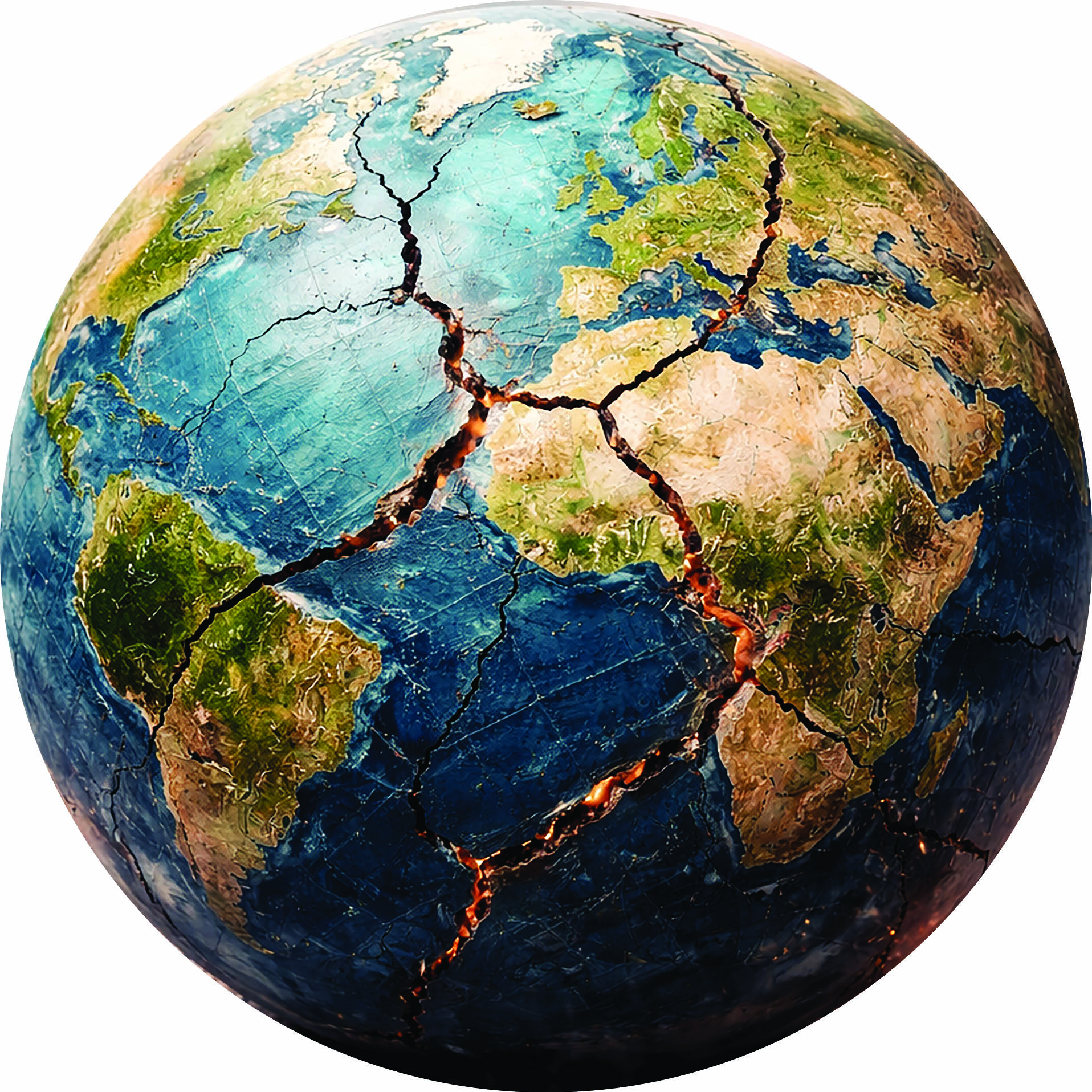
The debate should no longer be about saving the old global order. That chapter is already closing. The real question is whether countries like India can shape what comes next. Rules matter only when they are backed by strength. In today’s world, power creates space for principle, not the other way around.
The world is passing through a period of deep and unsettling change. For several decades after the end of the Cold War, there was a broad belief that international politics would be governed by rules, institutions, and shared norms. Power still mattered, but it was expected to operate within agreed frameworks. Today, that assumption is weakening rapidly. Across regions and across political systems, states are relying more openly on power military, economic, technological, and narrative to secure their interests. Rules still exist, but they no longer shape behaviour in the way they once did.
This shift from a rules-based global order to a power-based one is not a temporary disturbance. It reflects a structural transformation in global politics, driven by changing power balances, rising nationalism, institutional fatigue, and the return of strategic rivalry.
The Limits of the Rules-Based Order. The rules-based order emerged from the devastation of the Second World War and gained momentum after the collapse of the Soviet Union. At its core was the belief that shared rules could reduce conflict and manage competition. Institutions such as the United Nations were created to prevent war, manage disputes, and give even smaller states a voice. International law, multilateral treaties, and norms around sovereignty and non-aggression were meant to bring predictability to international relations.
Economic globalisation became another pillar of this order. Trade, investment, and integrated supply chains created interdependence between states. The logic for this was simple as countries that trade together are less likely to fight each other. For many years, this seemed to hold true. Global growth expanded, millions were lifted out of poverty, and large-scale wars between major powers were avoided.
However, the order had clear limitations. It reflected the distribution of power of its time, largely shaped by Western interests and leadership. While rules were presented as universal, they were often applied selectively. Military interventions without UN approval, financial crises driven by deregulated markets, and uneven development created resentment, particularly in the Global South. As long as the balance of power remained stable, these contradictions were manageable. Once power began to shift, they became impossible to ignore.
Why the Global Order Is Fragmenting
The breakdown of the rules-based order is not the result of a single event. It is the outcome of multiple trends reinforcing each other over time. The most important factor is the return of great power competition. The rise of China has fundamentally altered the global balance. China’s economic scale, military modernisation, and technological ambitions challenge a system once dominated by the West. Beijing does not reject international rules outright, but it questions those that constrain its strategic goals, particularly in its immediate neighbourhood and in emerging domains like technology and data governance.
At the same time, the United States is undergoing a shift in outlook. Domestic political divisions, economic pressures, and war fatigue have reduced its willingness to bear the costs of global leadership. The idea that the US will consistently enforce rules or underwrite global stability is no longer taken for granted, even by its allies.
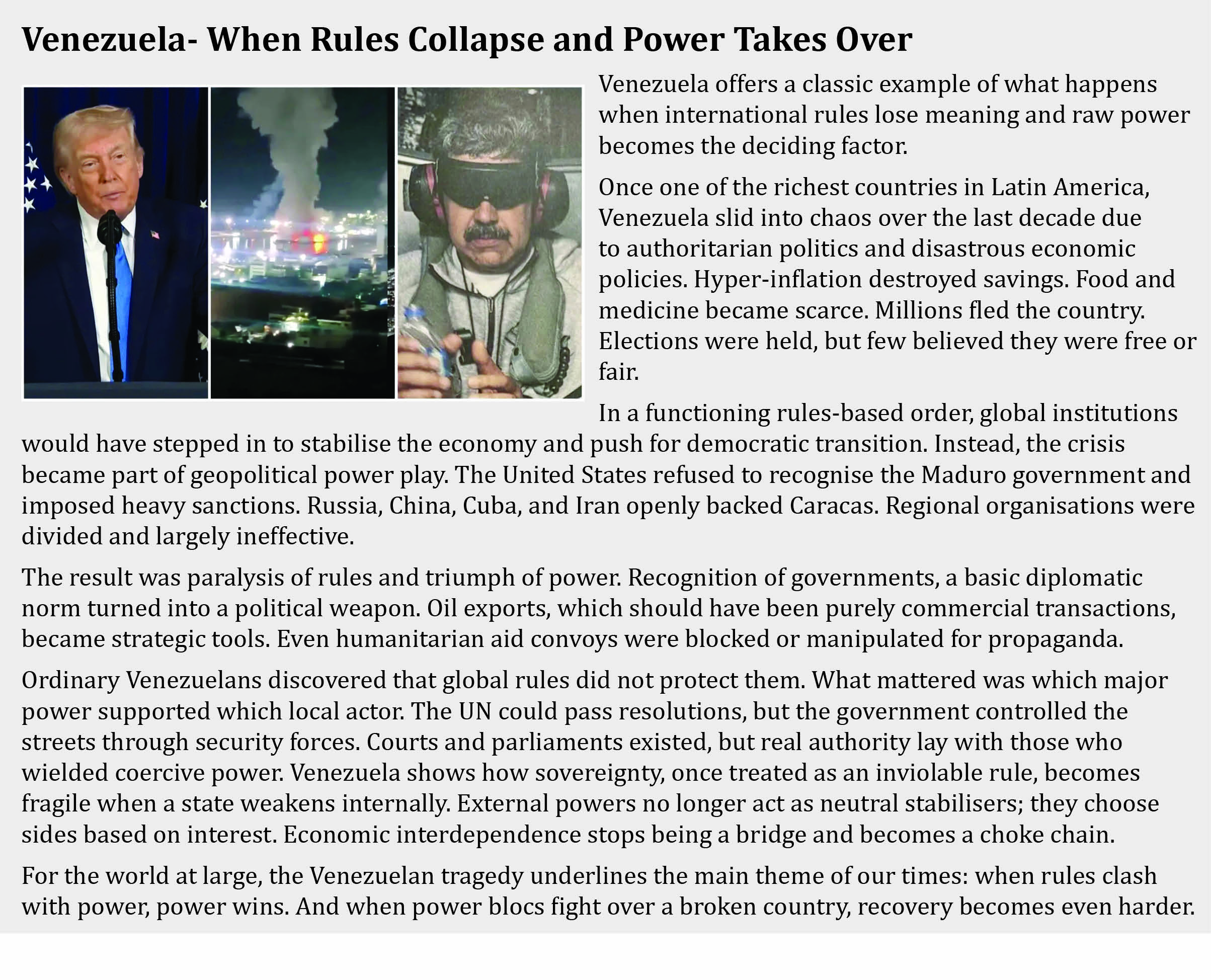
Another major driver is the resurgence of nationalism. Across democracies and authoritarian systems alike, domestic politics increasingly shape foreign policy. Leaders are under pressure to deliver visible national gains, often at the cost of long-term cooperation. Trade protectionism, border controls, and strategic autonomy are replacing the language of globalisation and collective security. In such an environment, international rules are often seen as constraints rather than safeguards.
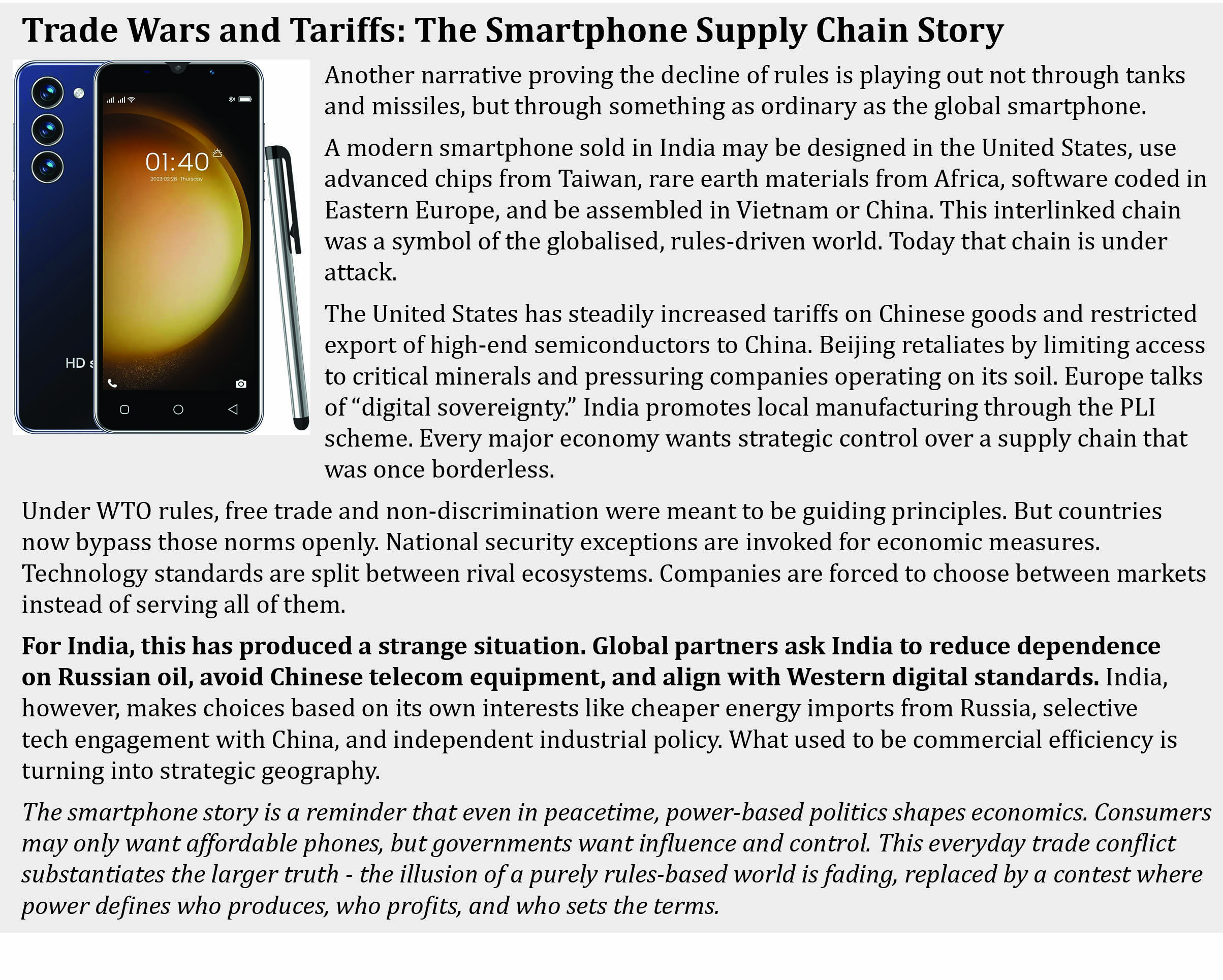
Equally important is the weaponisation of interdependence. Economic ties were once seen as a buffer against conflict. Today, they are used as tools of coercion. Sanctions, export controls, technology bans, and financial restrictions have become standard instruments of statecraft. The widespread use of sanctions during recent conflicts has sent a clear signal to many countries: dependence can be a vulnerability. As a result, states are seeking to reduce exposure, diversify partners, and secure control over critical sectors.
Finally, global institutions themselves are struggling. Decision-making bodies are paralysed by rivalry and veto politics. Trade dispute mechanisms have weakened. Even forums like the G20 find it difficult to deliver consensus on major issues. When institutions fail to act decisively, states naturally turn to unilateral or minilateral solutions.
The Rise of Power-Based Politics. As rules lose authority, power is returning to the centre of international politics. This does not mean a complete absence of norms, but it does mean that rules are increasingly applied selectively. Strong states interpret rules in ways that suit their interests, while weaker states have limited options but to adapt.
Power-based politics places renewed emphasis on military capability, economic scale, technological control, and narrative influence. Conflict today often remains below the threshold of full-scale war. Cyber operations, information warfare, proxy conflicts, and economic pressure allow states to achieve objectives without triggering open hostilities. This “grey zone” competition is harder to regulate and even harder to deter.
In such an environment, effectiveness matters more than legality. Actions are judged less by whether they conform to international norms and more by whether they succeed. This creates a more unstable system, where miscalculation is a constant risk.
Role of Middle Powers. The shift toward power-based politics places middle powers in a particularly complex position. These states are not strong enough to shape the global order on their own, but they are influential enough to matter. For them, the decline of rigid blocs offers both opportunity and danger. On one hand, strategic flexibility increases. Countries are no longer forced to choose sides in a binary world. Issue-based partnerships become possible. On the other hand, uncertainty grows. Without strong rules or reliable guarantors, middle powers must invest more in self-reliance and risk management.
For India, this reality is especially pronounced. India faces a challenging security environment, a volatile neighbourhood, and intense competition in emerging technologies. At the same time, its economic growth, demographic strength, and diplomatic credibility give it significant leverage.
India’s long-standing emphasis on strategic autonomy now appears well suited to the times. Rather than aligning rigidly with any one power bloc, India engages multiple partners, balances relationships, and preserves decision-making freedom. In a power-based world, this flexibility is not a weakness but a strength.
India’s Choices in a Fractured Order. The new global environment demands difficult choices from Indian policymakers. Security challenges from China require credible deterrence and military preparedness. Regional instability places additional burdens on Indian diplomacy and resources. Global partners increasingly expect India to take clear positions on contentious issues.
Yet these challenges are matched by opportunities. As trust deficits widen between major powers, India is viewed as a stable and responsible actor. Its participation in multiple groupings, without formal alliances, allows cooperation without loss of autonomy. India’s voice carries weight precisely because it is not seen as an extension of any one camp.
To succeed in this environment, India must continue strengthening its internal foundations like economic resilience, technological capability, military modernisation, and institutional capacity. Moral arguments and historical narratives alone will not secure interests in a power-based system. Capability will.
A Hybrid Future Awaits
It would be misleading to declare the complete death of the rules-based order. Rules still matter in many areas of global interaction, from trade standards to aviation safety and climate negotiations. What is changing is where and how those rules apply. The emerging system is likely to be a hybrid one. In areas where interests align, rules will continue to guide behaviour. In areas of strategic competition, power will dominate. This mixed order will be more demanding, requiring constant adjustment rather than reliance on fixed frameworks.
Stability in such a system will not come from institutions alone, but from a balance of power supported by diplomacy and deterrence. Misreading this reality could be costly.
Conclusion. The transition from a rules-based to a power-based global order marks a return to the fundamentals of international politics. Ideals have not vanished, but they now operate within stricter limits set by power and interest. For states that recognise this shift early and adapt wisely, the new order offers room for manoeuvre. For those that cling to outdated assumptions, it poses serious risks.
For India, the task is not to preserve an old order that no longer reflects reality, but to shape the emerging one in line with its interests and values. This requires clarity, confidence, and capability.
