

 Login
Login
Articles
The Indo-Pacific at the Centre of Global Power
Sub Title : The Indo-pacific region is witness to great power rivalries and India has a role to play as a stabilizing power
Issues Details : Vol 19 Issue 6 Jan – Feb 2026
Author : Editorial Team
Page No. : 19
Category : Geostrategy
: January 22, 2026
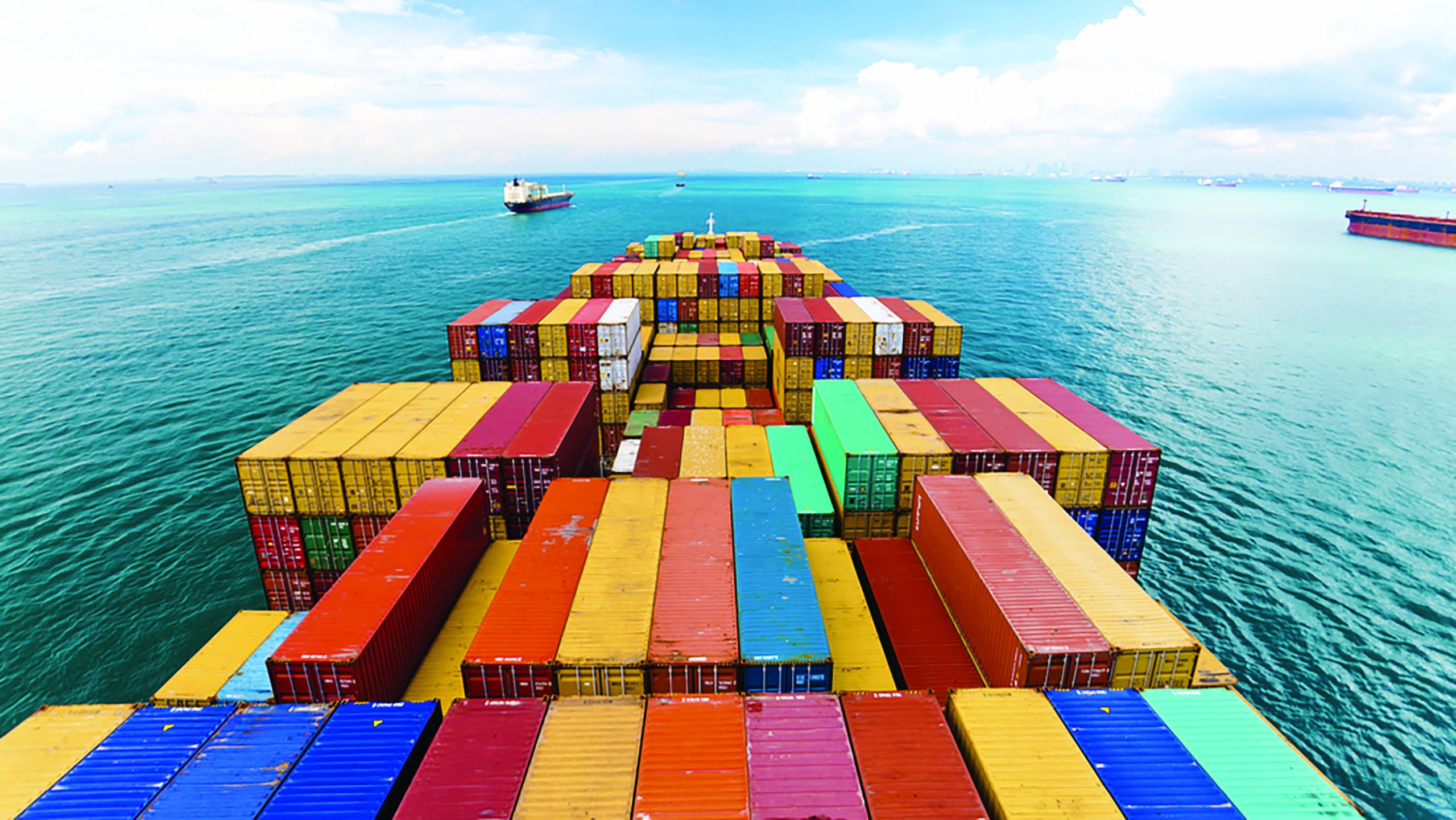
The Indo-Pacific has emerged as the most important strategic theatre of the 21st century. Stretching from the eastern shores of Africa to the western Pacific, it connects the world’s busiest sea lanes, largest economies, and most contested geopolitical spaces. What happens in this vast region now shapes global trade, security, and political balance.
Over the past decade, the Indo-Pacific has moved from being a largely economic region to a deep strategic one. It is not just about commerce and connectivity; it is about power, presence, and influence. Naval deployments, military bases, undersea cables, technology competition, and diplomatic signalling now define the region’s character.
At the heart of this transformation lies a simple reality that the Indo-Pacific is where the balance of global power is being negotiated.
A Region of Strategic Convergence. The Indo-Pacific brings together very different political systems, economic models, and security cultures. It includes established powers, rising powers, and small states whose strategic value far exceeds their size. What unites them is geography, shared seas, choke points, and trade routes and what divides them is the question of who sets the rules.
The rise of China has been the single most important driver of change in the region. China’s rapid naval modernisation, expansive maritime claims, and growing presence across the Indian Ocean and Western Pacific have altered long-standing power equations. Its activities in disputed waters, construction of military infrastructure, and increasing use of grey-zone tactics have raised concerns among many regional states.
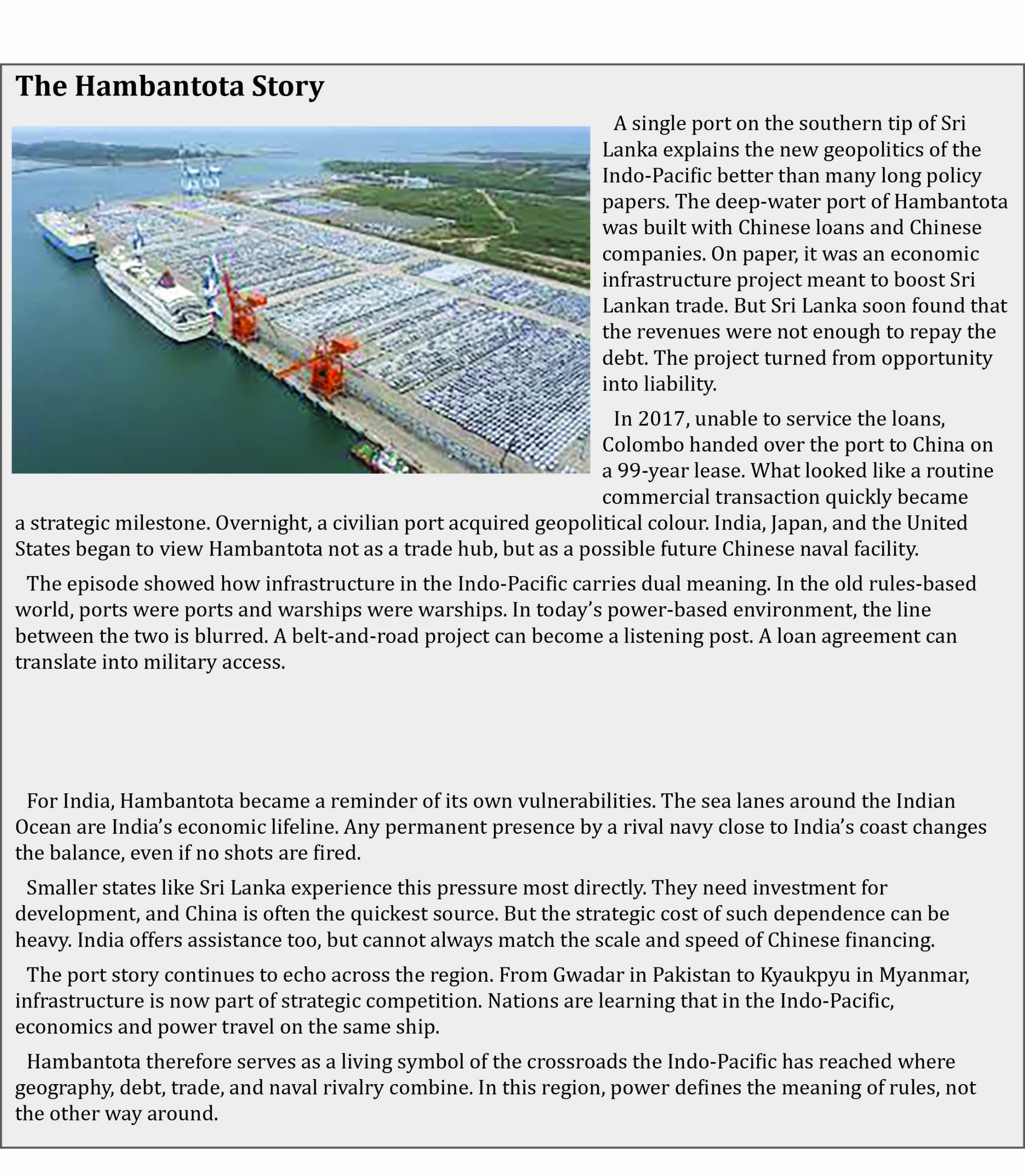
At the same time, the United States remains the most powerful military actor in the Indo-Pacific. However, its approach has shifted from uncontested dominance to strategic competition. The US now operates in an environment where its freedom of action is challenged, and where reassurance of allies is as important as deterrence of its rivals.
Between these two poles lie several key regional players like Japan, Australia, South Korea, ASEAN states, and India, each with its own interests, constraints, and threat perceptions. The Indo-Pacific is, therefore, not a single strategic space, but a mosaic of overlapping concerns and calculations.
Maritime Power and Grey Zones. The Indo-Pacific is, above all, a maritime theatre. Sea lanes across the region carry the bulk of global trade and energy flows. Control, or disruption, of these routes would have global consequences. As a result, naval power has returned to centre stage.
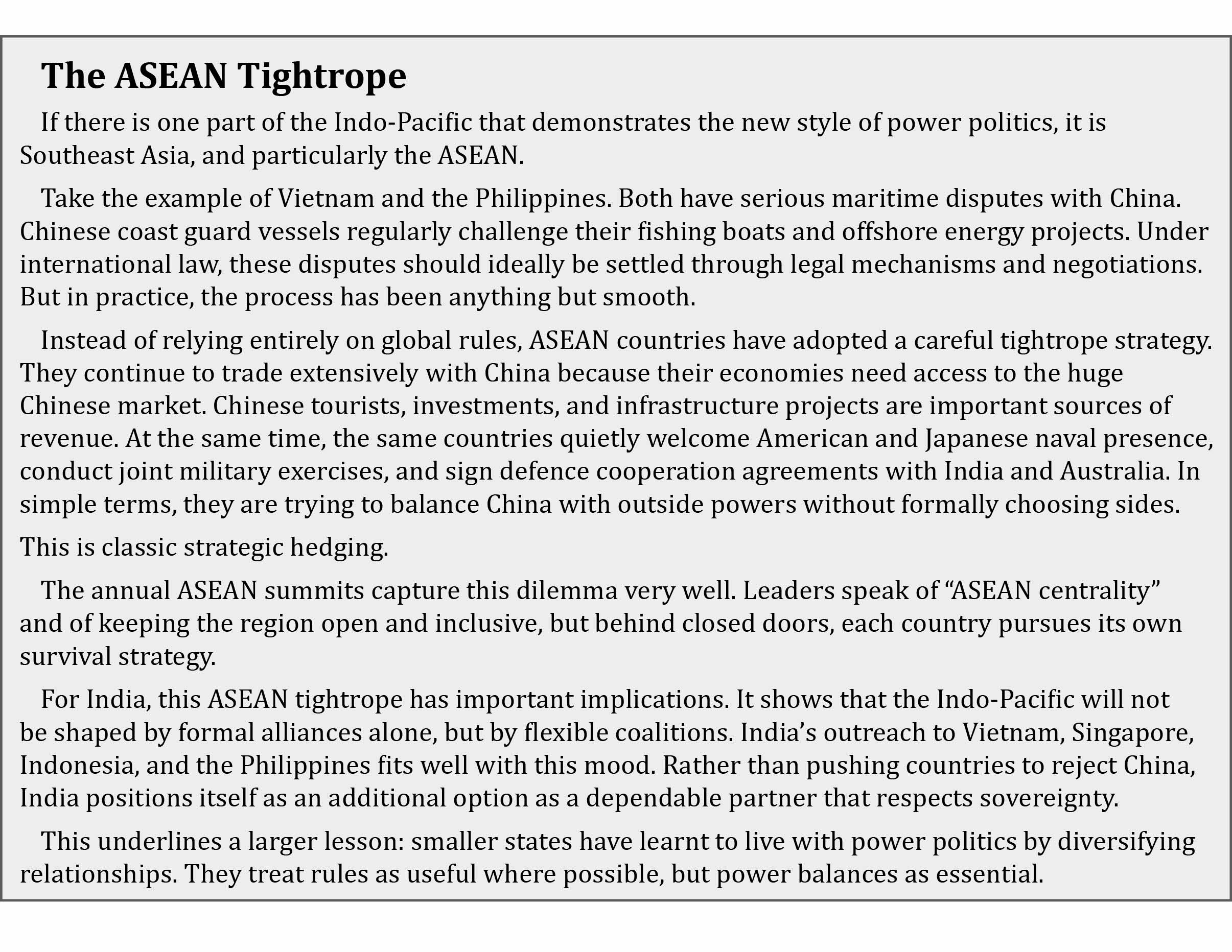
Yet, unlike the Cold War, competition in the Indo-Pacific is rarely overt. Instead of large-scale naval battles, states rely on calibrated actions, freedom of navigation operations, coast guard patrols, maritime militia activity, and persistent presence. These actions remain below the threshold of war but steadily change facts on the ground, or rather, on the water.
This is the essence of grey-zone competition. It allows states to advance claims and signal resolve without triggering open conflict. For smaller states, it creates constant pressure. For larger ones, it offers plausible deniability. Deterrence in this environment is subtle. It relies not just on firepower, but on presence, partnerships, and credibility. Naval exercises, joint patrols, and information sharing are as much about signalling intent as about building capability.
Undersea domains have also gained importance. Submarine deployments, surveillance systems, and the security of undersea cables are now critical elements of Indo-Pacific strategy. These are largely invisible to the public, but central to modern deterrence.
Alliances and Alignments. One of the defining features of the Indo-Pacific is the absence of rigid alliance blocs. While formal alliances exist, many countries prefer flexible arrangements that preserve autonomy. This has led to the rise of minilateral groupings and issue-based cooperation. The Quadrilateral Security Dialogue is a key example. Bringing together India, the US, Japan, and Australia, the Quad is not a military alliance, but a platform for coordination on security, technology, supply chains, and regional resilience. Its strength lies in shared interests rather than binding commitments.
At the same time, ASEAN continues to emphasise centrality and neutrality. For Southeast Asian states, strategic hedging is a survival strategy. They seek economic engagement with China while relying on broader regional balance to prevent domination by any single power.
India’s role in this landscape is distinctive. As both an Indian Ocean and Indo-Pacific power, India views the region through the lens of security, trade, and strategic autonomy. It participates actively in regional frameworks while avoiding formal alliances. This allows India to contribute to balance without being locked into confrontational postures.
What emerges is a complex web of alignments rather than clear camps. Cooperation and competition coexist, often involving the same actors. This fluidity provides flexibility but also increases uncertainty.
Uncertain Future. The future of the Indo-Pacific will be shaped less by grand declarations and more by daily actions like patrols conducted, agreements, crises managed, and signals sent. The risk of miscalculation remains real. With so many actors operating in close proximity, even small incidents can escalate if not carefully managed. At the same time, the region also offers opportunities. Economic growth, technological innovation, and connectivity initiatives can create shared stakes in stability. The challenge is to ensure that competition does not overwhelm cooperation.
For India and other regional powers, the task is to contribute to a balance that discourages aggression without provoking confrontation. This requires investment in maritime capability, diplomatic engagement, and institutional resilience.
The Indo-Pacific will not become peaceful through rules alone, nor stable through power alone. It will require a constant effort to manage rivalry, reassure partners, and keep channels of communication open.
The Indo-Pacific reflects the broader transition from a rules-based world to one shaped by power, presence, and strategic calculation. Stability in this region will determine the future of global trade, security, and political order.
For India, the Indo-Pacific is not a distant theatre, it is its extended neighbourhood. Navigating this space requires confidence, clarity, and caution. The region will remain contested, but how that contest is managed will decide whether the Indo-Pacific becomes a zone of conflict or a foundation for a new balance.
