

 Login
Login
Articles
Civil Military Convergence in Space: When Commercial Satellites Become Military Targets
Sub Title : Become Military Targets Commercial satellites increasingly shape and complicate modern military space operations
Issues Details : Vol 20 Issue 1 Mar – Apr 2026
Author : Kiran S Pillai, Founder, Vastuta Think Tank
Page No. : 39
Category : Military Technology
: March 21, 2026
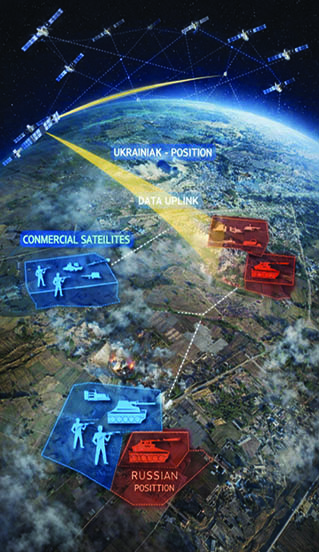
Space is becoming a contested military domain as commercial satellites increasingly support defence operations. This civil-military convergence creates legal ambiguity, escalation risks, and strategic vulnerabilities, especially in Asia. Managing it requires stronger governance, resilience, international norms, and balanced national policy to safeguard both security interests and civilian economic dependence on space systems.
Space is becoming a contested military domain as commercial satellites increasingly support defence operations. This civil-military convergence creates legal ambiguity, escalation risks, and strategic vulnerabilities, especially in Asia. Managing it requires stronger governance, resilience, international norms, and balanced national policy to safeguard both security interests and civilian economic dependence on space systems.
Space has moved from the background of military planning to its centre. What was once a quiet enabler of communications and navigation has become a contested operational domain. A defining feature of this transformation is the convergence of civilian and military assets. Commercial satellites now provide capabilities that were once the exclusive preserve of armed forces. High-resolution imagery, real-time communications, navigation services, and data relay are increasingly delivered by private operators serving both civilian markets and defence users. This convergence has strategic consequences that are only beginning to be fully understood.
The growth of commercial space capabilities has been driven by economics and innovation. Lower launch costs, miniaturisation, and private capital have enabled constellations that can image the Earth daily, provide global broadband coverage, and support precise navigation. Militaries have embraced these services because they offer redundancy, scalability, and rapid access to cutting-edge technology without the long development cycles of bespoke military systems. In peacetime, this arrangement appears efficient and mutually beneficial. In conflict, it creates ambiguity and risk.
When commercial satellites provide intelligence, communications, or navigation support to military operations, they become part of the battlespace. Adversaries may view them as legitimate targets, regardless of their civilian ownership. This challenges traditional distinctions between civilian and military objects—distinctions that underpin both international law and escalation management. The presence of private actors complicates deterrence calculations and raises questions about responsibility, proportionality, and control.
Asian security dynamics make this issue particularly pressing. The region is home to major spacefaring nations, intense strategic competition, and unresolved disputes. At the same time, it hosts some of the world’s fastest-growing commercial space sectors. Civilian satellites are deeply embedded in economic life, supporting finance, logistics, disaster response, and telecommunications. Disruption to these systems during a conflict would have immediate civilian consequences, even if the original military objective were narrow.
One challenge lies in attribution and intent. A commercial satellite may serve multiple customers simultaneously. During a crisis, determining whether a given service supports military operations can be difficult. Adversaries may assume worst-case usage and act accordingly. This increases the risk of escalation, particularly in grey-zone scenarios where actions are calibrated to remain below the threshold of open war. Interference that begins as limited jamming or cyber intrusion can escalate if responses are misinterpreted.
The legal framework governing such situations remains underdeveloped. International humanitarian law was not designed with dual-use space systems in mind. While principles such as distinction and proportionality apply, their practical interpretation in orbit is contested. Commercial operators may find themselves caught between contractual obligations to clients and pressure from states seeking to limit exposure. The absence of clear norms creates uncertainty that favours those willing to take risks.
From a military perspective, reliance on commercial space assets introduces both resilience and vulnerability. On one hand, diversified commercial constellations provide redundancy. Disabling them completely would require sustained effort and risk international backlash. On the other hand, their predictability and openness make them easier to target. Many commercial systems prioritise cost and performance over survivability. They may lack hardening against jamming, cyberattack, or kinetic threats. Militaries that depend heavily on such systems must account for these weaknesses in their operational planning.
States are responding in different ways. Some are seeking closer integration between military and commercial space sectors through contracts, information sharing, and joint planning. This can improve coordination but also deepens convergence, making it harder to argue that commercial assets are purely civilian. Others are investing in sovereign capabilities to reduce dependence, accepting higher costs in exchange for control and assurance. Few have resolved the fundamental tension between efficiency and security.
Commercial operators face their own dilemmas. Space companies operate in global markets and rely on international customers and partnerships. Being perceived as aligned with one military or bloc can expose them to political pressure, sanctions, or hostile action. At the same time, refusing defence contracts may be commercially unviable. Navigating this environment requires strategic clarity and support from national governments. Leaving companies to manage these risks alone is unrealistic.
Cyber operations further blur boundaries. Interference with satellites often occurs through ground-based networks and data links that are clearly civilian. Cyberattacks on these systems can disrupt services without touching hardware in orbit. This lowers the threshold for action and complicates response. For militaries, defending space capabilities now extends into protecting terrestrial infrastructure owned by private entities. This requires new forms of civil-military coordination and information sharing.
Deterrence in this context becomes complex. Traditional deterrence relies on clear signalling of red lines and consequences. When civilian assets are involved, signalling becomes ambiguous. States may hesitate to articulate thresholds publicly, fearing escalation or economic impact. Adversaries may exploit this ambiguity, conducting probing actions that test responses without triggering decisive retaliation. Over time, this can erode deterrence stability.
Resilience offers one avenue for managing risk. Distributed constellations, rapid reconstitution, and diversified service providers can reduce the impact of attacks. Commercial innovation has already moved in this direction, with large constellations designed for redundancy. Militaries can encourage such designs through procurement choices and standards. However, resilience is not a substitute for governance. Without clear frameworks, resilience may simply enable more aggressive behaviour by lowering perceived costs.
National policy must therefore address civil-military convergence explicitly. This includes clarifying the conditions under which commercial assets may support military operations, defining government responsibilities in protecting such assets, and establishing communication channels for crisis management. Transparency, within limits, can reduce miscalculation by making intentions and dependencies clearer.
International dialogue is also necessary. While binding agreements may be difficult, confidence-building measures and shared understandings can help stabilise expectations. Discussions on responsible behaviour in space must grapple with the reality of commercial involvement rather than treating it as an exception.
For countries like India, the issue carries strategic significance. India has growing military space ambitions alongside an expanding commercial sector. Balancing these interests requires careful policy design. Over-militarisation risks deterring investment and innovation. Under-protection risks vulnerability. The objective should be strategic autonomy supported by a resilient and responsibly governed space ecosystem.
Civil-military convergence in space is not a temporary phase but a structural feature of modern conflict. As commercial capabilities continue to advance, their military relevance will only increase. Managing this convergence will test legal frameworks, strategic doctrines, and institutional coordination. States that address these challenges proactively will be better positioned to protect both their security interests and their civilian economies. Those that do not may find that the next conflict reaches into orbit long before it reaches the battlefield.
