

 Login
Login
Articles
Harnessing Blockchain for Enhanced Space Surveillance and Military Operations
Sub Title : Blockchain enables secure, resilient data sharing in space-based military networks.
Issues Details : Vol 20 Issue 1 Mar – Apr 2026
Author : Samrat Pravin Patel
Page No. : 33
Category : Military Affairs
: March 21, 2026
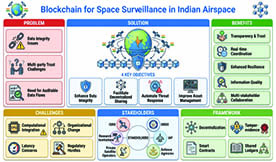
The article examines blockchain’s potential to strengthen Indian space surveillance amid growing airspace complexity and data demands. It maps blockchain’s decentralization, tamper-evidence, and smart contracts to needs for high-integrity, auditable data flows across sensing, validation, and multi-stakeholder sharing, while proposing a conceptual framework addressing AI integration, latency, and Indian regulatory challenges.
Envision a chilly December evening over the Bay of Bengal. An Indian surveillance satellite hovers silently above the ocean, capturing vast geospatial information, tracking ship movements, weather conditions, and electromagnetic signatures. Below, a ground station in Bhopal processes this data and transmits actionable intelligence to a naval command center. Meanwhile, an Indian Army convoy navigates a narrow Himalayan corridor, monitored by a digital system overseeing every crate of ammunition, medical kit, and fuel canister. A single cyberattack, such as a falsified satellite signal or altered logistics database, could disrupt this entire chain of trust. In modern warfare, data integrity is essential. Blockchain technology serves as a “tamper-proof logbook” for trusted partners, enabling the recording of various data types and facilitating decentralized governance. Its key features like decentralization, immutability, transparency, and smart contracts make it resistant to tampering and eliminate single points of failure. Analyses centered on Web3 highlight blockchain and cryptography as solutions to centralization and data control problems via peer-to-peer coordination, fitting the needs of surveillance and defense where shared data is critical. Why is this significant for India? The attributes that make blockchain transformative in finance and supply chains trustlessness, auditability, and resilience are precisely what modern military and space operations require.
Current Challenges in Defence and Space Systems
Data Tampering and Cyber Threats. India’s defense and space data infrastructure is increasingly vulnerable to cyberattacks. Traditional security measures limit real-time threat detection and struggle with zero-day vulnerabilities. For instance, Space Situational Awareness (SSA) data, vital to satellite operations, is often accessed through centralized databases, which increases the risk of data manipulation.
Vulnerabilities in Communication Networks. Military and space communication networks are at risk of interception, spoofing, and jamming. Their centralized nature can lead to widespread failures if a single node is compromised. In contrast, blockchain’s decentralized architecture removes central control points, thereby enhancing security.
Supply Chain Risks. The complexity of defense supply chains involves numerous vendors and international partners, which generates significant risks. Prevalent issues include a lack of transparency, counterfeit goods, and challenges in verifying product authenticity.
Centralized Control and Single Point of Failure. A primary weakness lies in the system’s architecture. Adopting blockchain technology through a distributed ledger removes single points of failure, strengthening the resilience of network systems. Transitioning from a centralized to a decentralized model not only enhances technology but also redefines trust in defense systems.
Blockchain Applications in Indian Space Surveillance
Ensuring Secure Satellite Communication and Data Integrity. India’s space capabilities produce data that is both strategically important and highly vulnerable. Implementing blockchain technology can provide tamper-proof validation for satellite communications, reducing spoofing risks and allowing for quick detection of data alterations. Using a blockchain verification system creates a secure chain of custody for geospatial information, enhancing both traceability and reliability.
Decentralized Ground Station Networks. India’s ground station network presently relies on centralized systems. Implementing a blockchain-enabled, decentralized ground station network would enable real-time synchronization of telemetry data across multiple nodes, preventing a single station from corrupting the overall data stream.
Space Asset Tracking. Utilizing Blockchain as a Registry: As India’s space program expands, a secure, comprehensive registry is essential. Blockchain technology can provide a decentralized registry for space assets, tracking launch data, orbital details, ownership changes, and decommissioning events. An example is drone registration, which shows how secure identifiers facilitate real-time tracking and compliance. This model can apply to various aerospace assets. The Space Situational Awareness (SSA) community is also considering blockchain as a decentralized alternative to traditional space surveillance databases, addressing reliability issues from single sources.
Blockchain Applications in the Indian Army
Supply Chain Security. Blockchain technology can significantly enhance the Indian Army’s supply chain, including weapons, ammunition, rations, medical supplies, and spare parts. It creates a transparent and immutable record of items from production to deployment, ensuring product authenticity through smart contracts and improving visibility. A consortium blockchain model that involves both military and civilian entities with varying access levels is a feasible implementation in India.
Identity and Access Management: The processes of soldier identification, access control, and authorization are critical security elements that are vulnerable to forgery and unauthorized access. Using blockchain for identity verification integrates multi-factor authentication and a smart contract-based access protocol that restricts access to sensitive systems to authorized individuals, addressing challenges such as identity fraud and complex authentication processes.
Operational Intelligence Sharing: Rapid and secure sharing of battlefield intelligence with assured data integrity is essential. The decentralized architecture of blockchain ensures data integrity by providing a tamper-proof ledger that securely stores and shares sensitive information among various agencies. By providing a resilient platform for exchanging threat intelligence data, blockchain fosters collective defense initiatives and encourages inter-agency cooperation.
Revolutionizing Military Communications and Cybersecurity Through Blockchain Technology. Blockchain-based communication networks offer a transformative security model for military communications, providing resistance to targeted attacks through secure data transmission between untrusted nodes. This decentralized defense approach enhances the overall security of communication systems. Additionally, blockchain serves as a foundation for advanced cybersecurity frameworks by maintaining immutable logs that enhance monitoring and investigation of cyberattacks while preventing unauthorized alterations.
Implementation Strategy
Pilot Projects and Phased Adoption. The integration of blockchain technology should commence with carefully defined pilot projects. These initial efforts could focus on specific, high-impact scenarios, such as tracking the ammunition supply chain or verifying satellite telemetry, before expanding to more comprehensive applications. Literature on space-sector policy suggests that agencies should adapt their partnership and ecosystem development methods, indicating that the incorporation of new coordination frameworks must align with broader institutional frameworks.
Integration with Existing Defense IT Infrastructure. When deploying blockchain, it is essential that it can interoperate with established legacy systems. Insights from NASA’s systems-engineering transformation reveal that large aerospace organizations typically undertake systematic changes, such as employing model-based capability matrices to guide transitions. This implies that integrating blockchain into surveillance streams may require similar organizational and systems-engineering change management rather than being implemented as a straightforward “add-on”.
Collaboration with ISRO, DRDO, and Private Defense Tech Firms. To create blockchain solutions that meet India’s specific needs, collaboration among India’s defense innovation ecosystem is vital. The policy literature on the space sector underscores the importance of evolving agencies’ approaches to partnerships and ecosystem building.
Scalability and Interoperability Considerations. Blockchain systems must be designed effectively to meet the scalability and speed requirements inherent to military operations. Scalability remains an ongoing challenge, necessitating further exploration of efficient consensus mechanisms, lightweight cryptography, and privacy-preserving approaches to harness the potential of blockchain-enhanced defense systems fully.
Risks and Limitations
Computational Demands and System-Level Constraints: A survey of the integration of blockchain with AI reveals significant research challenges, particularly in performance, scalability, and architectural choices. The use of AI in surveillance heightens concerns about the computational and systems integration requirements needed to incorporate blockchain technology effectively.
Integration with Legacy Systems and Organizational Transformation: Integrating blockchain with legacy systems requires careful planning and substantial investment. Major aerospace firms often undertake structured transformations based on capability matrices. Successful blockchain adoption must integrate smoothly into broader institutional frameworks and innovation ecosystems.
Latency and Real-Time Constraints: The ISS Logistics Information System (LIS) highlights operational contexts in which timing accuracy and timely delivery are vital to aviation safety. However, the current literature does not quantify the latency associated with blockchain, limiting the evidence base for evaluating the time sensitivity of surveillance applications. Prioritizing latency risk management is essential and requires empirical validation in the aerospace domain.
Regulatory and Policy Challenges in India: Legal analyses of blockchain-related digital assets in India reveal persistent issues with ownership, transfer, infringement, and enforcement, underscoring the need for robust legal frameworks. The convergence of blockchain technology with existing property laws could require reconfiguration of these legal structures. Implementing blockchain for surveillance in India will demand precise alignment between legal frameworks and technological design.
Smart Contract Limitations: Smart contracts aim to automate security enforcement, but are subject to certain vulnerabilities. Exploitable flaws in the code can arise, and once these immutable contracts are deployed on the blockchain, they are difficult to amend. To mitigate such risks, proposed security assessment frameworks employ threat modeling and adhere to industry standards to improve risk identification and management.
Future Outlook
Integration of Blockchain with AI, IoT, and Quantum Communication: The future of defense technology will advance through the integration of blockchain, artificial intelligence (AI), the Internet of Things (IoT), and quantum communication. Current research highlights that combining blockchain with AI enhances trust and security in AI systems. In low-altitude and aerial surveillance, the use of IoT sensor arrays, AI-driven decision-making, and blockchain trust frameworks creates real-time data environments for monitoring air traffic and environmental conditions. This integration allows AI models to optimize flight routes, detect anomalies, and manage autonomous operations.
Potential for Autonomous Defense Systems. Blockchain-enabled smart contracts are well-suited to function as the governance framework for autonomous defense systems, including uncrewed aerial vehicles (UAVs) and autonomous logistics systems. In the context of drones and UAVs, blockchain technology has been used to establish immutable records of all interactions, ensuring data integrity and preventing unauthorized alterations.
Conclusion
While not perfect, blockchain technology serves as a vital “trust engine” for India’s defense and space sectors. It enhances satellite communication security, ensures reliable geospatial intelligence, transforms military supply chains, and facilitates secure intelligence sharing on the battlefield—forming a robust foundation for trustworthy defense infrastructure. However, there is a notable gap in the literature regarding the implementation of blockchain in Indian space-surveillance programs, particularly within organizations such as ISRO, DRDO, and IAF, which warrants further research.
Samrat is an established researcher and technology consultant in Small Satellite Space Technologies, Sustainable Computing, UAV/IoT Robotics and Radio Frequency Technologies.
