

 Login
Login
Articles
Missile and Drone Warfare Redefining the Iran War
Sub Title : Precision strikes and swarms reshape dynamics of modern regional warfare.
Issues Details : Vol 20 Issue 1 Mar – Apr 2026
Author : Ashwani Sharma, Editor-in-Chief
Page No. : 26
Category : Military Affairs
: March 21, 2026
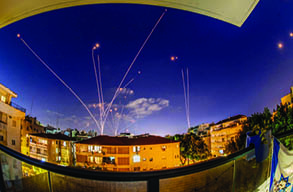
What makes the Iran war particularly important is that it combines lessons from several recent conflicts from Ukraine to the Gulf with a unique West Asian context. The biggest takeaway is that future regional wars will not revolve around territorial advances but around long-range strike ecosystems. Missiles, drones, and air defence networks are becoming the true strategic instruments of power
The ongoing conflict involving Iran, Israel, and the United States has rapidly evolved into a defining example of how missile and drone warfare is transforming modern regional conflicts. While traditional wars in the Middle East were historically dominated by armour manoeuvres, large air campaigns, and territorial battles, the present conflict has demonstrated a different operational paradigm – one defined by long-range missile strikes, drone swarms, distributed launch networks, and intensive air-defence battles.
In many ways, the war is not simply another confrontation in the Middle East. It is a preview of the future of regional warfare, where precision fires, autonomous systems, and integrated defence networks shape the battlefield far more than conventional ground forces.
The Rise of Missile-Centric Warfare
For decades, Iran has invested heavily in ballistic and cruise missile capabilities as a response to its conventional military disadvantages. Facing adversaries with technologically superior air forces, Tehran developed a doctrine centred on long-range strike systems capable of reaching targets across the Middle East.
Missiles have therefore become Iran’s principal strategic instrument. Systems such as the Shahab-3, Ghadr, and Sejjil provide ranges extending well beyond 1,500 kilometres, placing a large portion of the region within reach of Iranian strike forces. These weapons allow Iran to threaten military bases, critical infrastructure, and urban centres across a vast geographic area.
In the current war, this doctrine has been demonstrated through large-scale missile salvos aimed at overwhelming defensive systems rather than relying solely on precision targeting. Instead of a few carefully selected strikes, the emphasis has been on launching large numbers of projectiles simultaneously to saturate defensive networks.
This approach has effectively turned the conflict into a contest between offensive missile inventories and defensive interception capacity.
Drone Warfare and the Economics of Modern Conflict
Alongside missiles, unmanned aerial systems have emerged as a central element of Iran’s military strategy. Over the past decade, Iran has developed an extensive family of drones ranging from reconnaissance platforms to loitering munitions capable of striking targets hundreds or even thousands of kilometres away.
One of the most prominent examples is the Shahed 136, a relatively inexpensive one-way attack drone that can be launched in large numbers. These drones are designed not merely to destroy targets but to exhaust and complicate air defence systems. The economics of this approach are striking. A loitering munition costing tens of thousands of dollars can force an adversary to launch interceptor missiles costing several hundred thousand or even millions of dollars. Over time, such exchanges create a financial and logistical burden for the defending side.
This economic asymmetry has become one of the defining features of modern drone warfare. The goal is no longer simply to inflict damage but to deplete the opponent’s defensive resources and impose disproportionate costs.
Saturation Attacks and the Air Defence Duel
The Iran war has also highlighted the growing importance of layered air defence systems. Israel has deployed a sophisticated network of interception systems designed to counter threats at multiple altitudes and ranges.
Among these systems is Iron Dome, which intercepts rockets and short-range projectiles. For longer-range threats, Israel relies on systems such as David’s Sling and Arrow. Together, these systems form a layered shield capable of intercepting ballistic missiles, cruise missiles, and drones. However, the conflict has also exposed the limitations of even the most advanced air defence networks. Large-scale missile salvos and drone swarms can still penetrate defences, particularly when launched simultaneously from multiple directions. Even when interceptions are successful, they come at significant financial cost.
As a result, modern warfare is increasingly characterised by what analysts describe as the “missile-defence duel”, a prolonged contest between offensive strike systems and defensive interception capabilities.
Distributed Launch Networks and Operational Resilience
Another important lesson from the conflict is the value of distributed launch infrastructure. Iran has spent years constructing hardened missile bases, underground facilities, and mobile launch platforms. This dispersed architecture makes it extremely difficult for adversaries to eliminate Iran’s strike capabilities through air attacks alone. Mobile launchers can relocate quickly, while underground missile complexes protect weapons from aerial bombardment. Even after sustained air campaigns, Iran retains the ability to launch missiles from concealed or dispersed sites.
This approach reflects a broader trend in modern warfare of resilience through dispersion. Instead of concentrating forces in large bases that are vulnerable to precision strikes, militaries are increasingly adopting distributed networks of launch systems, sensors, and command centres.
Multi-Theatre Strike Warfare
The Iran war has also demonstrated how missile and drone systems can transform the geographic scope of conflict. Traditional wars were often confined to clearly defined battlefronts. In contrast, missile warfare enables attacks across vast distances, blurring the distinction between front lines and rear areas. Targets in multiple countries including military installations, infrastructure nodes, and energy facilities can be struck from hundreds or even thousands of kilometres away. This capability allows states to project power across entire regions without deploying large conventional forces.
As a result, the war has become a multi-theatre conflict, stretching from the eastern Mediterranean to the Persian Gulf. The geographic dispersion of targets forces defenders to protect an enormous number of potential strike locations. This expansion of the TBA represents one of the most significant changes in modern regional warfare.
The Integration of Missiles, Drones, and Intelligence Networks
Modern missile and drone warfare does not operate in isolation. It is increasingly integrated with intelligence, surveillance, and reconnaissance networks that provide real-time targeting information. Satellite imagery, electronic intelligence, and drone reconnaissance allow strike forces to identify targets rapidly and adjust operations dynamically. Data networks connect launch units, command centres, and reconnaissance platforms into a single operational system.
This integration has produced what many analysts describe as “network-centric strike warfare.” In such systems, sensors detect targets, command networks process the data, and missile or drone platforms deliver the strike. The effectiveness of these networks often determines the success of missile campaigns as much as the weapons themselves.
Implications for Future Warfare
The Iran war is already shaping strategic thinking across the world. Several key lessons are emerging. Some of these are:-
First, missiles and drones have become central instruments of regional power projection. States can influence conflicts across vast distances without deploying large conventional armies.
Second, air defence is becoming an essential component of national security. Countries must develop layered defensive systems capable of intercepting multiple types of threats simultaneously.
Third, the economic dynamics of drone warfare are changing the cost structure of conflict. Relatively inexpensive systems can impose substantial financial burdens on technologically advanced adversaries.
Finally, modern warfare is increasingly characterised by distributed networks of sensors, launch systems, and command nodes rather than traditional concentrations of military power.
Conclusion
The Iran war is rapidly emerging as one of the most significant demonstrations of missile- and drone-centric warfare in modern history. The conflict illustrates how long-range fires, autonomous systems, and integrated defence networks are reshaping the nature of regional combat. Rather than decisive battles between large armies, future wars are likely to be defined by prolonged exchanges of missiles, drones, and precision strikes, supported by complex information networks.
In this evolving environment, the side that can best integrate sensors, strike systems, and defensive capabilities will hold the decisive advantage. For military planners around the world, the message is clear – the age of missile and drone warfare is not a temporary phenomenon but a permanent transformation in the conduct of modern war.
