

 Login
Login
Articles
Restraint As Power
Sub Title : Strategic restraint emerges as a powerful tool in modern conflict and Counter insurgency operations
Issues Details : Vol 20 Issue 1 Mar – Apr 2026
Author : Wamika Sachdev
Page No. : 14
Category : Geostrategy
: March 21, 2026
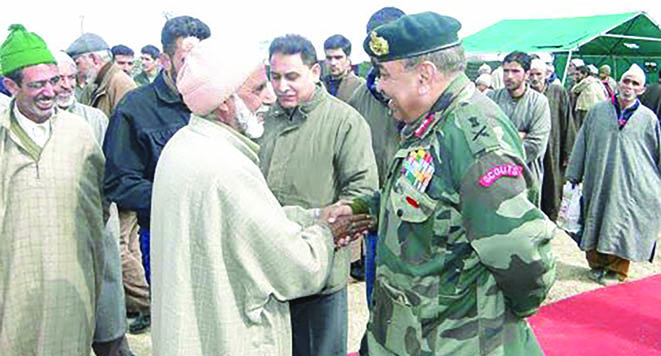
In this reflective and analytically grounded essay, Wamika Sachdev examines the ‘Hearts Doctrine’ introduced in Jammu and Kashmir in 2010-12 and situates it within the broader framework of humanitarian norms and institutional culture. With a Preface by its initiator, Lt Gen Syed Ata Hasnain, the then GOC 15 (Chinar) Corps, (see the previous page) the piece traces the evolution of an operational philosophy that placed dignity, restraint, and calibrated power at the centre of counter-insurgency practice. It offers timely insights into how professional militaries can embed ethical discipline as a source of strategic strength in asymmetric conflicts.
PREFACE
The Hearts Doctrine dates back to 2010-12, a period which coincides with my tenure as GOC 15 (Chinar) Corps, the Indian Army’s primary Counter Proxy War force. It was never conceived as a slogan, nor as an episodic outreach effort. It emerged from lived operational experience in a theatre where military success could not be measured solely in territory dominated or terrorists neutralised, but in the emotional temperature of society itself.
During my multiple tenures in the Kashmir Valley, it became evident that prolonged conflict of this nature, while eroding terrorist strength and capability, leaves behind more than physical damage. It corrodes trust. It diminishes self-worth. It creates psychological distance between the state and the citizen, and a complete loss of self-esteem of the latter). In such an environment, the overuse of force – even when legally justified – can deepen alienation and inadvertently strengthen the narratives of those who thrive on grievance. The Indian Army always prided itself in its capability of balancing hard and soft operations. The necessity for agility in the progression of the concept emerging from this, had to be realized and appropriately and responsibly executed.
The Hearts Doctrine therefore sought to move Military Civic Action, the concept universally followed by the Indian Army in its Counter Insurgency/Counter Terrorist Operations (CI/CT), beyond the transactional. Its essence lay in restoring dignity and self-esteem among people who had endured years of turbulence. Small acts of restraint, cultural sensitivity, disciplined conduct, and respectful engagement were not concessions of authority; they were assertions of confidence. They signalled that strength need not be loud to be effective.
Over time, this thinking matured into what I describe today as the Doctrine of Restraint. Restraint is not passivity. It is calibrated power. It is the conscious decision to use force proportionately, judiciously, and with awareness of its psychological and narrative consequences. In asymmetric conflicts especially, the contest is as much about legitimacy as it is about security.
Wamika Sachdev’s thoughtful examination of the Hearts Doctrine situates it within the broader framework of humanitarian norms and institutional culture. I welcome this interpretation. It reinforces the idea that professionalism in arms is inseparable from moral discipline. Yet beyond law and compliance lies something deeper — the recognition that durable stability depends upon restoring the confidence of the very population whose security the state seeks to ensure.
If the Hearts Doctrine was the operational expression of this philosophy, the Doctrine of Restraint is its strategic articulation. Both rest upon a simple conviction; that the strongest institutions are those secure enough in their authority to exercise power with humanity.
Lt Gen Syed Ata Hasnain PVSM, UYSM, AVSM, SM, VSM & BAR (Retd)
RESTRAINT AS POWER
Introduction
My engagement with International Humanitarian Law began in the classroom, among conventions, commentaries, and debates on proportionality and distinction. Yet even as I studied its doctrines, a question persisted; where does one see these principles lived – not merely cited – in the field? Where has restraint been exercised not because law compelled it, but because leadership chose it? I searched for an example where conflict was handled with a practitioner’s sensitivity; where violence was not allowed to spill indiscriminately into the lives of those who were neither combatants nor willing participants, but ordinary citizens caught in circumstances beyond their choosing.
That search led me to an article by Chander Suta Dogra published in Outlook in September 2011, which described what was then being referred to as the “Hearts Doctrine” in Jammu and Kashmir. The piece suggested something unusual; a senior military commander consciously moderating the visible and psychological footprint of force in a volatile environment, seeking not only operational advantage but emotional balance. It hinted at a model where authority and empathy were not adversaries.
Curiosity became inquiry. Inquiry became conversation. I soon discovered that Lt Gen Syed Ata Hasnain, the then GOC 15 (Chinar) Corps and my father shared not only the profession of arms but the same Regiment – the Garhwal Rifles – and even the same unit, 4 Garhwal Rifles. That unexpected connection made access easier, but more importantly, it transformed what could have been a formal interview into a candid exchange. Our discussions were not confined to doctrine and law; they explored leadership, restraint, dignity, and the unseen psychological dimensions of conflict.
This article grows out of that journey. It argues that the Hearts Doctrine offers more than a case study in civil-military outreach. It presents a practicable model of how humanitarian norms can be internalised within security institutions — not as external legal impositions, but as professional values embedded in culture and command. In doing so, it demonstrates that the ethical foundations of International Humanitarian Law can shape operational conduct even outside the formal classification of armed conflict.
The execution of the doctrine emerged in a period of heightened unrest in Jammu and Kashmir, particularly following the civilian protests of 2010, when the relationship between security forces and local communities was under considerable strain. The Hearts Doctrine sought to transform this relationship by focusing on empathy, respect, and public engagement rather than purely kinetic operations. Its objective was to restore trust and legitimacy in a setting where the military was viewed with suspicion and caution owing to incidents of abuse of authority and power under the AFSPA (Armed Forces Special Powers Act). For his emphasis on dialogue and dignity, General Hasnain earned the moniker “the People’s General.” His approach reframed the idea of military effectiveness to include emotional intelligence and cultural awareness alongside tactical skill.
From Concept to Conduct: The Hearts Doctrine in Application
The Hearts Doctrine becomes particularly instructive when viewed through the wider lens of International Humanitarian Law (IHL). While IHL is often understood as a framework triggered by formally recognised international or non-international armed conflicts, its foundational values — restraint, distinction, proportionality, and humane treatment — reflect deeper ethical commitments that transcend legal thresholds. The more enduring question is not merely when the law applies, but how its spirit can shape institutional behaviour in complex internal security environments. The Hearts Doctrine offers a compelling example of such internalisation; a case where humanitarian principles were not invoked defensively in response to scrutiny, but embedded proactively within command culture and operational practice.
At its core, it was an attempt to change public perception and humanise CI/CT operations by bridging the emotional distance between civilians and soldiers. It rested on two interlinked dimensions; psychological engagement with local communities and practical cooperation through development-oriented initiatives.
The psychological component of General Hasnain’s approach aimed to heal the emotional fatigue of a population that had lived for years under tension and uncertainty. His philosophy sought to humanize the conflict environment through empathy, respect, and dignity. Under his leadership, the Army adopted small yet meaningful gestures that spoke volumes to local sentiment. Military convoys were regulated so as not to disrupt civilian life, their visible aggressiveness reduced to lessen psychological stress. On days of religious significance such as Muharram, extra sensitivity was exercised to avoid interference with local observances. During Ramadan, rather than hosting ceremonial iftar events, the focus shifted toward ensuring that the deserving and needy were fed in keeping with Islamic tradition, a quiet but powerful reaffirmation of respect for faith and culture.
Contrary to some interpretations, the slogan Operation Jee Jenab did not originate with General Hasnain but predated his tenure. What he did was to restore its deeper meaning, not as a supplication to local demands, but as a reaffirmation of human dignity and mutual respect. Soldiers were sensitized to the value of courtesy and cultural understanding, without compromising the Army’s authority or discipline. The Awami Sunwais (public listening forums) became the hallmark of this outreach, offering civilians a space to voice grievances and interact with officials from both the Army and civil administration with the Army facilitating it through administrative arrangements and security. This helped rebuild trust in institutions that had long appeared distant. Likewise, opening the Badami Bagh Cantonment and its museum, Ibadat-e-Shahadat, to greater civilian footfall symbolized an unprecedented step; a conscious effort to make the Army more familiar, accessible, and human in the eyes of Kashmir’s people.
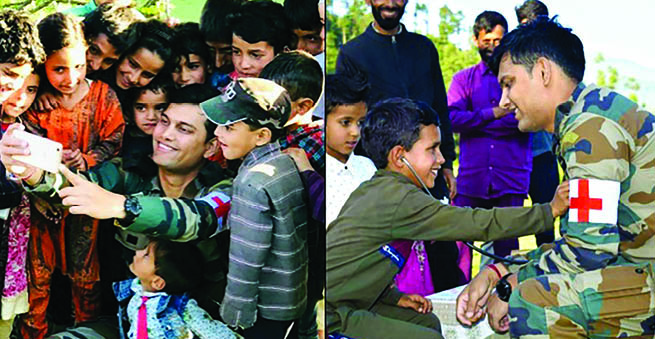
These initiatives helped reshape how the Army was perceived. They signalled that security could be exercised without coercion, that authority could coexist with civility. Over time, such practices contributed to a change in the tone of civilian-military interaction, creating an atmosphere where dialogue was possible even in disagreement. The practical pillar of the doctrine built on existing welfare programmes, most notably Operation Sadbhavana (Goodwill). This initiative expanded substantially during the time. The Army supported the construction of schools, vocational training centres, and healthcare facilities in remote areas where civil infrastructure was limited. Medical and veterinary camps were organised regularly, and educational tours for young Kashmiris were conducted to foster broader social integration.
These activities were not meant as substitutes for civil governance but as temporary confidence-building measures to fill immediate gaps in service delivery. The intent was to ensure that the Army’s presence was associated not merely with control but with care. While the region’s security situation remained complex, contemporary accounts from 2011–2012 noted a perceptible improvement in public cooperation, reduced hostility toward patrols, and greater community participation in outreach events. These outcomes were an indication that a respectful approach could produce tangible security dividends.
At its deepest level, the Heart Doctrine was not merely an exercise in perception management or humanitarian sensitivity; it was an effort to restore collective self-esteem within a society fatigued by prolonged conflict. The doctrine recognised that alienation thrives where dignity diminishes, and that extremist mobilisation often feeds upon perceived humiliation rather than material deprivation alone. By consciously practising restraint, cultural respect, and consistent engagement, the Army sought to reverse this emotional erosion. The restoration of dignity was therefore not a moral accessory to security operations but a strategic instrument, intended to reduce grievance, deny adversarial narratives their emotional leverage, and rebuild a relationship in which authority could coexist with trust.
Embedding IHL: Voluntary Compliance in Domestic Operations
Although the asymmetrical conflict situation in Jammu and Kashmir raises debate on whether it fits the definition of an armed conflict under the Geneva Conventions of 1949, many aspects of the Hearts Doctrine reflect the principles that underpin IHL. In Jammu and Kashmir, despite prolonged terrorist violence and sustained counter-terror operations, the Indian state has addressed the situation within its domestic legal framework rather than formally classifying it as a non-international armed conflict under International Humanitarian Law.
Yet, the ethical logic of IHL, its emphasis on limiting harm and preserving human dignity extends beyond formal classifications. The customary rules of IHL, recognised through consistent state practice and considered binding on all states, apply to situations involving the use of force even when they fall short of a legally defined armed conflict. The International Committee of the Red Cross (ICRC), in its 2005 study on Customary International Humanitarian Law, observed that many of the humanitarian protections contained in the Geneva Conventions are part of customary law. These include the obligation to distinguish between civilians and combatants, to exercise restraint and proportionality in the use of force, and to ensure respect for cultural and religious practices.
India is a party to all four Geneva Conventions of 12 August 1949: the protection of the wounded and sick in the field; the wounded, sick, and shipwrecked at sea; the treatment of prisoners of war; and the protection of civilians during war. Although India has not ratified the 1977 Additional Protocols I and II, which provide detailed rules for international and non-international armed conflicts, it has consistently affirmed the humanitarian principles that those instruments codify.
Against this background, General Hasnain’s approach can be viewed as a voluntary internalisation of humanitarian norms in a domestic operational setting. His emphasis on restraint proportionality, and respect for cultural identity mirrored IHL’s core concern with balancing security objectives and human welfare. For instance, the decision to regulate convoys during religious observances reflected the same precautionary spirit found in IHL’s proportionality rules, which seek to avoid incidental harm to civilians. Similarly, adopting courteous language and conducting open dialogues resonated with the principle of humane treatment enshrined in Common Article 3 of the Geneva Conventions.
By embedding these principles into the daily routines of military operations, the Hearts Doctrine illustrated that adherence to humanitarian values does not depend on the existence of a declared conflict. Rather, it demonstrated that professionalism in armed service includes moral discipline; the ability to protect and engage without demeaning or alienating the civilian population.
Humanity as a Strategic Ethic: The Future of Cultural Compliance
The doctrine’s underlying premise; that humanity in conflict is both a moral and strategic necessity, has continued relevance. It shows that the principles of IHL hold instructive value for domestic security contexts as well. In such environments, voluntary adherence to humanitarian norms can reinforce public confidence, reduce alienation, and strengthen the legitimacy of state institutions. In its October 2025 update of the customary IHL database, the ICRC highlighted that the 161 rules identified in its 2005 study remain subject to evolving state-practice and thus reflect continuous normative obligations. This confirms that even absent the classification of a situation as a non-international armed conflict (NIAC), the duty to respect humanitarian norms persists, echoing the Hearts Doctrine’s insistence that institutional culture, rather than formal legal triggers, can embed humanitarian values into security operations.
For India, this model offers a useful template for operational conduct that aligns national security objectives. It demonstrates that even outside the formal boundaries of international law, the preservation of dignity and restraint can serve as effective tools of peacebuilding. By embodying these values, the Hearts Doctrine reaffirmed that the strength of a professional military lies not only in its capacity to enforce order but also in its ability to uphold the principles of humanity that underpin a democratic state. The Indian Army deserves all the appreciation for understanding this so vividly and living by the principles enshrined in the concept of the Hearts Doctrine.
Wamika Sachdev is an international law researcher specialising in gender, conflict, and humanitarian frameworks. She is a Researcher at the National Human Rights Commission of India and holds an Advanced LL.M. in Public International Law from Leiden University.
