

 Login
Login
Articles
The Pursuit of Contrapunto
Sub Title : Balancing opposing forces in strategy, technology, and military thought.
Issues Details : Vol 20 Issue 1 Mar – Apr 2026
Author : Lt Gen Sanjiv Langer PVSM,AVSM
Page No. : 56
Category : Geostrategy
: March 21, 2026
‘The world is not of one mind….. it is without a single animating spirit’ – Sarvapalli Radhakrishnan, President of India
In a rapidly fragmenting world order, the pursuit of strategic balance has become both complex and unavoidable. As power centres multiply and conflict mutates across domains, India must navigate a turbulent neighbourhood through contrapunto – balancing competing forces while safeguarding autonomy, stability, and long-term national interests
Primacy of Wealth, Knowledge and War waging capability has over the history of Humankind, endowed those who have harnessed this Triad, with enormous success. Influence and seductive socio-cultural norms used to last decades if not centuries, post 1991 the world changed. Two power centres were replaced by a gaggle of aspiring powers and one Hyper Power. The Information Revolution, decoupling of a world that was globalising and the unprecedented momentum of science and technology has spawned a 21st Century full of promise but resounding with macabre realities.
India defines itself by strategic autonomy, however the immediate geography both land and sea, is effervescent with 21st Century promise and realities. Historic physical connectivity, has been roiled together, with an indivisible information space, an enormous perceptual theatre, and an unrestricted domain of opinion largely based on curated truth. Stealthily, human armed conflict has mutated and metamorphosed, imparting unprecedented power to those at the apex of the Triad. Economic, Market and Financial power, has been weaponised and compression of time and space has imparted them a disturbing velocity. As we visit some of our priorities in South Asia, the global tragi-comedy, presently at play must remain a mise-en scene.
The Great Convergence, Indo-Pacific.
While the term finds mention in German Political Geography, its present avatar originates in the thought of the erstwhile PM of Japan Shinzo Abe, articulated to the Indian Parliament in 2007. The term formally entered US strategic thought 2010 onwards. Historically the US had inherited the mantle of Indian Ocean in 1971, after the hurried withdrawal of UK from the Gulf Residency. In the Pacific uncontested supremacy rested with the US post World War II, and challenges to it only commenced with Chinese assertive actions commencing in 1988.
From the Indian perspective the Indian ocean was central to trade, exchange of population, culture, religion and transit of armies over millennia. The seas however were free, land was owned. The concept of possession of waters, a product of western Colonial thought, became evident with the advent of Portuguese Influence in 1605 AD. Indian coasts have been historically connected to Africa, West Asia, Indonesia, and the Western Pacific. It is through the Indian Ocean that Europe and West Asia established their relationship with the Western Pacific. For the Pacific Ocean Main, there is a different story. Post the voyage of Magellan 1521-22, Spain captured the Philippines in 1565, and declared the Pacific Mare Clausum, the closed ocean, only for Spain. The 1898 capture of the Philippines by the US as a high point of the US-Spanish wars, ensured Primacy of the US here till the Second World War. The defeat of Japan cemented US dominance over the Pacific, once again.
Undivided Colonial India had a clear geostrategic sweep over the coastline from Aden to Burma. Today the high waters of the Arabian Sea and passage to Iranian waters and West Asia are with Pakistan. Bangla Desh and Myanmar, have an overwatch on the high waters of the Bay of Bengal. They also share influence over the Straits of Malacca, 6- and 10-degree channels as well as the A&N Islands and the Eastern Indian Seaboard. Sri Lanka occupies an outstanding geography, with an eye on all the Northern Indian Ocean degree channels, the 6 and 10 degrees to the East and the Maldivian channels to the West. Before we leave this geography, some shipping statistics are revealing. 80% of Gulf’s oil transits the Strait of Hormuz. With about 30,000 vessels @ year this is 20-30 % of global seaborne oil and petroleum products trade. Compare this with the Straits of Malacca, 25-33% of Global Trade,90-94,000 vessels @ year, (200-250 ships a day). 80% of China’s oil imports are part of this Malaccan transit. To the immediate East the South China Sea handles transit of 25-33% of Global Trade. Suez, the Cape and the other Indonesian Straits, also handle traffic but the volumes are far less. The last statistic that must smack us in the face, is that 95% of Indian trade by volume and 70% by value is seaborne.
India’s historic and existential connectivity to the Indian Ocean and its littoral, as well as the Western Pacific, carry a permanence as critical as its land borders. Firmly committed to the Indo-Pacific as a peaceful, cooperative and mutually beneficial sphere. Indian participation in the several constructs and fora in the Indo-Pacific is to further this vision. While realities on our land borders prevail the dynamics in our neighbourhood, have an enormous impact on the seas.
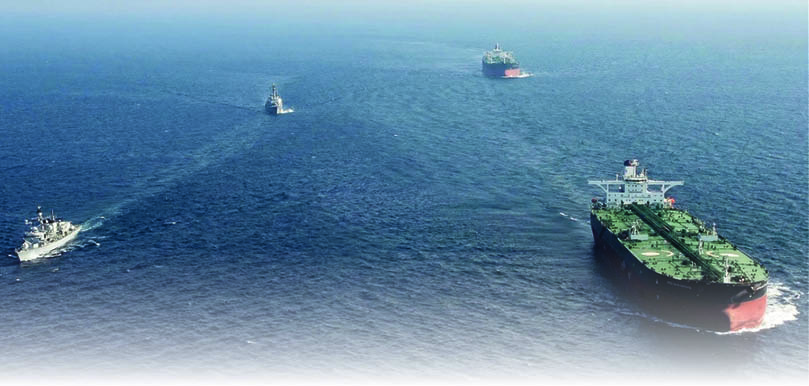
We are now painfully aware of the last two weeks conflagration stretching from the Mediterranean to the Arabian Sea, and its debilitating effect on multiple economies. The average 80 ships @ day through the straits of Hormuz have reduced to a spasmodic 1/2.
Chinese Sea Dragon
The Chinese ambitions and moves in the South and East China Seas are well known. In the IOR, China has a varying degree of control and interest in 17 ports. These extend from Dar-Es-Salaam, in Tanzania to Port Darwin in Australia. It has over the past five plus decades been and now is the major consumer of hydrocarbons, making it captive to the Gulf entities and transit through Malacca. In its grand design the initiatives of connectivity through, Myanmar, Bangladesh and Pakistan to the Seas, is largely to make redundant the passage through Malacca.
None of the initiatives have seen fruition. The Civil War in Myanmar has left the border with China in control of the Northern Shan State and the Kachin Independent State. The Chinese jewel, the deep-sea port of Kyaukphu on the Bay of Bengal cannot be completed, due to conflict in the Arakan now Rakhine State, between the Arakan Army, and the Myanmar Army. Half the port site of Ramree Island is in the control of the Arakan Army. This stands in sharp contrast with the Indian developed deep-sea port at Sittwe completed in May 2023.
In Bangladesh the Chinese aggressively pursued a deep-sea port among several other infrastructure projects since 2010. Its fiasco in Hambantota in 2017, and entrapment of Sri Lanka resulted in three prominent refusals. Its proposal for Sonidia in Bangladesh was turned down and the deep-sea project was awarded to Japan and India at Moheshkhali. Mahatir Mohammad in Malasia called off two proposed projects, and Nepal terminated the Chinese offer for the Budhi Gandhaki Hydel project.
Undoubtedly the most ambitious Chinese project is in Pakistan the CEPC. A promise to completely transform Pakistan. The high waters of the Arabian Sea however remain elusive. Seldom has a project been so bitterly opposed. It has become the centrepiece of denial by the Baloch independent movement. The Balochis are on fire and going from strength to strength. Pakistan not satisfied with being burnt has now commenced another inferno with Afghanistan, also impacting Chinese futures. The Baloch and TTP convergence now has greater centrality.
That has left the Chinese dream dependent on the benevolence of the Sea Dragon, in the Indo Pacific. The last two weeks has clearly demonstrated that the Chinese hydrocarbons in a major proportion can be unforgivingly interrupted. It is scrambling around the globe but so are many others. Its hyperbolic and megalomanic schemes have spluttered. Time will cast a longer shadow.
Pakistan on Fire
‘Yas yetii soor gov, tas tatii zalen kya’, an old Kashmiri proverb, which says; he who has already been burnt, what can fire do to him. Its wisdom seems to turn infirm in the case of Pakistan. Having chosen an identity and rationale, the state has stubbornly refused to re-cast or redefine itself. Apart from its fatal Punjabi centralism, it has in its most recent incarnation, formalised a dual power structure. The Military and the Polity now run the country together, with the Military, having electoral, economic, governance and foreign policy centrality. This abomination ensures that the head of the only effective power centre, the Army, has disproportionate powers and influence, in a Nuclear Armed Nation.
Its internal politics and society in turmoil, Baluchistan in the firestorms of irredentism, a drip irrigated economy, schisms and fractures, none of this has imparted wisdom. The State has declared war on Afghanistan, a nation and people that have defied superpowers. While the Pakistani Defence Minister proudly proclaimed their strategy quoting a revered Sufi Qalam, in a most inappropriate manner, the operational logic of offensive operations against the Baloch and the Afghans, ethnicities that are so tightly woven, defeats comprehension.
But the fire does not end there. Riding their popularity with the US post their Op SINDHOOR supplication, they were feted by the US, and presumably egged on for a formal defence pact with Saudi Arabia. This Pact also tied up indirectly with the GCC. Pakistan then prostrated itself to the US accepting all and promising much. Its Iron Brother China had to accept this, stepping back into the wings while Pakistan and its Field Marshal gave the elevated dais to the US. Geography can be brutal. Directly connected to Baluchistan and the Baluchis is Iran. US intervention twice over in Iran has left Pakistan in deep discomfort. Formally tied to Saudi Arabia and the US, deeply impacted by conflict in Iran, Pakistan sits in a very uncomfortable place. It is also home to 21-40 million Shias, the majority section of Islam in Iran. The typically Pakistani response, war with Afghanistan.
Bangladesh
While the 2024 youth uprising and the resultant unrest ousted the Awami League and the PM from power, the redefinition that the nation has undergone needs attention. The Awami league government led by Begum Haseena, was painted in pro India as well as supplicant to India colours. The interim authority only served to exacerbate xenophobia, as well as play to the sentiments and interests of the youth. The message for India was clear, 1971, was an internal freedom struggle, whatever support India extended at that time was coloured in its self-interest. Not all wanted a parting with Pakistan as finally occurred. In any case the Bangladesh of today as defined, wanted no special relationship with India, since Pakistan, China and the US were available for benevolent long-term arrangements. The resurgent JEI, stretched out to its Islamic Pakistani lodestone, and an interfering and overbearing non-Islamic India, was a geographic inconvenience.
The violent change of 2024, ushered in renewed Pakistani, Chinese and US focus. Pakistan as a historic and senior Islamic entity, now together with the new Bangladesh resolutely opposed to India. China as a guarantor of infrastructure, weapons supply, with added momentum given, to swallowing all the oxygen and space denied to India. The US continues to play the larger game of ensuring a firm presence in the Bay of Bengal, with an eye on China, Myanmar and the Indo-Pacific.
Outcome of the recent elections and the assumption of power by the BNP, brings to fore certain realities. The Awami League and its supporters being banned from elections has left large sections of the populace disgruntled and sour. The youth of Bangladesh nearly 50 to 60 % of the population who led the uprising, have not been able to independently gain power, hence large sections will be smouldering. The Jamaat I Islami has got its largest mandate in the history of Bangladesh and has demanded more, it claims illegally denied, from the Election Commission. Its electoral dominance in the regions bordering India, is disquieting. The main universities are politically dominated by the Jamaat. Despite the restrained and balanced statements of the new Government, the potent mix of eternal and internal ingredients are evident.
It must however be stated that the Bangladesh Army has all along maintained a balanced stance related to India. The interim government despite its motivations, held back from irretrievable damage to Indo-Bangladesh relations. The recent purge of military officers who were found to be religiously compromised, and the intent of the PM Tarique Rehman, to steer away from extremism, and engage positively, are welcome contours for a new Bangladesh.
The Thing That Cannot be Named
Since Feb 28, the geographic extent from the Eastern Mediterranean to the Arabian Sea is embroiled in a bizarre conflagration. It is many layered, and ranges from the perceptual domain to that of extreme hard power. Its politico military construct and grand strategy remain occluded. With Vessels like Sonagol Namibe off Kuwait, to MKD Vyom in the Gulf of Oman, being struck, among many others. Oil and Gas, minerals, markets, currencies and national priorities over the globe are reeling. Incalculable losses human and physical are underway.
Dreams of a new world order, an era of humanitarian focus, peace on the planet, all remain shattered. A new genre of extraordinary power has been born, which cannot be named. On an evolutionary path since the first Gulf War this nascent and evolving genre needs a greater understanding beyond the scope of this article. Quite singular from the wars that raged since the American Civil War, those Gulf War and beyond, have evolved in an extraordinary trajectory. To draw inspiration from Amitav Ghosh’s Book The Hungry Tide, the thing that cannot be named, in the book is the incredibly powerful Sundarbans Tiger. Its extraordinary power, beyond the horizon view, and fear of its ability to manifest, prevent taking its name. In my opinion the present conflict defies being named. Its unfettered reach, exceptional potency and Sea to Space extent challenges the concept of naming and labelling. As in the case of the Tiger it is an unfortunate visitation, best avoided.
For India a combination of Contrapunto and balancing on changing legs, will remain a reality. In our immediate neighbourhood the recent elections in Nepal and the evolving relations with Sri Lanka are extremely encouraging. It is also equally evident, that the manner in which politico-military priorities are configured, as well as the manner in which nations engage will mutate.
‘Things alter for the worse spontaneously, if they are not altered for the better designedly”
Francis Bacon
Lt Gen Sanjiv Langer PVSM,AVSM, former member AFT and Dy Chief, IDS
