

 Login
Login
Articles
Contours VII : Time to Raise a UAV Corps.
Sub Title : In order to train and exploit the maximum potential of UAS and autonomous systems and anti drones, a UAV corps is essential
Issues Details : Vol 20 Issue 2 May – Jun 2026
Author : Ashwani Sharma, Editor-in-Chief
Page No. : 16
Category : Geostrategy
: June 1, 2026
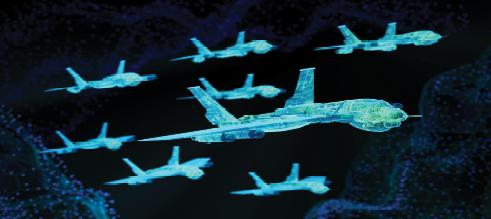
Over the past two years, these pages have carried a few articles that, at first glance, may have appeared to offer contrasting arguments on unmanned warfare. One strongly advocated the raising of a dedicated UAV Corps and a centralised training ecosystem to harness the transformative potential of drones. The other questioned the survivability of large, slow-moving unmanned platforms in contested airspace, arguing that legacy systems such as the MQ-9 Reaper and IAI Heron, though enormously successful in permissive environments, may no longer enjoy the dominance once associated with them. Recent wars have not weakened either argument. On the contrary, they have reinforced both. If anything, events in Ukraine, the Black Sea, the Red Sea, the Middle East, and closer home during Operation Sindoor have confirmed that the age of unmanned warfare is not approaching – it is already here. What is changing is not the relevance of drones, but the nature of drones, the scale at which they will be employed, and the organisational architecture required to exploit them. The debate is no longer whether drones matter. The real question is whether our armed forces are institutionally prepared for a future in which unmanned systems may outnumber manned platforms by several orders of magnitude and shape the tempo, transparency, and lethality of the battlefield.
For nearly two decades, military planners viewed unmanned systems largely through the prism of the War on Terror. Large drones like the Reaper, Predator, and Heron became symbols of a new era in warfare. They could remain airborne for over twenty-four hours, watch vast stretches of territory, track moving targets, relay intelligence in real time, and strike with precision. They appeared to represent the future of air power. Yet modern conflict has exposed the limitations of that model. Dense integrated air defence networks, passive sensors, electronic warfare suites, networked radars, inexpensive missiles, and AI-assisted detection systems have demonstrated that platforms designed for uncontested skies may struggle to survive in contested airspace. The drone itself is not becoming obsolete. Far from it. What is becoming obsolete is the old idea of what a drone should be. The future drone may be stealthier, smaller, faster, autonomous, expendable, networked, or even operating in near-space, but it will certainly not resemble the legacy UAVs that dominated the skies over Iraq or Afghanistan.
This changing character of unmanned warfare strengthens, rather than weakens, the case for raising a dedicated UAV Corps. In fact, it makes such a move urgent. The challenge before modern militaries is no longer the acquisition of drones as individual platforms. The challenge is the creation of an ecosystem that can absorb, train, deploy, sustain, network, and command thousands of unmanned systems across multiple domains. Today, drones are scattered across services, formations, intelligence agencies, special forces, research establishments, and increasingly private industry. Each service may be evolving its own doctrine, communication architecture, maintenance protocols, training methods, and tactical procedures. This may be manageable when drone inventories are limited. It will become unsustainable when future inventories run into tens of thousands. In the next major conflict, platoons may fly first-person-view drones for local reconnaissance, battalions may deploy loitering munitions for precision strikes, brigades may use electronic warfare drones, corps may command deep ISR swarms, and strategic commands may control high-altitude pseudo-satellites and stealth unmanned combat systems. Unless all of these are integrated through a common philosophy, network, and command architecture, the result may be duplication, electromagnetic fratricide, spectrum conflicts, data overload, and operational confusion.
This is precisely where a UAV Corps becomes indispensable. Such a corps must not merely operate drones. It must own the unmanned battlespace. Its mandate should extend from doctrine development to training, certification, spectrum management, software integration, tactical experimentation, maintenance, operational deployment, logistics, lifecycle support, and counter-drone capability. It should function as a tri-service organisation with theatre-level integration, drawing personnel not only from aviation backgrounds but from infantry, artillery, armour, air defence, signals, cyber, space, and electronic warfare. Drone warfare is no longer confined to the air. It spans land, sea, cyber, space, and what may increasingly be called the air littoral. The commanders of tomorrow will not merely manoeuvre platforms. They will command networks of autonomous systems, sensor webs, electronic effects, and AI – enabled kill chains.
One of the earliest arguments made in these pages was the need for a centralised training institution for drone warfare. That argument is stronger than ever. India requires a National UAV and Counter-UAV Warfare Academy that becomes the doctrinal heart of unmanned operations. Such an institution should train not just drone pilots, but drone commanders. It should teach autonomous swarm operations, FPV combat employment, loitering munition mission planning, anti-jamming techniques, AI-assisted target recognition, electronic warfare integration, satellite-linked operations, battle damage analytics, and human-machine teaming. Training cannot be left to short vendor courses or unit-level improvisation. The complexity of future drone warfare demands institutional depth, standardisation, experimentation, and a continuously evolving doctrine informed by operational lessons from global conflicts.
Perhaps the most profound change that future warfare will witness is the shift from one drone, one operator to networked drone warfare. Tomorrow’s drones will not fight alone. They will fight as swarms, clusters, and intelligent collaborative systems. A platoon commander may launch surveillance drones, a battalion headquarters may release loitering munitions, a brigade may deploy electronic warfare drones, and a corps commander may control strategic ISR platforms – all simultaneously within the same battlespace. These systems must communicate, deconflict, share data, prioritise targets, and avoid fratricide in real time. This requires a unified drone combat network that can track friendly unmanned systems, allocate spectrum, assign targets dynamically, fuse sensor feeds, relay intelligence, and connect seamlessly with artillery, missiles, fighters, armour, and naval assets. In effect, the UAV Corps must become not only an operator of drones, but the orchestrator of unmanned warfare, and that is also going to be a form of manoeuvre warfare.
Equally important is the issue of inventory philosophy. Traditional acquisitions focus on a limited number of high-value platforms. Drone warfare demands a completely different mindset. Future inventories must be layered. At the tactical edge, cheap first-person-view drones and expendable reconnaissance systems will dominate. At the operational level, loitering munitions and electronic warfare drones will shape engagements. Deeper inside contested airspace, stealth platforms such as India’s DRDO Ghatak will hunt high-value targets, while loyal wingman systems similar to the MQ-28 Ghost Bat will accompany manned fighters. At the strategic level, high-altitude pseudo-satellites and low-earth-orbit constellations will provide persistent surveillance, communication, and targeting support. Managing this layered architecture cannot be left to fragmented service procurement. It requires a single doctrinal and operational owner.
Recent wars have also demonstrated that drone warfare is ultimately an industrial contest. Iran has shown how mass-produced loitering munitions can shape strategy. Ukraine has shown that thousands of drones may be consumed in a matter of weeks. Major powers are now thinking in terms of inventories measured not in hundreds, but in hundreds of thousands. India cannot afford to view drones as boutique acquisitions. The UAV Corps must work closely with DRDO, private industry, start-ups, academia, and organisations such as the Drone Federation of India and Society of Indian Defence Manufacturers to build a resilient indigenous ecosystem. Secure datalinks, propulsion systems, sensors, batteries, AI software, and electronic payloads must increasingly be designed and produced at home. In the drone age, supply chains may become as important as squadrons.
Every drone, however, invites a counter-drone response. Therefore, offensive and defensive unmanned warfare must remain institutionally integrated. A UAV Corps must own not only the skies occupied by friendly drones, but also the technologies that deny those skies to the adversary. RF detection, acoustic sensors, passive radars, GPS denial, cyber disruption, kinetic interceptors, directed-energy systems, and AI-based threat recognition must become part of the same operational philosophy. Drone warfare and counter-drone warfare are two sides of the same coin.
Ultimately, raising a UAV Corps is not about creating another branch of service. It is about preparing for a new grammar of war. The future battlefield will be less about visible platforms and more about invisible networks. The military that masters these networks – through doctrine, training, technology, scale, and industrial depth – will dominate. The one that merely acquires drones may simply add clutter to the sky. India has the talent, the operational necessity, the industrial momentum, and the strategic imperative. What remains is institutional vision and the courage to act. The time to debate drones has passed. The time to raise a UAV Corps has arrived.
