

 Login
Login
Articles
Future Drones
Sub Title : Survivability, Scale and the Shape of Air Power to Come, as drones are produced at an industrial scale
Issues Details : Vol 20 Issue 2 May – Jun 2026
Author : Ashwani Sharma, Editor-in-Chief
Page No. : 33
Category : Military Affairs
: June 1, 2026
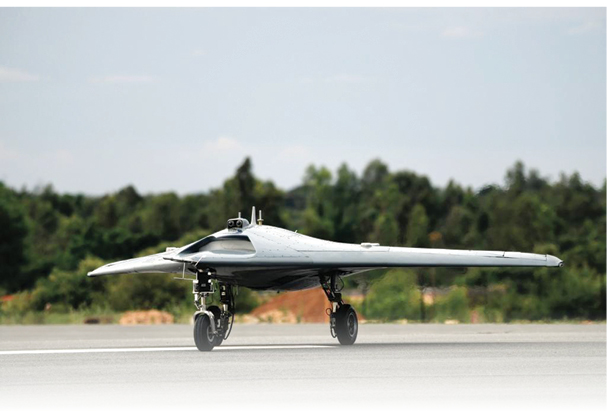
For two decades, large drones symbolised precision, persistence, and the future of air power. But conflicts from Ukraine to the Middle East have exposed their vulnerability, proving that drones remain vital, yet survivability in contested airspace now demands entirely new designs, concepts, and operational philosophies.
In the preceding essay, Air Marshal Chopra, has discussed the vulnerabilities of drones and UAVs in the contested airspace. What then is the future, what types unmanned systems will survive and achieve mission success? In this feature we discuss some of those attributes.
The future of unmanned warfare is not about a single platform. It is about the ecosystem which ought to be distributed, autonomous, stealthy, networked, and available in large numbers. Survivability and not endurance alone will define the next generation of drones. Some of the features that would ensure survivability are discussed in subsequent paras.
Stealth.
The first major trend shaping future drone warfare. Just as combat aircraft evolved from the fourth generation to low-observable platforms, drones too are moving away from conventional airframes toward flying-wing designs with reduced radar and infrared signatures. Platforms such as the Northrop Grumman X-47B, GJ-11, and India’s DRDO Ghatak reflect this evolution.
The logic is simple. If the drone can be detected hundreds of kilometres away, its endurance means little. Future drones will therefore be designed to avoid detection altogether. Internal weapons bays, blended airframes, reduced heat signatures, radar-absorbent materials, and intelligent emission control will become standard features. Such drones will not merely observe from outside enemy airspace; they will penetrate deep into defended zones to hunt mobile missile batteries, command centres, and high-value targets.
For India, this trend is especially relevant. Any future conflict involving either China or Pakistan will involve dense radar coverage, layered missile defences, and electronic attack. In such an environment, stealth may no longer be a luxury. It may become a necessity.
Industrial scale and Mass. The second defining characteristic of future drones. Recent conflicts have shown that quantity has a quality of its own. The success of loitering munitions and swarm attacks has demonstrated that dozens, or even hundreds of relatively inexpensive drones can overwhelm sophisticated air defence systems. A defender may possess missiles worth millions of dollars, but if it is forced to expend them against drones costing a few thousand dollars each, the economics of war begin to favour the attacker.
Platforms such as the Shahed-136, Switchblade, and similar systems employed in Ukraine have changed operational thinking worldwide.
Countries that build resilient supply chains, indigenous propulsion systems, secure communication links, electro-optical payloads, AI software, and battery technologies will enjoy strategic autonomy. Those dependent on imported components may find themselves vulnerable at the very moment conflict begins.
The future will therefore not belong exclusively to exquisite platforms costing tens of millions of dollars. It will belong equally to attritable systems, drones designed with the expectation that some will be lost. Some may carry sensors, some may jam enemy radars, some may act as decoys, and others may carry explosive payloads. Working together, they will create a complex threat environment in which the defender struggles to identify what is real, what is expendable, and what must be engaged first.
In many ways, the battlefield is moving from platform-centric warfare to inventory-centric warfare. The side that can manufacture, deploy, replenish, and network drones in large numbers may enjoy a decisive advantage.
Manned – Unmanned Teaming (MUMT). The third major trend is MUMT. Rather than operating independently, future drones will increasingly fly alongside manned combat aircraft, helicopters, and even ground forces. The concept is already visible in programmes such as the Boeing MQ-28 Ghost Bat.
A fighter aircraft may enter contested airspace accompanied by multiple unmanned wingmen. One may act as a forward sensor, another as an electronic warfare node, another as a decoy, and another as a strike platform. The pilot becomes less an individual combatant and more a mission commander controlling a network of autonomous assets.
This concept aligns closely with the evolving idea of multi-domain operations. It also resonates strongly with India’s emerging doctrinal thinking, especially in relation to mechanised warfare, where manned-unmanned teaming is already gaining traction. The logic in the air domain is identical i.e. distribute risk, multiply options, and preserve human decision-making at the centre.
Altitude and Persistence. The fourth major shift lies in being beyond traditional airspace. Future surveillance may increasingly move into what is often called near-space which is between twenty and one hundred kilometres above the earth. High Altitude Platform Systems, or HAPS, are already attracting significant attention. Airbus Zephyr is one such example. Solar-powered and capable of remaining aloft for weeks or even months, such systems can provide persistent intelligence, surveillance, and communications support while remaining above the reach of most conventional air defence systems.
For India, this offers enormous potential. Persistent surveillance over the Himalayas, the Indian Ocean, the Arabian Sea, and remote border regions could be maintained without constantly risking aircraft or relying solely on satellites. Near-space platforms could eventually become the bridge between airborne ISR and space-based reconnaissance.
Space-enabled drone warfare. Future drones will no longer operate as isolated assets. They will become nodes in a larger constellation involving satellites, ground sensors, naval platforms, cyber networks, and AI-driven command systems. Low Earth Orbit satellite constellations such as Starshield are already changing how intelligence is gathered and distributed. When linked with autonomous drones, these constellations can provide near-real-time targeting, navigation, battle damage assessment, and communication redundancy.
In the future, the drone may simply be the visible tip of a much larger invisible architecture.
Artificial Intelligence. The sixth and perhaps most revolutionary change is AI. Today many drones are remotely piloted. Tomorrow, many will be mission-commanded rather than continuously flown. Artificial intelligence will enable drones to navigate denied environments, recognise targets, avoid threats, reroute around electronic jamming, cooperate with other drones, and adapt in real time. A swarm may independently assign targets, change formations, distribute sensors, and continue the mission even after losing communication with its operator.
For India the message is unmistakable. The country has already built momentum through start-ups, defence innovators, and programmes in unmanned systems. But the next phase demands greater urgency, stealth UCAVs, loyal wingmen, swarm technologies, near-space platforms, indigenous sensors, secure datalinks, and mass manufacturing.
The drone of the future will not simply fly longer. It will fly quieter, faster, smarter, higher, and in greater numbers. More importantly, it will not fight alone. It will fight as part of a connected, distributed, intelligent combat ecosystem.
And in the wars of tomorrow, survivability may no longer belong to the biggest drone in the sky. It may belong to the hardest one to find.
