

 Login
Login
Articles
Global Realignments
Sub Title : An analytical investigation into how the world is shaping up with changing equations and regional priorities
Issues Details : Vol 20 Issue 2 May – Jun 2026
Author : Ajay Singh
Page No. : 19
Category : Geostrategy
: June 1, 2026
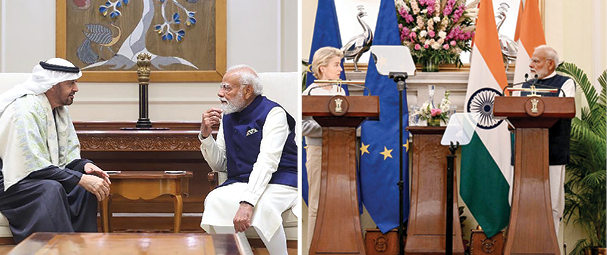
May has been a busy month in the world of diplomacy. It is not just the behind-the-scenes actions going on to bring some kind of closure to the Iran war. It has witnessed the visits of President Donald Trump and President Putin to Beijing within the span of just a week. It also saw Prime Minister Modi’s visit to the Nordic countries, Netherlands and Italy, coming soon after another fruitful interaction with the UAE. These visits were consequential – some produced tangible outcomes, others little more than photo-ops. But taken together, they revealed gradual shifts taking place in global alignments.
Trump’s visit to Beijing grabbed most of the headlines. It had little to show in terms of actual outcomes, but definitely revealed the rising stature of China and the declining one of the USA. It was the first by a US president in almost a decade – the last was Trump’s own trip in 2017. But much water has flown down the Potomac and Yangtze rivers since then. China, in spite of an economic slowdown, has slowly enhanced its military and diplomatic imprint across the world. The USA meanwhile, has alienated allies, walked out of treaties and international institutions, ceded strategic space in Europe and Afghanistan and entered a disastrous war in Iran from which it desperately seeks an exit strategy.
The two leaders met from a position of equals – ‘G2’ as Trump is fond of referring to the two nations – but it was China that seemed to hold the cards. China already held the upper hand when Trump’s tariff war rebounded spectacularly – struck down by his own Supreme Court. China responded to the 150 percent tariffs by imposing tariffs of its own. It also clamped down on exports of rare earths and semiconductors essential to US industry, forcing the US to back off. And though the removal of tariffs and economic cooperation was the main issue, other subjects – especially Taiwan and the Iran war – would have keenly discussed behind closed doors.
China had clearly laid down its sensitivities on Taiwan, warning that any mishandling of the Taiwan issue could “lead to clashes, even conflict.” Trump did make a conciliatory statement saying he was against Taiwan’s independence, implying he supported the ‘One-China two-systems’ approach that earlier governments have upheld. But he also stated that, “I will not travel 9500 kilometres to fight a war,” signalling a weakening US resolve and delayed approval for a $11Billion arms sale to Taiwan. As China gets more assertive to reunify Taiwan, US ambiguity and diminishing stature could be well exploited. The US has been weakened in the war with Iran – in terms of national will, allies and in the expenditure of critical weapons systems – especially Air Defence and long-range missiles. Its inability to subdue Iran, would also make it wary of other confrontations with an even stronger adversary. All this could embolden China to hasten its often-stated goal to “complete reunification by 2027, by military force, if required.”
Trump claims he did not ask China for help to end the Iran war, but that would have been on the agenda. China has close ties with Iran, whose foreign minister visited Beijing just a few days earlier. Its influence could help end the war and reduce its disastrous impact. That would enable it to present itself as the stabilising force in the world, in a sharp contrast to the USA and Trumpian policies.
What emerged from the Chinese perspective was that it “seeks stability in its relations with the USA” – as long as it does not impinge on Chinese interests. It sees itself not only as a ‘near-peer’ (as the US does) but as an equal. Its long-term aim is to take over as the leading global power – either in conjunction with the US, or in confrontation with it. And as US and China compete for global influence, whether their relationship will be that of competitors, adversaries or partners could well determine the global order of this century.
At the end of Trump’s visit, there was nothing to show. Trump boasted that China had agreed purchase 200 Boeing aircraft and “billions of dollars” of beef and soya beans from the USA. This would have brought cheer to its ailing aviation industry and US farmers, but there was no mention of it from the Chinese side. Even the large entourage of CEO’s and business leaders who accompanied Trump left with none of the grand business deals that were envisaged. The only concession the Chinese made was to agree to a reciprocal visit by Xi to Washington, sometime in September.
China further cemented its position with the visit of President Putin to Beijing, which followed just a week later. Both parties condemned the USA for President Trump’s “Golden Dome” missile defence shield – a $1.5 Trillion project that goes against the norms of the Anti-Ballistic Missile Defence Treaty – and his refusal to extend the START II Treaty, which limits the number of missiles, warheads and delivery systems by the erstwhile USSR (and now Russia which has taken over the position) and the USA. The two treaties had preserved a delicate balance between the two sides and their removal could again bring back the nuclear fears of the Cold War. Only that, this time there will be a third major player – China.
Putin did not clinch the Power of Siberia II gas deal – the ambitious 2600-kilometre gas pipeline that would carry 50 billion cubic meters of gas from Russia to Chine through Mongolia. But that could materialise in a few years. This will provide Russia with another large market to enable it to recoup its losses caused by the blockage of energy sales to Europe. But the visit – and its reaffirmation of ‘friendship without limits’ attained more than that. Russia demonstrated that it has shrugged off western isolation, and China succeeded in projecting itself as the pillar of global stability and a balance to the USA.
The growing closeness of Russia and China can challenge the dominance of the Western led order in the coming years. As it is, the US-Europe alliance is fraying with Trumpian policies on Greenland, NATO, his rebuffing of European leaders, and virtual disavowing of Ukraine. It will also be of concern to India. With Russia squarely dependent on China, its support may not be so forthcoming for India in the future – especially when Indian and Chinese policies clash. Both Xi and Putin are likely to be in New Delhi for the BRICS meeting in September. That would be a good platform where the Russia-India-China concept can be revived for greater economic and strategic cooperation. But cooperation with China – though essential – would be marked by wariness. After all, the border standoff with China began just weeks after Xi’s last visit to India in Oct 2019. And even though ties have mended somewhat, there are still over 50,000 troops are deployed along the LAC on both sides, and suspicion and lack of faith remains.
India’s Multi-lateral Initiatives
India’s diplomatic alignments too are at a major inflection point. Indo-US ties are on a dangerous spiral and have lost much of its sheen. The visit to US Secretary of State, Marco Rubio to New Delhi has helped repair ties somewhat, and emphasised the importance of the relationship to both sides. But there have been too many points of contention between the two. India had been subject to arbitrary tariffs of almost 50 percent – amongst the highest on the world. This was smoothened somewhat by the announcement of the Indo-US bilateral trade agreement, but its implementation has been tardy. The US seems to have a greater interest in selling oil, defence products and nuclear reactors to India, rather than address our strategic concerns. Indo-US ties have lost the special significance it once had, and Washington has tilted towards China and Pakistan at our expense. Even QUAD seems to have lost its earlier significance. The QUAD meeting of Foreign Ministers in New Delhi provided a temporary boost, by announcing a raft of new initiatives to strengthen cooperation in the Indo-Pacific. But Trump does not seem to hold it in great store – like NATO – and without that, QUAD will have little more than symbolic value.
The fraying of Indo-US ties has led to a greater outreach to other partners who are also affected by the churn – especially in the Middle East and Europe. Prime Minister Modi’s recent visit to the UAE helped cement bonds which can translate to greater economic interaction and energy security. Trade is already a sizeable $100 Billion, but can grow to $200 Billion by 2032. India’s ties with Middle East nations – including Iran, Israel and Saudi Arabia have been traditionally strong. But the relationship with Saudi could be impacted by the Pakistani-Saudi Mutual Defence Pact and their growing military cooperation.
Modi’s visit to UAE was followed by a four-nation trip to Netherlands, Sweden, Norway, and Italy. Coming soon after the Free Trade Agreements stuck with the European Union and UK, it marks a growing interdependence between India and Europe. Both are impacted by Trump flip-flop policies and China’s growing assertiveness. Growing economic and strategic ties could help provide a steadying balance for both.
While India and Netherlands have elevated their ties to a ‘Strategic Partnership,’ even more significant has been their investment in semiconductors, renewable energy and education. Tata Energies and the Dutch semiconductor manufacturer ASML have joined hands to set up a chip manufacturing plant in Gujarat – something that will increase Indian capabilities in this vital sector. Similarly, the Indo-Nordic Summit and meetings with the heads of Sweden and Norway also elevated ties to a ‘Green Strategic Partnership’, signalling greater cooperation in clean energy, climate resilience, education, and the opening Arctic region.
Modi’s meeting with Italian Prime Minister Giorgia Meloni was more in the public eye for his present of ‘Melody’ toffees to her. But that is part of the symbolism that goes with foreign ties. Italy is vital to India as a trade partner. It also provides the anchor in the Mediterranean to the India-Middle East-Europe-Economic Corridor, which could boost Indian connectivity across the Middle East and Europe, strengthen supply chains and enhance energy security.
The growing diplomatic initiatives tell of the realignments taking place in world affairs. The world has been wracked by war, economic recession and climate change and the established order is fast fraying. The pole power of the world – the USA – is proving to be an increasingly destabilising factor – to both friend and foe alike. It is slowly ceding ground to China – which can be even more dangerous in the long run. In the subtle changes taking place in the geo-political balance of the world, India’s multilateral initiatives could well be the hedge against even greater turbulence ahead.
