

 Login
Login
Articles
A TALE OF TWO NEIGHBORS
Sub Title : Contrasting strategic trajectories are reshaping the security dynamics of India's immedate neighbourhood, namely, Pakistan and Bangladesh.
Issues Details : Vol 20 Issue 3 Jul – Aug 2026
Author : Ajay Singh
Page No. : 36
Category : Geostrategy
: July 28, 2026
India’s neighbourhood presents a study in stark contrasts. While Pakistan grapples with insurgency, political instability and internal fragmentation, Bangladesh stands at a strategic crossroads where political change, expanding Chinese influence and renewed engagement with India will shape the region’s future security landscape.
Pakistan is basking in its success in brokering a peace deal between the US and Iran, which unfortunately, seems to be unravelling – its overtures to Saudi Arabia, the United States, China, Türkiye, and even Bangladesh. But its diplomatic gains seem to be fast overshadowed by increasing unrest at home. In Baluchistan, the freedom movement has gathered momentum; Waziristan has been torn by the actions of the Tehrik e Taliban Pakistan, (TTP) which has led to a state of ‘direct war’ with Afghanistan. And to add to the mix, Pakistan Occupied Jammu and Kashmir (POJK) has seen waves of protests for greater autonomy and self-representation. And of course, the looming shadow of Imran Khan, who has just marked three years of imprisonment still threatens the political fibre of the country.
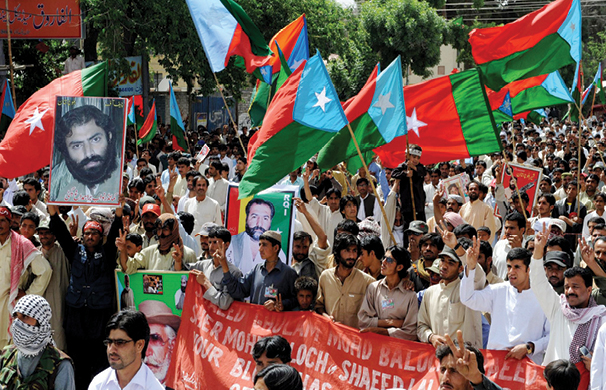
Most worrying would be the events in Baluchistan and Waziristan. In the month of July itself, 42 security personnel were killed in three major attacks by the Baloch Liberation Army (BLA). 18 policemen were taken hostage and then executed in Ziarat; 11 soldiers were killed in a suicide attack on an army convoy in Musakhail district. And the BLA claimed to have killed 30 sailors in an audacious attack on a Coast Guard camp in Jiwani, just an hour’s drive from Gwadar port. Members of the BLA’s elite Majeed Brigade drove an explosive laden Mazda into the gates of the camp and detonated it, while troops of its Fateh squad launched a coordinated attack on the dazed survivors. This was followed by another attack on an Army convoy in Mastung in which the BLA claimed to have destroyed 15 trucks and killed 45 army personnel. The actions of the BLA now encompass the entire province, as the Baloch calls for independence gather momentum.
Even though Pakistan has launched its much-touted OPERATION SHABBAN to counter what they call are “Fitna al Hindustan”, a blanket term calling all terrorists as Indian sponsored , its high-handed actions have only inflamed the populace even more. Pakistani army actions have targeted civilians and activists and added to the list of people that have disappeared without a trace. All this has added to the resentment. In fact, Baloch leader Mir Yar Baloch recently declared Baluchistan as an independent country and called on India and the United Nations to recognise it. They claim that the BLA controls over 85 percent of Baluchistan, along with all its gas and coal mines. They also announced their single-starred, green red and blue flag of Baluchistan, and its national anthem ‘Ma Chukain Balochani’ and its own currency, the Balochi Falus. The flags and the song now appear freely in each rally in the troubled province.
There is a valid reason for the unrest and resentment. Pakistan’s largest province comprises of 44 percent of its land and is rich in minerals and natural resources, but much of it is siphoned away. Even the CPEC which runs from the port of Gwadar through the rugged mountains of Baluchistan, before entering the Xinjiang province of China, is seen as a project that exploits Baluchistan’s natural land and natural resources but gives them little in return. It is not surprising that many BLA attacks target the Chinese and CPEC projects. Even though the Army Chief had given a personal assurance to the Chinese premier to ensure its security, two full divisions have proved inadequate to protect the road or the lines of communication. Pakistan is losing its hold on its largest province and even the hardline JUI-F chief, Maulana Fazlur Rehman admitted that Pakistan has no control over 85 Baluchistan, and that Waziristan too is going the same way.
He is right. To its North, Waziristan too seems to be slipping out of control with the activities of the TTP. In fact, BLA and TTP actions seems to be in coordination with each other. In Waziristan, Pakistan finds itself drawn into open conflict not just with the TTP but with the Taliban regime in Afghanistan, whom it accuses of sheltering and supporting the TTP. Things had come to a passe this February, when Pakistan launched a series of air strikes inside Afghanistan, in an apparent retaliation for TTP attacks. The attacks were directed not just at TTP bases, but also Taliban military targets, but attained little besides killing civilians on ground. This led to a state of open war between Pakistan and Afghanistan which lasted for two weeks and led to a breakdown of virtually the entire Durand Line, which the Taliban does not recognise. Although a fragile cease fire was brokered, the strikes by both sides continue and the actions of the TTP remain unchecked. This movement will gather momentum with the BLA successes and a fresh round of violence seems to be on the cards.
Pakistan’s policy of establishing the Taliban in Afghanistan, hoping for a pliant, eternally grateful regime that would provide it with “strategic depth” has rebounded spectacularly. Instead, it seems that it will be Pakistan that could provide strategic depth to Afghanistan. Pakistan has responded by launching another grandiosely named operation – OPERATION GHAZAB LIL HAQ, but as in Baluchistan, it has little to show. Their refusal to address the root cause of the problem has led to both their western provinces slowly slipping out of control.
While Waziristan and Baluchistan have been on the boil for years, a fresh wave of unrest has also swept across POJK. The problem began innocuously enough, with protests breaking out in Rawalkot and Muzaffarabad over rising food prices, shortages of fuel and electricity and anger at the reservation of 12 seats in the POK legislative assembly for outsiders. These were legitimate demands which should have been addressed. Led by the Joint Awami Action Committee, (JAAC) people took to the streets, some of them waving Indian flags and calling on India for help. Pakistan responded to with its usual brutality. Police firing has killed over 40 protestors and many have been arrested or simply disappeared. Such was the brutality of the security forces that the European Union expressed concerns over human rights abuse in POK.
The shoe is squarely on the other foot now. The reality of the so-called ‘Azad Kashmir’ is coming to the surface and it can erupt even more as the movement morphs into one demanding greater autonomy and self-rule. Legislative elections are to be held in July and that could prove to be a watershed moment. It will be tempting to intervene in POJK but one should not fish in troubled waters (less the occasional statement and diplomatic protests). Pakistan’s chickens are coming home to roost and we must merely focus on consolidating our gains in Kashmir and ensure complete economic and psychological integration there.
Bangladesh
Bangladesh seems to be returning to some semblance of normalcy after the national elections of February 26. This brought the Bangladesh Nationalist Party back in power after 20 years in the wilderness, and saw Khaleda Zia’s son, Tarique Rahman takeover as Prime Minister. Fortunately, the elections went off relatively smoothly and the feared violence and fragmentation did not take place. Even more fortunately, the BNP got a clear majority winning 209 of the 297 seats, which side-lined the hardliner extremist parties, and will provide a measure of political stability that is so essential to bring Bangladesh back on track.
With a stable government in power, Bangladesh seems to have got down to the business of national governance over mere rhetoric. Ties with India were at an all-time low with the interim government under Mohammed Yunus seeming to go out of the way to provoke India, but now both sides seem to be making concerted attempts to rectify them. The depth of anti-India feeling in Bangladesh is still high, but in spite of that, India must mend fences. Bangladesh is an important neighbor and essential for India’s security and to provide connectivity to South East Asia.
As it is, Chinese influence in Bangladesh is growing rapidly. Prime Minister Rahman chose to visit China before India in his first state visit – in what was clearly a symbolic move. And Chinese presence in Bangladesh is increasing. Besides Pakistan, Bangladesh is the largest recipient of Chinese aid and investments – in everything from roads, to ports to airfields to river management projects. Bangladesh signed a deal with China to develop an Economic Zone near Mongla port on land once allotted to India – an action that will bring Chinese presence dangerously close in the Bay of Bengal. But then, India has only itself to blame. It had dawdled over the project for four years with no progress, and its tardiness provided the grounds for China to move in.
Even more worrying are other areas that China has gained inroads in. It has emerged as Bangladesh’s largest defence supplier providing tanks, fighter aircraft, naval frigates and submarines. It is also trying to develop the Lalmonirhat airbase in Northern Bangladesh – perilously close to the vital Siliguri corridor. Chinese presence so close to India’s vulnerable ‘Chicken’s Neck’ is a definite security concern, and one which Bangladesh must take cognisance of.
China has also entered another critical space – water management. One of the sore points in India-Bangladesh relations is the fact that the Teesta Waters Agreement could never be fructified. China has attempted to capitalise on this by trying to enter in the Teesta River management project which will enable it to control its waters, and thus impact critical infrastructure and local economies. Water is a sore point in Indo-Bangladesh relation – especially as 54 rivers flow from India to Bangladesh – and the inability to enter into a comprehensive water sharing agreement, by successive governments has been a major irritant in ties. Once again, this is an area that must be addressed before it is too late.
Another major irritant is the presence of Sheikh Hasina on Indian soil – where she has sought asylum since the Student Uprising of August 24 that toppled her. She has been sentenced to death by Bangladesh’s International Crimes Tribunal, and India has rightly rejected calls to return her. Though, once the dust settles, it is likely that she will return to Bangladesh. With time her Awami League Party could once again come back to power. India had made the cardinal error of not understanding the sentiment in Bangladesh as the student movement erupted. It must not do the same again and maintain contact with all parties, get relations back on an even keel and ensure that our security concerns are upheld – irrespective of who is in power in Bangladesh.
The situation on both flanks is dramatically different from each other. With Pakistan unfortunately, the level of mistrust is very high and the chances of rapprochement are low – at least in the near term. Though back-channel diplomacy and informal talks must continue. It is still strong enough to hold itself together, which it undoubtedly will, in spite of the turbulences within. With Bangladesh, the situation is more delicate. We have had decades of good relations – especially with Sheikh Hasina’s government – and must aim for the same with the present regime as well. The geography binding us can never be discounted and both sides have much to gain by greater economic interaction. But Bangladesh must recognise our security concerns, especially in controlling Islamic fundamentalism on its soil, and preventing others from impinging in our areas of interest. In turn, India should make concessions in water sharing, provisioning of electric power, reduced tariffs and access to markets, and provision of technology and research. That will ensure good neighbourly relations and provide stability on one flank at least.
