

 Login
Login
Articles
India’s Theatre Command Journey
Sub Title : The long-awaited transition towards integrated theatre commands promises to reshape India's future warfighting architecture.
Issues Details : Vol 20 Issue 3 Jul – Aug 2026
Author : Dr Amit Sharma
Page No. : 43
Category : Military Affairs
: July 28, 2026
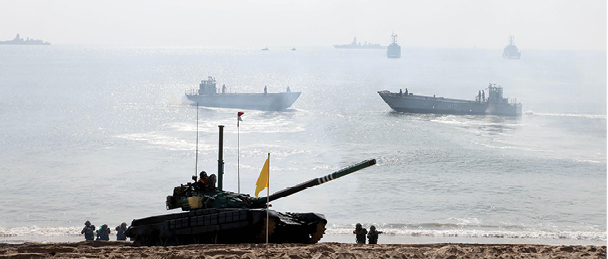
Integrated Theatre Commands represent the most significant reform of India’s higher defence management since Independence. Designed to enhance jointness, optimise multi-domain operations and prepare the Armed Forces for a two-front challenge, theatreisation will fundamentally reshape India’s future warfighting capability.
Introduction
Integrated Theatre Commands represent one of the most significant military reforms undertaken by India since Independence. Conceived to enhance jointness among services and other domains, optimise the employment of military power in India’s unique two front dilemma and prepare for the demands of twenty-first-century warfare, theatreisation seeks to transform India’s traditionally service-centric command structure into an integrated, multi-domain warfighting architecture. However, the reform is far more than an organisational exercise. It is the culmination of over two decades of operational experience, institutional evolution and strategic learning, while simultaneously presenting complex challenges relating to command, doctrine, technology, resources and inter-service integration. This article examines the evolution, current status, challenges and future prospects of India’s theatre-command initiative, drawing lessons from evolving national security needs and international models to assess the road ahead.
Why India Needs Theatre Commands
For India, however, the strategic imperative extends well beyond the general evolution of warfare. India is one of the few major powers that must simultaneously prepare for two very different military challenges along its continental frontiers while also safeguarding expanding maritime interests in the Indian Ocean Region.
The continental challenge is characterised by a unique strategic asymmetry. Along the northern frontier, India confronts China, a military power which have significant advantages in conventional capabilities, defence industrial capacity and long-range precision strike systems across all domains. Any future conflict with China would therefore require India to possess the capability to absorb, hold and sustain prolonged conventional military operations while preventing China from exploiting its conventional superiority to achieve strategic objectives.
On the western front, the strategic equation is fundamentally different. India enjoys a clear conventional military advantage over Pakistan in terms of economic strength, military resources and force potential. Pakistan, however, seeks to offset this imbalance through its policy of first use of nuclear weapons and shallow geography, thereby attempting to deter a large-scale conventional response. Consequently, India faces the challenge of developing military options that are sufficiently integrated, precise and scalable to achieve decisive operational objectives while remaining below Pakistan’s declared nuclear threshold.
This creates a unique strategic requirement for India’s military. Against China, the Armed Forces must be capable of sustaining a prolonged, high-intensity conventional campaign across multiple domains. Against Pakistan, they must possess the ability to execute rapid, integrated and decisive conventional operations that can achieve military and political objectives before Pakistan is able to exploit the coercive value of its nuclear posture.
Beyond its continental frontiers, India faces an increasingly complex maritime security environment. The Indian Ocean Region has emerged as a theatre of growing geopolitical competition, with expanding Chinese naval deployments, increasing submarine activity, the security of vital sea lines of communication, and the protection of India’s island territories and offshore assets assuming greater strategic significance. Simultaneously, the Arabian Sea remains critical for safeguarding India’s western seaboard, protecting energy supplies from the Gulf, countering maritime terrorism and ensuring freedom of navigation. These challenges demand close integration between naval, air and land capabilities, supported by space-based surveillance, maritime domain awareness and long-range strike capabilities. A dedicated Maritime Theatre Command would enable unified planning and execution across these interconnected operational responsibilities.
Evolution of India’s Theatre Command Plan
India’s journey towards Integrated Theatre Commands has been evolutionary rather than revolutionary. Although the creation of the Chief of Defence Staff (CDS) in 2019 is often viewed as the starting point of theatreisation, its origins lie in more than two decades of institutional reforms, operational experience and growing recognition of the need for greater jointness.
The process began after the 1999 Kargil conflict, when the Kargil Review Committee (KRC) identified deficiencies in intelligence coordination, inter-service cooperation and higher defence management. Building upon its recommendations, the Group of Ministers (GoM) in 2001 proposed wide-ranging reforms to strengthen jointness and integration among the Services. These reforms led to the establishment of the Andaman and Nicobar Command (ANC) in 2001—India’s first integrated tri-service theatre command, and the Strategic Forces Command (SFC) in 2003, responsible for managing the country’s strategic nuclear forces.
Over the following decade, successive expert bodies, including the Naresh Chandra Task Force (2012) and the Shekatkar Committee (2016), reiterated the need for greater jointness and recommended reforms in higher defence management. While these initiatives stopped short of recommending a specific theatre-command model, they gradually built institutional consensus that India’s service-centric command structure required transformation to meet the demands of modern warfare.
A major breakthrough came in 2019 with the appointment of General Bipin Rawat as India’s first Chief of Defence Staff (CDS) and the creation of the Department of Military Affairs (DMA) within the Ministry of Defence. Together, these reforms provided, for the first time, an institutional mechanism to promote joint capability development, integrated planning, common logistics and the restructuring of military commands.
Since 2020, the focus has shifted towards designing an Indian model of Integrated Theatre Commands. Various proposals have envisaged geographically oriented commands for the northern and western fronts, supported by functional commands such as the Maritime Theatre Command and an integrated Air Defence Command. Although the precise organisational structure continues to evolve through extensive consultations among the Services, broad agreement has emerged that future warfare demands higher levels of jointness, integrated planning and unified operational command.
India’s theatre-command initiative should therefore be viewed not as a sudden organisational innovation, but as the culmination of more than two decades of institutional learning and defence reforms. Driven by operational lessons, technological change and an increasingly complex strategic environment, it represents the natural progression of India’s long-term effort to build a more integrated, agile and effective warfighting structure.
The emerging framework envisages a combination of geographically oriented and functional commands tailored to India’s strategic requirements. Proposals include a Northern Theatre Command focused on the Line of Actual Control with China, a Western Theatre Command responsible for the Pakistan front, and a Maritime Theatre Command to integrate naval, air and land capabilities for operations across the Indian Ocean Region. Parallel proposals for an Integrated Air Defence Command seek to unify surveillance, air defence and missile defence capabilities under a common command-and-control framework, while significant progress has also been made towards joint logistics, integrated communications, common training and harmonised operational procedures.
Although important issues relating to command relationships, the employment of air power and organisational restructuring continue to be debated, the overall direction of reform is now well established. India’s theatre-command initiative has progressed beyond conceptual discussion into an active programme of institutional transformation. Viewed in its entirety, theatreisation represents the culmination of more than two decades of operational learning, institutional reform and strategic adaptation. The remaining challenge is not whether India should adopt Integrated Theatre Commands, but how best to develop a command architecture that preserves the strengths of the individual Services while delivering the jointness, operational agility and multi-domain integration required for future warfare.
Challenges
The principal challenge facing India’s theatre-command reforms is not the creation of new headquarters but the integration of three Services that have evolved independently for over seven decades.
The most debated issue has been the employment of air power. Unlike land or naval forces, air assets can rapidly shift effort between theatres and achieve strategic effects far beyond a single operational area. With an operational fighter strength of around 30-31 squadrons against an authorised strength of 42 squadrons, the Indian Air Force argues that permanently assigning scarce air assets to individual theatre commanders could reduce operational flexibility and the ability to concentrate combat power at decisive points. Advocates of theatreisation, however, contend that theatre commanders require assured access to air assets if genuinely integrated, multi-domain operations are to be achieved. The challenge, therefore, is to devise a command arrangement that balances centralised control of strategic air power with decentralised support to theatre operations.
The Indian Navy’s principal concern is preserving unity of command across the maritime domain. Unlike land operations, where theatres are geographically discrete, the Indian Ocean constitutes a single, interconnected operational space in which naval task groups routinely shift between the Arabian Sea, Bay of Bengal and wider Indo-Pacific. Fragmenting maritime assets across multiple theatre commands could reduce operational flexibility and dilute the Navy’s ability to concentrate combat power. Consequently, the Navy has generally supported an integrated Maritime Theatre Command that preserves maritime unity while facilitating joint operations with the Army and Air Force.
For the Indian Army, the principal challenge lies in reorganising a force built around seven long-established geographical commands into integrated theatres without compromising operational readiness. Theatreisation will require the redistribution of corps, logistics, aviation, air defence and support assets while simultaneously addressing two fundamentally different operational environments: a sustained, high-altitude conventional campaign against China that demands resilience and endurance, and a rapid, offensive campaign against Pakistan across mountainous, plains and desert terrain. Integrating these contrasting operational requirements within a coherent theatre-command structure, without creating duplication, capability gaps or command ambiguities, will be a major organisational and doctrinal undertaking.
Closely related is the question of command relationships. Determining the respective responsibilities of the theatre commander, the Service Chiefs and the Chief of Defence Staff remains one of the most complex organisational issues. While theatre commanders are expected to exercise operational control, the Service Chiefs will continue to remain responsible for force generation, training and capability development. Clearly defining these responsibilities, particularly for strategic assets such as long-range missiles, airlift, space and cyber capabilities, is essential to avoid ambiguity during crises.
Technology presents an equally formidable challenge. Modern theatre commands depend upon integrated C4ISR (Command, Control, Communications, Computers, Intelligence, Surveillance and Reconnaissance) networks capable of providing a common operational picture across multiple domains. Although India has made significant progress through systems such as the Integrated Air Command and Control System (IACCS), Defence Communication Network (DCN) and expanding space-based ISR capabilities, achieving seamless interoperability across all Services remains a work in progress.
These challenges should not be viewed as arguments against theatreisation but as indicators of the scale of institutional transformation involved. International experience demonstrates that successful theatre-command reforms typically evolve over a decade or more and are supported by sustained doctrinal development, technological integration and organisational adaptation. India’s own approach has similarly been gradual and consultative, recognising that the ultimate objective is not merely organisational restructuring but the creation of a genuinely integrated warfighting capability suited to the country’s unique strategic environment.
International Models and Lessons
India’s theatre-command reforms are part of a broader global trend towards integrated military command, but international experience suggests that there is no universal model. Every major military power has developed its command architecture in response to its own geography, strategic priorities, military culture and political system. Consequently, India’s objective should not be to replicate any single model but to adopt those principles that best suit its own security environment.
The United States offers perhaps the most mature model of joint warfare. The Goldwater-Nichols reforms clearly separated force generation from force employment, strengthened theatre commanders, institutionalised joint professional military education and created highly integrated planning and C4ISR systems. China, on the other hand, reorganised its armed forces into five Theatre Commands to facilitate integrated, multi-domain operations under unified operational control. Of particular relevance to India is China’s Western Theatre Command, which integrates land, air, rocket force and strategic support capabilities against India. While the US demonstrates the importance of institutional jointness and China highlights the operational advantages of unified theatre command, neither model can be replicated wholesale because both reflect their respective global ambitions and political systems.
The experiences of Russia, the United Kingdom and Australia provide equally valuable insights. Russia’s ongoing conflict in Ukraine has shown that integrated command structures alone do not guarantee battlefield success unless supported by resilient logistics, effective communications and adaptive leadership. The United Kingdom has achieved a high degree of jointness not through extensive theatre commands but through common doctrine, integrated planning and professional military education. Australia, operating under a Chief of Joint Operations, demonstrates how clear separation between operational command and force generation can improve joint operations without excessive organisational complexity. Together, these models reinforce that successful theatreisation depends as much on doctrine, training, logistics and technology as on command structures.
The overarching lesson for India is clear. It should adopt principles such as unified operational command, integrated planning, joint logistics, interoperable C4ISR networks and professional military education, while avoiding the temptation to mechanically transplant foreign organisational models. India’s command architecture must reflect its own strategic realities—simultaneously deterring a conventionally superior China, maintaining conventional dominance over a nuclear-armed Pakistan and safeguarding expanding maritime interests in the Indian Ocean. Ultimately, the effectiveness of India’s theatre commands will depend not on how closely they resemble those of other countries, but on how successfully they integrate the nation’s military capabilities into a coherent and agile warfighting system.
The Road Ahead
India’s journey towards Integrated Theatre Commands has reached a stage where the debate is no longer about whether theatreisation is necessary, but how it should be implemented. Although the final organisational architecture may continue to evolve, the broader direction of reform is unlikely to reverse. The creation of the Chief of Defence Staff, the Department of Military Affairs and the steady expansion of joint planning, logistics and capability development have already placed the Indian Armed Forces on an irreversible path towards greater integration.
Future warfare will further reinforce this trajectory. Rapid advances in artificial intelligence, autonomous systems, long-range precision weapons, cyber and space capabilities, together with the emergence of Multi-Domain Operations (MDO), will demand seamless integration of land, maritime, air, cyber and space capabilities. Theatre commanders will increasingly rely on integrated C4ISR and fused intelligence from satellites, drones, airborne sensors, maritime surveillance and cyber networks to create a real-time common operational picture, enabling faster and more informed decision-making. Consequently, theatreisation must be viewed not merely as an organisational reform but as a technology-enabled transformation of the way military operations are planned and conducted.
The success of this transformation, however, will depend upon far more than the creation of new headquarters. Continued reforms in doctrine, joint professional military education, career management, integrated logistics, digital command-and-control systems and indigenous technological capabilities will be equally important. International experience demonstrates that effective theatre commands are built through sustained institutional adaptation rather than organisational restructuring alone.
At present, neither India’s security environment nor its available resources justify the creation of a large expeditionary maritime force comparable to those maintained by major global powers. India’s strategic partnerships with the Quad, Indonesia, Vietnam, the Philippines, Oman and the UAE, coupled with its continuing requirement to address a complex two-front continental challenge, necessitate prudent prioritisation of defence resources. However, as India’s geopolitical interests, overseas economic investments and maritime responsibilities continue to expand, the need for enhanced expeditionary capabilities cannot be ruled out.
India’s theatre-command architecture must therefore remain evolutionary, indigenous and capability-driven. Rather than emulating foreign models, it should reflect India’s unique strategic realities—deterring a conventionally superior China, retaining conventional dominance over a nuclear-armed Pakistan, and safeguarding India’s expanding maritime interests in the Indian Ocean Region. Ultimately, the success of theatreisation will not be judged by the number.
