

 Login
Login
Articles
Skyroot Aerospace’s Vikram-S Mission
Sub Title : Skyroot Aerospace's successful Vikram-S mission heralded the arrival of India's private sector as a credible player in space launch capabilities.
Issues Details : Vol 20 Issue 3 Jul – Aug 2026
Author : Lt Gen AK Bhatt (Retd) Director General, Indian Space Association (ISpA)
Page No. : 50
Category : Military Technology
: July 28, 2026
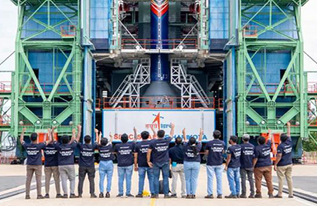
The successful launch of Skyroot Aerospace’s Vikram-1 marks a defining moment in India’s space journey, demonstrating that private enterprise has evolved from a supporting role into a strategic partner capable of advancing the nation’s commercial, technological and defence space ambitions.
For decades, the defining imagery of India’s space journey was an archival photograph from 1963; a rocket cone transported on the back of a bicycle across the coastal village of Thumba. Today, as the thunder of Skyroot Aerospace’s Vikram-1 rocket echoed across the Bay of Bengal, we are witnessing a complete paradigm shift. A sleek, seven-story, all-carbon composite orbital vehicle successfully launched from the First Launch Pad at Sriharikota represents a new reality: India’s private space sector has officially transitioned from experimental towards an industrial powerhou
Mission Aagaman, literally meaning “the arrival”, this successful test flight is not just a triumph for a single company. It is a watershed moment for the Indian private space sector and a resounding validation of India’s 2020 space sector reforms initiated and monitored personally by the Prime Minister.
India’s “Falcon 1” Moment
To understand the importance of what Skyroot has achieved, one must look at global precedence. In September 2008, a young company called SpaceX successfully launched Falcon 1 into orbit after three failed attempts. That single flight laid the foundation for the modern commercial space era, proving that private enterprise could disrupt a domain traditionally restricted to Government agencies.
This single flight in a way was the start of new space age led by the private sector and bringing in new disruptive technologies like reusable rockets, miniaturised satellites, and Low Earth Orbit (LEO) constellations for broadband communication.
By successfully placing payloads into low-Earth orbit, Skyroot has made India one of the very few nations with a fully operational, privately developed orbital launch capability. What makes this achievement profoundly significant is the sheer speed and efficiency with which it was accomplished. Developed over nearly 3,000 days by a team of 1,000 engineers, Vikram-1 didn’t rely on legacy tech transfers. It features cutting-edge, in-house innovations including high-thrust solid rocket motors, 3D-printed liquid engines and advanced carbon-fiber structures designed to carry up to 350 kg to Low Earth Orbit (LEO). Signifying its immense commercial potential, the rocket successfully deployed a highly sophisticated, diverse payload stack on its maiden flight, ranging from Cosmoserve’s specialized space debris removal soft-robotic arm, to advanced CubeSats, to even symbolic art representing the globalized, multi-disciplinary future of space.
Decoding the Power of this Ecosystem
Being at a vantage point in India’s private space sector, the most gratifying aspect of this launch isn’t just the rocket itself, but the invisible Indian network that lifted it. Skyroot’s journey engaged over 400 domestic suppliers. From precision machining units in micro-industrial hubs to advanced material labs, this launch proves that India has successfully cultivated a highly sophisticated, indigenous deep-tech supply chain.
What we are witnessing is the rapid maturation of a multi-layered ecosystem. Just recently Agnikul Cosmos another startup which had launched a pre orbital rocket in May 2024 is now looking forward to their next milestone, Mission 02 flight. This reflects how deep legacy expertise is now actively guiding private commercial ambitions. The momentum is palpable across the board. They have also onboarded former ISRO Chairman S. Somanath as a board observer. Crucially, the government has also decided to share Small Satellite Launch Vehicle (SSLV) and PSLV technology directly with private industry consortia, setting the stage for India to scale up its commercial bandwidth almost immediately. Skyroot, Agnikul, and SSLVs being manufactured by HAL, once fully operational, will, apart from commercial launches, provide, in the long term, the much-needed flight cadence that would be required for our strategic/military needs in times of crisis/confrontation, as these would give an option for Responsive launch/launch on Demand. An essential capability in future war where augmentation of existing gaps in ISR or communication satellite or replacement of voids created by adversaries actions can be quickly made up.
From Vendors to Co-Travelers
India now has the opportunity to offer cost-effective and reliable launch services at competitive costs, at a time when global demand for small satellite launches continues to outpace supply. While the government targets scaling India’s share of the global space economy to 10%, developments like Vikram-1 provide the exact commercial muscle required to make that a reality.
Apart from the launch vertical of Space, Indian Private Sector and Startups have successfully proven capabilities by launch of ISR satellites. The launch of hyper-spectral satellite by Pixxel, and attempt of OptoSAR satellite by GalaxEye as well as Electro-optical Earth observation satellites by TASL, and Azista are indicative of growing ISR Capability in the country. Even the allocation of manufacture of 31 out 52 satellites of Satellite Based Surveillance (SBS) 3 by Indian Startup consortiums is an indicator of the growing indigenous capability which is essential. In the domain of Space domain Awareness the capabilities developed by Digantara, an Indian startup in manufacturing ground-based telescope and launching the SCOT satellites are augmentation of these critical capabilities for strategic use.
In the future, the efforts for on-orbit maintenance and refueling being attempted by Indian startups would be useful for developing autonomous Indian Space capability. For years, the Indian private space industry acted merely as tier-2 or tier-3 vendors supplying components to the Indian Space Research Organisation (ISRO). The policy shifts over the last few years, spearheaded by the creation of IN-SPACe has deliberately broken that glass ceiling.
Private entities are no longer just contractors; they are independent builders, intellectual property creators and equal co-travelers. Notwithstanding the same ISRO’s role as an enabler, providing world-class launch infrastructure at the Satish Dhawan Space Centre and handholding and supporting young companies is most critical and shows how a public-private partnership ought to function. The role of IN-SPACe created to promote and authorize private Space has also been an important enabler and catalyst
The New Horizon
The successful orbital flight of Vikram-1 and the launch of satellites by multiple Indian Space Companies and Startups is the opening chapter of the larger playbook. The private space era hasn’t just arrived; it is ready to scale new heights.
As space becomes more and more critical both for military and civilian use; the developing private Space capabilities are not just for India to get a large share of global space economy but also to develop, India’s Military Space Power with ‘Self-Reliance’ in Indian Strategic space capabilities in the whole spectrum i.e. from ISR to Space Domain Awareness. Orbital Space Resilience in future scenario is not a luxury but a fundamental necessity. Mission Aagaman is therefore more than a successful launch. It signals the emergence of a mature private space ecosystem capable of strengthening India’s economic competitiveness, technological sovereignty and strategic resilience.
