

 Login
Login
Articles
Forging India’s Defence Innovation Ecosystem
Sub Title : IIT Ropar’s endeavoures towards building a bridge between academia, defence and industry.
Issues Details : Vol 20 Issue 4 Sep– Oct 2026
Author : Defstrat Editorial Team
Page No. : 22
Category : Military Affairs
: September 23, 2026
Modern warfare is changing faster than conventional defence-development cycles can accommodate. Artificial intelligence, autonomous systems, drones, cyber, advanced materials and directed-energy technologies are moving from laboratories to battlefields at unprecedented speed. Yet India’s challenge is not merely to develop these technologies; it is to connect the soldier who identifies the operational problem with the scientist who can solve it and the industry that can manufacture the solution. It is in this gap that IIT Ropar’s Defence Research and Innovation Foundation (DRIF) seeks to position itself.
In May 2025, IIT Ropar formally launched the Defence Research and Innovation Foundation (DRIF) created to channelise the Institute’s technical talent pool directly into India’s defence ecosystem. Chaired by the Institute’s Director, Prof Rajeev Ahuja and steered on ground by
Lt Gen SS Mahal, PVSM, AVSM, VSM (Retd), its Managing Director, DRIF was conceived as a structured bridge between a leading technical Institute and the Armed Forces, Industry, Defence public-sector units, and a fast-growing community of MSMEs & defence start-ups. The Foundation’s stated vision is ambitious: to achieve excellence in next-generation defence innovation and manufacturing, bringing together operational readiness and technological capability in the service of a secure, self-reliant India. That vision draws on IIT Ropar’s own institutional depth. Established in 2008, the IIT Ropar has grown into a campus with twelve academic departments, offering undergraduate, postgraduate and doctoral programmes – the kind of base a defence-oriented foundation needs to draw talent and research capacity from.
A Changing World, A New Imperative. Why does India need this now? The pace of change is the starting point. “The contemporary security environment is characterized by rapid technological disruption, multidomain competition and increasingly complex threats,” notes the institute’s leadership. “Artificial intelligence, autonomous systems, cyber capabilities, advanced materials, space technologies, secure communications and robotics are redefining the character of warfare. “For India, this is both a challenge and an opportunity: “We must progressively move from a technology-consumption paradigm towards one of technology creation, technology ownership and technological sovereignty from the defence side, the framing is strategic. Modern warfare has expanded well beyond conventional battlefields into cyber, electronic, autonomous and algorithmic domains”. DRIF’s leadership observes. “In such an environment, technological dependence can create strategic vulnerabilities. Strategic autonomy therefore cannot be separated from technological capability.”
The goal is indigenous technology designed around India’s specific operational environment and security requirements. This operational lens shapes what the Armed Forces are now asking for: AI-enabled surveillance and decision support, unmanned and autonomous systems, drones and counter-drone technology, electronic warfare and secure communications.
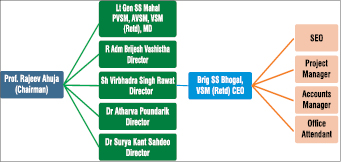
Organisation of DRIF. DRIF, IIT Ropar follows a three-tier organisational structure designed to ensure effective governance, strategic direction and professional execution. At the apex is the Chairman, providing overall institutional leadership and guidance. The Board of Directors consists of senior experienced and knowledgeable veterans from the services as well as faculty members to provide strategic oversight and direction. The Executive layer has been kept functional with a Managing Director and a CEO with minimal support staff. The structure combines academic expertise, operational defence experience and professional management, enabling DRIF to effectively bridge the requirements of the Armed Forces, Academia and the Defence industry.
DRIF’s Six Strategic Pillars. The thinking behind this structure is straightforward: The objective is not merely to develop technologies in individual laboratories but to bring different disciplines together around mission-oriented problems. An autonomous platform, for instance, may require expertise in AI, computer vision, communications, control systems, mechanical engineering, materials and cybersecurity all at once — which is precisely why a multidisciplinary research environment matters. DRIF’s work is organized around six strategic pillars, each anchored by a distinct set of institutional and industry partners:
- Research & Technology Development. This forms the core pillar, with the Indian Defence Forces, PSUs collaborating on armament systems, indigenisation and applied defence R&D and the various Departments of IIT.
- Human Capital. Connects DRIF with the HQ IDS (CENJOWS), HQ ARTRAC and the Directorate General of Resettlement and the Ministry of Home Affairs, supporting academic programmes, professional certification and resettlement training for in-service personnel.
- Defence Innovation & Start-up Ecosystem. Links DRIF to IIT Ropar’s own Technology Business Incubation Foundation (TBIF), the Indian Accelerator and the Society of Indian Defence Manufacturers (SIDM) to nurture and mentor defence start-ups from incubation through to commercialization.
- Military Infrastructure & Smart Systems. This pillar focusses on developing solutions in collaboration with the Armed Forces to imbibe next-generation habitat technologies, from precast modular shelters to new generation materials and Geothermal Energy.
- Emerging Technologies. Covers drones & counter-drone systems, Quantum Communications, AI/ML, cybersecurity, autonomous vehicles and directed-energy weapons to harness these technologies for defence applications.
- Strategic Partnerships. Formalises DRIF’s institutional relationships across the Armed Forces including IDS (CENJOWS), various government bodies and industry associations for collaborations as also certification and to bring formal accreditation to various Technical Courses conducted in various Armed Forces Institutes of repute.
Three Communities, One Triangle. If DRIF has a single organising idea which is bridge-building. The Foundation was deliberately structured so that no single stakeholder group – the Armed Forces, the Academia or private industry – has to work through the others alone. Instead, DRIF sits at the centre of a triangle, translating between three communities that usually speak different languages: the Forces express operational requirements, IIT Ropar contributes research depth and academic rigor, and industry – from public-sector giants to early-stage start-ups – supplies manufacturing scale and technological agility.
- On The Defence–Academia Edge, the bridge runs through people as much as projects. Programmes with HQ ARTRAC place serving officers into M.Tech. and PhD seats in AI/ML, structural engineering and signal processing, while faculty development and online courses move expertise in the other direction. Resettlement training run with the Directorate General of Resettlement extends the relationship to future veterans, giving retiring personnel a route into technical careers on the same campus infrastructure that trains active-duty officers.
- On the Academia-Industry Edge, DRIF leans on Industry, pairing it with the Society of Indian Defence Manufacturers (SIDM) to move ideas out of the lab and into companies that can build them at scale. Startps gain access to campus research capability, testing support and a curated network of institutional buyers, while DRIF’s defence start-up portfolio gives the ecosystem visibility.
- On The Defence-Industry Edge, DRIF has direct MoUs with the Important Government organisations, SIDM, niche startups in defence covering testing, technology transfer, indigenisation and collaborative research- the practical mechanics that let a manufacturer work against a genuine Service requirement, with IIT Ropar’s infrastructure available to validate the result before it reaches the field.
What distinguishes DRIF’s approach is that these three edges are not run as separate initiatives but as one coordinated structure – the same partners often appear across more than one pillar. HQ ARTRAC, for instance, features in both the education and strategic-partnership pillars. Such an overlap is intentional: a defence requirement identified through a Service partnership can move directly into a training programme or a start-up collaboration without leaving the DRIF ecosystem, shortening the distance between an operational need and a fielded solution.
Bridging Two Worlds. DRIF’s core function is simple: “The Armed Forces understand the operational problem, while researchers and engineers possess the scientific and technological capabilities required to address it. DRIF acts as the connective bridge between these two worlds.”
That bridge follows a defined pathway:
Operational Challenge → Problem definition → Research → Prototype → Defence mentoring → User validation → Field testing → Industry partnership → Scale-up → Deployment
From requirement to Deployment. Mentoring, in particular, is a distinctive strength of the model. “Researchers and start-ups may possess excellent technical capabilities but may not always have exposure to the operational environment in which their technologies will eventually be used.” Experienced defence personnel can fill that gap – advising on threat assessment, reliability, logistics, battlefield constraints and human factors. The role of the defence mentor is not to replace the scientist or engineer, the Foundation’s leadership explains. It is to provide operational context so that scientific capability is directed towards a solution that is relevant, robust and usable.
That same logic extends to India’s wider pool of veterans. “India possesses a substantial reservoir of military and technical expertise” — personnel with decades of institutional knowledge in operations, logistics, maintenance and training. Structuring that experience into mentorship and field validation benefits everyone:
Training at Scale. DRIF’s education arm has already moved from concept to measurable output. Certain tailor-made courses are being run in partnership with ARTRAC. We are also offering formal M.Tech. and PhD seats besides also awarding M.Tech Degrees and Diplomas to some niche Technical Courses being conducted in various Category A training establishments.
DRIF Training at a Glance. A training snapshot compiled by the Foundation shows 767 personnel trained over the last three years across four major training programme areas:-
Programme Personnel Trained Partner(s)
Drone Technology 380 Directorate General of Resettlement,
ARTRAC / Western Command
Cybersecurity 155 Directorate General of Resettlement
Industrial Management & Entrepreneurship 107 Directorate General of Resettlement & Industry
Material Science & Mission Reliability 125 Directorate General of Resettlement & Industry
A further batch of 105 persons for the Drone Technology Course and Material Science and Mission Reliability Course are scheduled beginning in Sep-Oct 2026.
From Blueprints to the Field. DRIF’s infrastructure work has already reached deployment. Among its visible outputs is precast habitat construction, exploring 3D modular habitats, multi-weather precast shelters, and lightweight structures designed to withstand snow loads – technologies aimed squarely at improving living and operational conditions for troops in adverse terrain. On the innovation side, DRIF also curates a defence start-up portfolio, showcasing companies working across AI-driven consulting, construction technology, directed-energy systems and autonomous platforms – underlining the Foundation’s role not just as a funder or convenor, but as an active platform connecting early-stage defence technology companies with institutional and military partners.
Closing the Technology Gap. One of deep tech’s oldest problems is the gap between a promising prototype and a deployable product. The challenge is described plainly: “A promising technology may require additional prototyping, testing, user validation, certification, manufacturing support and funding before it can become a viable product. The ecosystem must therefore support innovators beyond the initial idea.”
This is where DRIF’s structure earns its keep, working alongside IIT Ropar’s Technology Business Incubation Foundation (TBIF). TBIF can provide the venture-building environment while DRIF brings operational orientation and defence-domain expertise. Together, this creates a more continuous pathway from research to enterprise to deployment. Incubation, meanwhile, enables promising technologies to move beyond the laboratory through prototyping, intellectual property creation, business development, funding and market access.
Field validation is treated as non-negotiable throughout this process: A technology that performs successfully in a controlled laboratory environment may encounter very different conditions in actual deployment. Terrain, temperature, weather, electromagnetic environment, mobility, power availability, human factors, maintenance and logistics can all influence performance.
A Widening Web of Partnerships. Central to DRIF’s model is a strategy built on formal Memoranda of Understanding. Rather than a handful of headline partnerships, the Foundation has assembled a dense network spanning across Government Organisations, Defence Establishments and niche Industry houses. This breadth reflects a deliberate approach: pairing large public-sector and institutional partners, who bring scale and procurement pathways, with agile private firms and start-ups, who bring speed and specialised technical.
Industry’s role is framed as one of co-creation rather than downstream manufacturing: Industry contributes manufacturing capability, quality assurance, supply chains, systems integration, certification, scale and lifecycle support. These capabilities should be brought into the development process at an appropriate stage rather than only after the technology has been developed. As the Foundation’s leadership adds: “A technology that cannot be manufactured, maintained or scaled will ultimately have limited operational value.”
Dual-Use by Design. Both academic and defence leadership see dual-use technology as central to a sustainable ecosystem. “Many of the technologies transforming defence are simultaneously transforming civilian sectors” – AI, drones, robotics, secure communications, sensing and advanced materials all have applications well beyond the battlefield. A strong dual-use ecosystem gives start-ups a broader market opportunity, helping them achieve commercial sustainability while retaining the ability to address strategic requirements.
Beyond Self-Reliance. Where does this all lead? The ambition reaches beyond self-sufficiency: “India must aspire beyond self-reliance towards global technological leadership in selected areas. This requires excellence in fundamental research, strong intellectual property creation, advanced engineering, world-class testing infrastructure, industry partnerships and rapid translation of research into products.” India’s specific circumstances, the Foundation argues, could become a competitive edge on the world stage: “Technologies designed for India’s challenging operational environment can also become globally competitive. The combination of Indian scientific talent, defence experience, cost effectiveness and manufacturing capability can become a significant strategic advantage. “On DRIF’s long-term measure of success, the framing is precise: “The true measure of success will not be the number of projects initiated. It will be the number of technologies that move successfully from ideas to prototypes, prototypes to validated systems, and validated systems to operational capability.”
A Model for Academia-Defence Convergence. Taken together, DRIF’s management structure with its six strategic pillars, a growing MoU network, measurable training output, field-ready infrastructure projects, and a deliberate bridge-building role across defence, academia and industry — positions it as more than a research cell within IIT Ropar. It functions as a dedicated interface between a reputed technical Institute and India’s defence establishment, built to translate laboratory research and academic training into equipment, infrastructure and skilled manpower usable by the Armed Forces.
Conclusion
India’s defence innovation challenge is no longer simply one of generating ideas. It is about creating an institutional pathway through which operational problems are identified, scientific expertise mobilised, prototypes tested, users involved and successful technologies taken to scale. DRIF represents one attempt to create such a pathway. Its longer-term significance will depend not on the number of partnerships or projects it announces, but on how many technologies ultimately cross the difficult final mile from laboratory to operational capability.
