

 Login
Login
Articles
India in a World of Shifting Alliances
Sub Title : The international system is passing through a period of profound uncertainty.
Issues Details : Vol 20 Issue 4 Sep– Oct 2026
Author : Ashwani Sharma, Editor-in-Chief
Page No. : 11
Category : Geostrategy
: September 23, 2026
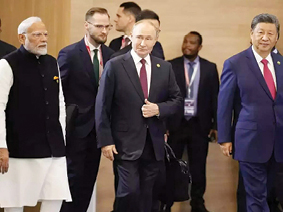
As global power equations shift, India is navigating a complex landscape of competing powers, partnerships and interests. From China and the Indo-Pacific to West Asia and the Indian Ocean, strategic autonomy is increasingly becoming strategic influence.
The great strategic contest of the 21st century is no longer a simple competition between two opposing blocs. The United States remains the world’s most powerful military and financial power, China continues to challenge American influence across the Indo-Pacific, Russia remains a major military power and an important source of energy and defence technology, while Europe is rediscovering the language of strategic power. At the same time, countries of the Global South are increasingly unwilling to accept a world in which they have to choose between competing camps.
For India, this fluidity presents both an opportunity and a formidable challenge. New Delhi has spent decades cultivating what is conventionally described as strategic autonomy. But the environment in which that autonomy operated has changed dramatically. The question today is not simply whether India can avoid choosing sides. It is whether India can use its relationships with competing powers to build sufficient national power and strategic space to pursue its own interests.
The events of the past few weeks have demonstrated this clearly. India hosted the BRICS Summit in New Delhi and participated in the SCO Summit in Bishkek. Both groupings bring together countries with sharply different interests, but both remain important platforms through which India can engage the Global South, Russia, China, West Asia and Central Asia. At the same time, India is deepening its defence relationship with the United States, maintaining its longstanding relationship with Russia, managing an intensely competitive relationship with China and building substantive partnerships with France, Japan, Australia, the Gulf states and Southeast Asia.
The recently announced RAKSHA defence-diplomacy framework adds another dimension to this approach. Its emphasis on strategic partnerships, capacity building, indigenous defence exports and India’s role as a security provider in the Indian Ocean indicates that India increasingly sees defence diplomacy as an instrument of national power, rather than merely as an adjunct to foreign policy. India, in other words, is gradually moving from being a participant in the great-power game to becoming one of the players capable of shaping it.
The Strategic Challenge from China. Of all the relationships that will determine India’s strategic trajectory, none is more consequential than that with China. The two countries have enormous economic complementarities and share membership of several multilateral institutions, but their relationship remains fundamentally competitive. The unresolved boundary question, China’s military infrastructure in Tibet, its expanding presence in the Indian Ocean, its partnership with Pakistan and the wider contest for influence across Asia all place limits on the prospects for a genuine strategic rapprochement.
The Line of Actual Control remains important, but the China challenge extends well beyond the Himalayan frontier. China is building a comprehensive strategic ecosystem around India in which infrastructure, ports, connectivity, economic relationships and political influence increasingly intersect with military strategy. Its Indian Ocean approach is not necessarily about acquiring conventional naval bases. Commercial access, logistics, connectivity and political influence can collectively create strategic options without requiring a formal overseas base.
India should therefore resist the temptation to view every Chinese infrastructure project as an embryonic military base. The more important issue is the accumulation of strategic access. This means that India’s China strategy has to be both continental and maritime. India needs the ability to deter Chinese military planning along the northern frontier while developing sufficient maritime power to influence the approaches to the Indian Ocean. At the same time, it needs to compete for influence among its neighbours—not necessarily by matching China’s financial resources, but by offering trusted security partnerships, technology, capacity building and political choice.
The objective should not be to construct an anti-China alliance in the traditional sense. India needs instead a network of relationships that makes it increasingly difficult for any external power to establish regional dominance.
Pakistan. Pakistan remains India’s most immediate military adversary, but the Pakistan problem increasingly has to be understood within the larger China-centred strategic environment. The traditional competition involving land forces, artillery and air power is being supplemented by missiles, drones, electronic warfare, information operations, space-based surveillance and precision strike.
For Islamabad, China is not merely an arms supplier. It has become its principal external strategic partner. Pakistan’s growing dependence on Chinese defence technology and industrial cooperation means that the military balance on India’s western front cannot be examined independently of the wider India-China competition.
For India, this has an important implication. A future India-Pakistan crisis will inevitably be viewed through the prism of the wider India-China relationship. India must therefore prepare for a more technologically sophisticated Pakistan, supported by Chinese systems and industrial cooperation.
India’s Natural Strategic Theatre – The Indian Ocean. If the Himalayas are where India faces its principal continental challenge, the Indian Ocean is where it possesses its greatest structural advantage. Geography places India astride the sea lanes connecting the Middle East, Africa and Europe with East and Southeast Asia, while the Andaman and Nicobar Islands provide a strategic position overlooking the approaches to the Malacca Strait. China’s dependence on maritime trade and energy imports makes the Indian Ocean increasingly important. Beijing has consequently developed relationships with countries around India’s maritime periphery. Ports and infrastructure projects in Pakistan, Sri Lanka, Bangladesh, Myanmar and elsewhere have often been discussed in the context of potential Chinese strategic access.
India should not, however, view every Chinese infrastructure project as a military base in waiting. The more important issue is the gradual accumulation of access, influence and strategic options. This is where India’s growing emphasis on maritime security and its role as a first responder becomes important. India can build influence through maritime-domain awareness, coastal surveillance, humanitarian assistance and disaster relief, search and rescue, anti-piracy operations, training and defence exports. It can give smaller Indian Ocean states alternatives to excessive dependence on any one external power.India does not need to dominate its neighbours. It needs to make itself indispensable to their security. That is a subtler and potentially more sustainable form of influence.
West Asia. India’s strategic environment can no longer be divided neatly into an eastern and western front. The wars and crises of West Asia have demonstrated how rapidly events thousands of kilometres away can affect India’s security, energy supplies, shipping, diaspora and economy.
The Gulf is particularly important. Millions of Indians live and work there, while the region remains critical to India’s energy security and trade. The Strait of Hormuz and the Red Sea are therefore not distant geopolitical abstractions. Disruption in either waterway can have immediate consequences for India. India’s relationships with Saudi Arabia, the UAE, Iran and Israel are consequently strategic assets, but they cannot be managed as a single bloc. India has deepening relations with Israel and the Gulf monarchies while simultaneously maintaining important ties with Iran. Chabahar remains significant because it provides an alternative route towards Afghanistan and Central Asia.
The recent BRICS Summit demonstrated the value of this approach. Iran and the UAE are both members of the expanded grouping, despite their different regional interests. India’s ability to engage with both reflects the wider philosophy of strategic autonomy. The lesson is important. Strategic autonomy is most valuable not when there is peace, but when one’s partners are themselves on opposite sides of a conflict.
The Indo-Pacific and the New Strategic Network. Indo-Pacific is where India’s relationships with the United States, Japan, Australia, France and ASEAN converge. The Quad has become an important component of this architecture, but India’s interests are broader than simply countering China. It seeks open sea lanes, freedom of navigation, stable supply chains, technological access and a regional balance that prevents any single power from dominating Asia.
The India-US defence relationship is strategically valuable, but it also presents a challenge. India must ensure that greater interoperability enhances Indian capability without creating technological dependence. The same principle applies to partnerships with France, Israel, Japan, Russia or any other major defence supplier. This is particularly important as defence technology becomes increasingly software-defined. Dependence on foreign platforms can become dependence on foreign ecosystems and communications networks. Strategic autonomy in the future will therefore depend as much on industrial and technological sovereignty as on diplomatic independence.
From Strategic Autonomy to Strategic Influence. The phrase “strategic autonomy” has served India well, but it may no longer adequately describe what New Delhi is attempting to achieve. The next phase should be about strategic influence. India has sufficient scale to shape its environment rather than merely respond to it. Its economy is among the world’s largest; its military is one of the world’s largest; its geography gives it extraordinary maritime significance; and its diplomatic relationships span virtually every major strategic grouping.
The opportunity is to turn these assets into a coherent national strategy. India should build overlapping networks rather than rigid alliances. With the United States and its Indo-Pacific partners, it can deepen technology, intelligence, maritime and defence-industrial cooperation. With Russia, it can preserve critical defence and energy relationships while gradually diversifying legacy dependencies. With Europe, it can build industrial and technological partnerships. With Japan and Australia, it can strengthen maritime security and resilient supply chains. With the Gulf, it can develop energy, investment and security relationships. With Iran and Central Asia, it can preserve connectivity options. With the Global South, it can use development assistance, defence exports, training and capacity building to create long-term partnerships.
And with China, it must simultaneously compete, deter and engage. This is difficult diplomacy. But it is precisely the diplomacy that India’s growing power makes possible.
The New Great Game. The great game of the 21st century will not be fought on a chessboard divided into black and white squares. It will be played across multiple overlapping networks to include military, economic, technological, maritime, diplomatic and informational. The countries that succeed will not necessarily be those with the largest armies or the biggest economies, but the ones capable of connecting their different sources of national power.
India has an unusual advantage in this contest. It does not have to choose between the West and the Global South, between Russia and America, or between continental and maritime strategies. Its challenge is to construct an architecture in which each relationship contributes to Indian power without compromising freedom of action. That requires a fundamental shift in mindset. Strategic autonomy should not mean standing apart from power blocs. It should mean having enough power, partnerships and alternatives that India cannot be compelled to join one.
The BRICS and SCO summits have demonstrated that India is already using this space. The RAKSHA framework takes the idea further by linking defence diplomacy with strategic partnerships, indigenous defence production and India’s role in the Indian Ocean. The central question for India is therefore no longer, “Whose side are we on?” It is: “How do we ensure that whichever way the world moves, India has the power to move in the direction of its own interests?” That is the essence of the New Great Game. And India has every reason to play it.
