

 Login
Login
Articles
India’s non-western outfits: BRICS and SCO
Sub Title : India’s engagement with BRICS and SCO reflects strategic autonomy amid an evolving multipolar global order.
Issues Details : Vol 20 Issue 4 Sep– Oct 2026
Author : Amb Anil Trigunayat
Page No. : 14
Category : Geostrategy
: September 23, 2026
As global power equations shift, India is seeking greater strategic space through BRICS and the SCO. This article examines New Delhi’s role in shaping these platforms, balancing divergent interests, advancing practical cooperation and positioning India as a bridge between competing centres of power.
In the ongoing global churn ignited by crass unilateralism, certain balance is essential which could be constructive rather than conflicting. From New Delhi’s strategic perspective, both the Shanghai Cooperation Organisation (SCO) and BRICS+ fulfil that requirement, as India maintains robust ties with its Western partners through strategic partnerships and functional economic mechanisms, including Free Trade Agreements (FTAs) and Comprehensive Economic Partnership Agreements (CEPAs). Economy and security are the critical requirements for any country and India is no exception.
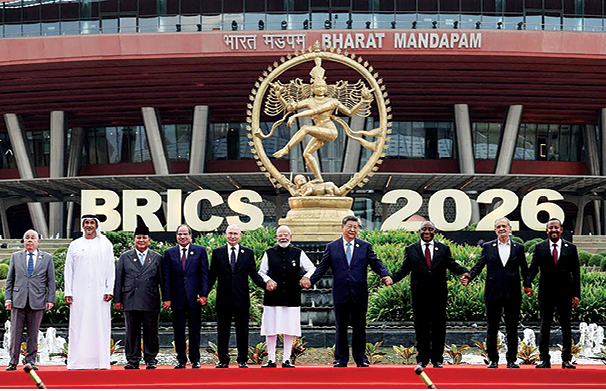
In less than a fortnight, Prime Minister Narendra Modi participated in and led the SCO Summit in Bishkek and hosted the BRICS Summit in New Delhi with credible and constructive outcomes and roadmaps for practical cooperation and relevant mechanisms. Even as both these organisations are consensus-based and driven, there are internal dynamics and divergences that are interwoven and driven by national positions and perspectives. Often, it makes the task challenging for the host country to craft an acceptable document. To do so requires strong and clear-eyed leadership and smart diplomacy. India just did that at the 18th BRICS Summit (Sept 12-13).
Growing Global Footprint of BRICS
BRICS has evolved from its five original members – Brazil, Russia, India, China and South Africa into a much broader economic and geopolitical grouping. The original BRICS economies, alongside the members Egypt, Ethiopia, Iran, the UAE and Indonesia, with Saudi Arabia being more than half, show how significant the bloc has become in terms of population and economic output. The expansion gives BRICS a much broader footprint across Asia, Africa, the Middle East, Latin America and Eurasia, bringing together some of the world’s largest emerging economies, major energy and critical minerals producers, and rapidly growing consumer markets. Representing over half of the world population and its human resource dividend, and forty per cent of global GDP, BRICS+ has already acquired the requisite geo-economic heft.
India was not only able to bring consensus to the 45-page, 140-para New Delhi BRICS Declaration, the longest ever, by bridging the divisive positions between Iran, UAE and Saudi Arabia, but also a highest-level meeting between the leaders of the UAE and Iran since the war could be arranged. This surely is a testament to the diplomatic feat that New Delhi achieved, for which significant credit goes to the personalised diplomacy of PM Modi.
Focussing on his vision and theme of BRICS as ‘Building for Resilience, Innovation, Cooperation and Sustainability’, India delivered a significant paradigm shift from ideation to practical cooperation by devising frameworks and institutionalised mechanisms to bridge the gap between promises and projections to delivery. PM added, “Pandemics, climate disasters, and supply-chain disruptions have shown that in today’s interconnected world, no crisis remains confined to a single region. Therefore, within the BRICS group, we have placed special emphasis on strengthening Resilience. It is equally important to identify challenges in time, be prepared for them, and take prompt action.” With this approach, we have agreed on a BRICS Integrated Early Warning System for the prevention of and response to infectious diseases. Early Warning Data Integration Guidelines have been prepared for disaster management. The BRICS Logistics Supply Chain Cooperation Framework will help make our supply chains more reliable and resilient.
Since seafarers have been in the line of fire, and many Indian seamen have lost their lives, while they remain critical for navigation, trade and energy supplies, PM Modi proposed setting up a Seafarers Emergency Support Network. This network could connect the maritime authorities and missions of the countries concerned. It could facilitate distress alerts, medical assistance, communication with families, and support for evacuation.
From Commitments to Implementation
The New Delhi Declaration reaffirmed BRICS’ commitment to resilience, innovation, cooperation and sustainability, while advancing a more representative and inclusive global order. The expanded grouping also strengthened cooperation across political, economic, financial, cultural and people-to-people domains, which are its essential three pillars. Speaking at the plenary, PM laid out the contours of BRICS@20 for the next two decades while specifying the priorities and clearly underscoring that ‘We are not against any one’.
BRICS has come of age and is ready to take on greater responsibility at the global stage as a rule shaper rather than just a rule taker in the past. For this, there is a need for reforms of the global institutions, including the UNSC and WTO, which cannot be allowed to be delayed any further. PM Modi also spoke of the basis of text-based negotiations for UNSC reforms, which has already been submitted. He suggested evolving a ten-point programme and converting it into a BRICS Reforms Roadmap by the next summit. This was adequately reflected in the New Delhi Declaration and was reiterated by Antonio Guterres, UNSG, who was present at the summit.
In this connection, it will be important to underscore that even though the Declaration refers to support for representation for India and Brazil by China and Russia, and that of Africa through the Ezulwini Consensus, which was a departure from earlier, perhaps due to all three African claimants, i.e. South Africa, Nigeria and Egypt, being there, I am somewhat disappointed by the anodyne support and language by China and Russia instead of clear and unqualified support to India and Brazil. The wordings give away the hesitations dictated by geopolitical considerations as BRICS focuses on enhanced and equitable Representation, Responsiveness and Rule-making role.
Since all the original BRICS countries and most others are facing and subjected to unilateral US sanctions and tariffs, and even 100 per cent more in the pipeline for importing Russian/Iranian oil, it was but natural that BRICS called out these unilateral measures without naming any country. Whether it will have any impact remains to be seen.
The USA’s arbitrary policies had triggered de-dollarisation in essence and effect. But, to avoid any direct conflict, members led by India did not approve of a BRICS currency but preferred to deal more and more in their national currencies by calibrating various mechanisms like UPI, CIPS and Russian SPFS. As such, India and China trade with Russia in their bilateral currencies for almost 90% of all transactions. A Task Force has been set up to take it forward. This is a trend which is unlikely to be arrested.
One more area of core interest for India remains the scourge of terrorism, extremism and radicalisation, manifested also in cross-border terrorism by Pakistan for the last four decades. The heinous terrorist attacks by Pak-based groups and condemnation had been highlighted at the last Rio Summit and have been reiterated with vehemence in the New Delhi Declaration, emphasising the need for abdicating hypocrisy and double standards while advocating for early adoption of CCIT, gathering dust in the United Nations. India had also headed the Counter Terrorism Working Group and had prescribed several workable recommendations.
SCO Summit
The theme of the SCO Heads of State Meeting this year was “25th anniversary of the SCO: strengthening stability, expanding cooperation for further joint development.” 27 documents were signed/adopted, including the Bishkek Declaration, Protocol to Amend the SCO Charter, MoUs (Climate, Information Sphere, and Artificial Intelligence), Protocol to amend the Agreement on Combating Crime, Regulations on Universal Center and Anti-Drug Center, Regulations on SCO ‘Partner,’ and cooperation between SCO and African Union.
Another important dimension of this SCO Summit is the 3rd edition of the SCO+ format meeting. Apart from SCO Member States, Azerbaijan, Armenia, Vietnam, Laos, Mongolia, Togo, Turkey, Egypt and Turkmenistan, along with the UN, CIS, CSTO, EEC and CICA, are expected to attend the SCO+ Meeting. The theme of the “SCO plus” meeting this year was ‘The UN as a key element of a just world order: contribution of SCO+ states to the formation of a multipolar world.’ This also provided an opportunity for several bilateral meetings, including with the Russian and Iranian Presidents, where PM Modi spoke of ending the endless wars which were creating a tremendous humanitarian crisis.
The SCO Dimension
India’s priorities at the SCO, as underscored by PM Modi himself, include and are defined by ‘SECURE’ SCO, i.e., Security; Economy and Trade; Connectivity; Unity; Respect for Sovereignty and Territorial Integrity; and Environment. (PM’s Vision; Qingdao-2018), b) Security, Connectivity, and Opportunity (PM’s Vision; Tianjin-2025), c) Fight against Terrorism, Separatism, Extremism – three evils, d) Central Asia as Core of SCO, e) Cultural, Humanitarian, People-to-People ties. In the Bishkek Summit, one can identify 10 key takeaways from PM Modi’s SCO speech:-
- Zero tolerance for terrorism & its ecosystem, calling out the Pakistanis sitting across without naming him. No double standards on state-sponsored terror
- Peace and stability in Afghanistan
- Dialogue & diplomacy to resolve conflicts
- Stronger action against drugs & organised crime
- Connectivity with respect for sovereignty
- Easier customs & digital trade documentation
- More efficient regional logistics
- Greater opportunities for youth, farmers & entrepreneurs
- Expand start-up, science, cultural & civilizational exchanges
Which eventually formed the core areas of discussions.
The Summit essentially focussed on Security, Connectivity and Opportunity — with a focus on measurable outcomes.
From Summit to Implementation
PM Modi, knowing too well the expansive and voluminous nature of recommendations by 100-plus working groups across 35 verticals through 400 meetings, and how challenging it could be to implement, suggested creation of a Troika mechanism like that of G20 to keep a focussed, action-oriented system. However, if BRICS indeed wishes to assiduously follow through its objectives and a big To-Do list effectively, it must create a BRICS Secretariat at the earliest.
Several important bilateral meetings of PM Modi with leaders like the Russian, Iranian, Egyptian, South African and Chinese Presidents and dozens of other leaders were also consequential and future-oriented, especially in a fractured world where India and BRICS are trying to present an alternative and civilizational world view bedecked by multipolarity and multilateralism. No doubt, like any multilateral or plurilateral organisation, BRICS+ has its own contradictions, but they also have India at the centre, which follows its strategic autonomy and multialignment, allowing it to be a bridge builder between North and South and East and West.
Ambassador Anil Trigunayat is a former diplomat and strategic affairs expert with extensive experience in India’s foreign policy.
