

 Login
Login
Articles
A New Trainer for the IAF? Look no further than Tejas
Sub Title : With the IAF seeking a new trainer to replace the Hawk, could Tejas offer an indigenous and timely alternative?
Issues Details : Vol 20 Issue 4 Sep– Oct 2026
Author : Dr. Amit Gupta
Page No. : 27
Category : Military Technology
: September 23, 2026
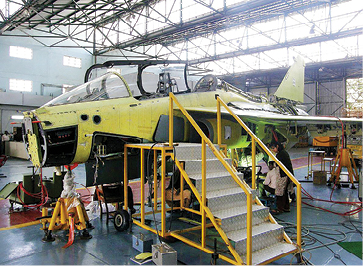
The Indian Air Force faces an urgent need to replace its ageing Hawk trainers while preparing pilots for increasingly sophisticated fifth and sixth generation combat aircraft. This article argues that, rather than pursuing another costly foreign acquisition, India should consider developing a dedicated Tejas-based trainer. Leveraging an existing airframe and production ecosystem could offer a faster, more economical and indigenously controlled solution, while also creating an effective platform for weapons training and future manned-unmanned operations.
The Indian Air Force (IAF) has put forward a Request for Information (RFI) for a new Stage III jet trainer to replace the aging Hawk. In typical Indian bureaucratic fashion, the RFI gives a lot of technological specifications and the expectation is that the Boeing T-7 Redhawk, the Korean T-50, the Italian Leonardo M-346 and the Russian Yak-130 will be contenders with a yet to developed HAL HLFT-42. Trainers are needed urgently since a new generation of combat aircraft are entering service and an aircraft is required that can help pilots learn the complexities of a modern fighter jet. The problem with acquiring a new trainer, however, is two-fold.
First, the Indian arms acquisition process moves at a glacial pace and it will be years before a contract is signed with a foreign contractor. It took fifteen years to sign the Rafale contract and that was for a fraction of the jets the IAF required. Since Balakot, in 2019, the IAF has been asking for more Rafales and even if a contract is signed expeditiously it will be the early 2030s before the first planes enter squadron service—Dassault has a backlog which will not be cleared till then. In the meantime, Pakistan and China continue to rapidly modernize their air forces.
The second problem is that HAL always promises more than it can deliver. After a long delay the first batch of Tejas have finally been delivered to the IAF but the Mk.1a is behind schedule due to engine problems and the IAF having reservations about the quality of the aircraft.
Thirdly, the foreign vendors face their own problems. The Swedish-American T-7 Redhawk has only now, after teething problems, entered low level production in the United States and the American plan is to order 14, 23, 36, and 42 aircraft over the next four years. That means, if things go according to plan, the American company will be able to supply aircraft, providing a deal is quickly reached with India, sometime in the early 2030s.
The T-50 purchase will require clearance from the United States since it has an American F-404 engine and the Koreans have found a good foreign market for the trainer and its fighter variant with countries as varied as Poland, Indonesia, and Iraq. This means that not only is there likely to be a backlog of planes that runs into the 2030s but Washington may well veto the sale as it did in the case of Argentina which wanted to purchase a version of the aircraft.
The Leonardo M-346 is a tested aircraft and has been purchased by a number of countries and Indonesia is supposed to start receiving its first planes by 2030 which again means that the IAF would see its first trainers in the early 2030s. This would defeat the purpose of the purchase.
Which leaves the Yak-130. The plane was developed with Leonardo but then the two companies decided to go their separate ways. The aircraft, however, has been sold around the world and, being Russian, there are no problems due to the logjams in producing engines. The question is, would the IAF agree to buy a Russian trainer? Given the lack of enthusiasm in IAF decision making circles for the Su-57 it is likely that the powers that be would prefer not to buy Russian.
IAF Requirements
According to the RFI the IAF is looking, “cutting-edge capabilities, including fly-by-wire control systems, glass cockpits, and “zero-zero” ejection seats capable of safely launching a pilot even at zero altitude and zero speed.”
Furthermore, “the jets must feature embedded virtual avionics, electronic warfare (EW) suites, and compatibility with India’s NavIC satellite navigation system. A key demand is the ability to link the aircraft to a 360-degree dome simulator through a Live-Virtual-Constructive setup, which allows pilots to practice beyond-visual-range missile tactics and radar operations mid-flight.” If one looks at these requirements then the IAF already has a plane in the trainer mode which fits these requirements and that is the Tejas.
It is often forgotten that the Tejas was never supposed to be a state-of-the-art fighter but a replacement for the MiG-21. The plan was to have a fleet with some high-end fighters like the Sukhoi-30, the Mirage 2000, as well as now the Rafale, and combine them with a lower-end fleet of up to 300 Tejas aircraft. This would have been a hi-lo mix where the upper end planes were used to take out the high value targets (which were well defended) and then allow the Tejas to go in bomb lesser targets.
The United States Air Force has used this hi-lo mix with some success with its upper end F-15s and the lower end F-16 Viper (although by the time the newer versions of the plane were brought into production the Viper had become and advanced aircraft rather than just a light-weight dogfighter). Even now, with a growing fleet of F-35s, there are over 800 F-16s in the American arsenal and this is a testament to their versatility as combat aircraft.
By now over 100 Tejas should have been inducted by the IAF but developmental delays, problems with the supply of engines, and the IAF’s unwillingness to accept the aircraft unless certain criteria were met, have all delayed the entry of the plane into squadron service. In the meantime, the Chinese have introduced fifth generation aircraft into service and are already testing prototypes of two sixth generation aircraft.
In the light of these developments the Indian government should be working to make the AMCA program viable and purchase a fifth-generation aircraft for the IAF. Instead, the plan is to build 180 Tejas Mk1.a and initially 120 Tejas Mk.2. Given the slow production rates at HAL—the company did not meet the eight per year schedule for the Mk.1—we are talking of a 10 to 15-year program of producing these aircraft which by the 2040s will be obsolescent compared to China’s sixth generation fighters and to Pakistan’s future induction of fifth generation J-35. What then should be done with the Tejas?
HAL would like to sell a total of 300 Tejas (Mk.1, Mk.1.a, and Mk.2) to the IAF and make a healthy profit from it but that makes littles sense for if the last Mk.2s enter squadron service by the late 2030s to early 2040s they will be obsolescent. Moreover, the AMCA is a fifth-generation aircraft which will give a greater service life and combat relevance to the IAF and, therefore, it makes sense to leap-frog the Tejas and move to the AMCA.
A Tejas Trainer
The fact is that the Indian government is pushing ahead with the manufacture of AMCA and has taken the revolutionary step of asking for bids from the private sector to be the primary contractor for the aircraft. The IAF cannot induct 180 Tejas Mk.1.a and maybe 100 Mk.2 as well as purchase the AMCA and the Rafale because its budget will not allow it. But at the same time the IAF needs a new trainer to replace the aging Hawks and to better prepare trainee pilots for fifth and sixth generation aircraft.
Nor is the Tejas in any of its versions going to be a plane that has an export market. Despite all the hype about countries like Argentina and Malaysia being interested in the Tejas, no nation has signed a deal to purchase it. In contrast, the Chinese-Pakistani JF-17 has been sold to Azerbaijan, Nigeria, and Myanmar and secured orders from Libya and Somalia. The Korean T-50 is being sold Indonesia, Iraq, Malaysia, Philippines, Poland, and Thailand making the plane an export success. Given the failure to find an export market, the Tejas should be built for the domestic market.
Also, rather than go abroad and face supply issues and an unwillingness to transfer technologies, it is better to build the Tejas at home as an attack trainer for the IAF. There are several reasons for this.
First, despite its lackluster record with the Tejas, HAL has over twenty years of experience with the manufacture of the aircraft. This means it has the production infrastructure in place, it has trained personnel, and it has design experience to make innovations to future aircraft.
Secondly, HAL has already built a two-seat trainer version of the aircraft and it can transition seamlessly into building these aircraft in larger numbers for the IAF. Thirdly, the Tejas fits all the requirements of the RFI sent out by the IAF so why waste time and money in the lengthy evaluation of foreign aircraft?
A point to remember here is that the IAF is not happy with the performance of the Tejas as a frontline combat aircraft and it was not used in Sindoor as foreign made aircraft were preferred for operations. The IAF has had concerns about the aircraft including reportedly, the ability of its AESA radar to communicate with the missiles the plane carries. In fact, the recently retired vice-chief of the IAF, Nagesh Kapoor, pointed out that the plane had not been delivered on time, lacked some of the capabilities promised, and would likely not fit into the combat environment of the 2030s and 2040s.
None of these issues are problems for a Tejas trainer since it would not have to perform these missions. Instead, its role would be to provide the next generation of pilots to the IAF and once inducted the planes could do so for the next 25-30 years.
Additionally, the plane can be useful as an attack trainer. The Tejas could be used for weapons training (which is what the IAF wants) and in the event of a war used for combat with rocket pods and bombs as the aircraft’s payload. Once the frontline aircraft had done the job of degrading the enemy’s air defenses, the Tejas could be used to inflict further damage on what were now weakly defended targets.
Such attack trainers will also be useful given the direction being taken by modern air combat. Drones are increasingly being used by Ukraine to not just carry out anti-personnel operations with small payloads but to also strike deeper with larger ordnance packages. To do so, both Russia and Ukraine, as well as other western air forces, are talking of using manned aircraft to carry drones so that they have an extended range. The Tejas trainer would be well suited for that especially if the planes are fitted with the first-person view (FPV) capability to direct the drones accurately to their targets. This would be particularly useful since it would not put the aircraft in danger of being hit by ground-based defenses.
Lastly, a Tejas trainer gives HAL a chance to redeem itself after the lengthy delays associated with the development of the aircraft. While HAL blames engine delays as Air Marshall Kapoor and others have pointed out, the aircraft company has never delivered what it has promised. Its production schedule has always been low and not matched the required delivery numbers and this meant that the first Tejas squadron was actually below the full numbers when it was set up.
HAL’s has paid the price for its poor performance by losing the primary contractor status for the AMCA and it can ill-afford another such debacle. What it needs to do, therefore, is to set a realistic delivery schedule for Tejas Trainers, get the IAF aboard by promising them an aircraft that they can live with, and scrap the HLFT since it is an unnecessary and expensive alternative to pursue in this era of costly aircraft. Building a Tejas trainer also allows for greater indigenization of the plane which has been a goal since the start of the program.
The IAF can help the process by stating what it wants on the aircraft and to get rid of those technologies that are complicated and expensive. The aircraft does not need a costly AESA radar but can do with a cheaper air to ground one and a capability monitor the flight of FPV drones. If this strategy is successfully pursued, the IAF gets a trainer in a timely manner and the country saves valuable financial resources by not importing yet another aircraft.
Dr. Amit Gupta is a Senior Fellow in the National Institute for Deterrence Studies, Fairburn, Ohio. The views in this article are personal. He may be contacted at agupta1856@yahoo.com
