

 Login
Login
Articles
Building a Sixth Generation Fighter -The European Option
Sub Title : Europe’s pathway to next-generation air dominance beyond fifth-generation capabilities.
Issues Details : Vol 20 Issue 1 Mar – Apr 2026
Author : Amit Gupta
Page No. : 42
Category : Military Technology
: March 21, 2026
India stands at a strategic crossroads; with the recent free trade agreement with the European Union opening doors for deeper defence collaboration, New Delhi has a timely opportunity to partner with one of two leading sixth-generation fighter programs- the Franco-German-Spanish Future Combat Air System (FCAS) or the British-Japanese-Italian Global Combat Air Programme (GCAP). Either choice could accelerate the Indian Air Force’s modernization amid growing two-front threats from China and Pakistan, addressing critical gaps in fifth-generation capabilities and enabling net-centric warfare integration.
With the new free trade agreement with the European Union (EU) India has the chance to collaborate with one of two consortiums for the development of a sixth generation aircraft. These consortiums are the Franco-German Future Combat Air System (FCAS) and the British-Japan-Italy Global Combat Air Programme (GCAP). Joining either program would make sense given the future needs of the Indian Air Force (IAF).
Background
To counter the two-front threat posed by China and Pakistan the IAF has been sanctioned 42 squadrons (over 800 aircraft) but the Air Force has proposed building the fleet up to 60 squadrons (which is around 1200 aircraft). This is a recognition of what will be needed in the future to counter Chinese and Pakistani modernization efforts.
Despite recognizing the two front aerial threat, little has been done to successfully tackle it. The original Rafale deal was cut from 126 aircraft to 36 planes and Chinese analysts correctly pointed out that this small a number aircraft would not make a difference along the long India-China border.
Nor has domestic production met the expectation of the Indian government or the Air Force. After forty years of development, the Tejas program has barely delivered two squadrons and the entire project is now jeopardized by General Electric’s ability to provide engines in a timely manner for the aircraft. Now there is talk of buying more Rafales but when this deal will be signed is a matter of conjecture. In the meantime, the IAF bravely soldiers on with 29 combat squadrons.
The fact is that the air balance in South Asia is becoming more problematic for India as China is boosting its force of fifth generation fighters and is flying the prototypes of sixth generation aircraft. Pakistan is getting more modern missiles and J-10 aircraft from China and it may even receive some fifth-generation J-35 fighters. The IAF must be provided with the capabilities to match these challenges and that means the acquisition of more fighter aircraft in a timely manner.
In this context, collaborating with the Europeans becomes one way to meet the requirements of the IAF. At present there are two European fighter aircraft programs and India can choose what to invest in, the GCAP or the FCAS. Both have pros and cons attached to them which have to be carefully considered by the Indian government.
FCAS
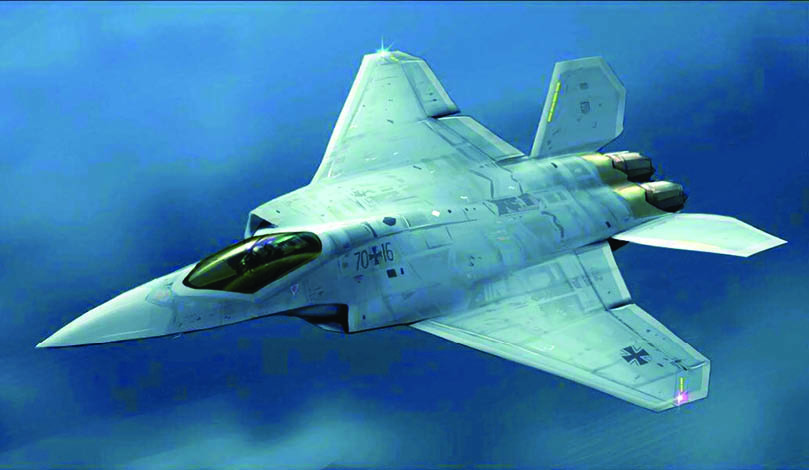
The FCAS is a French, German, and Spanish program which has three parts to it: the first is the building of a new sixth generation fighter aircraft; the second part is the construction of the cloud of systems required to link the fighter to land, sea, air, and space based assets; and the third is an autonomous drone to work with the fighter as a “loyal wingman.” For several reasons becoming a partner in this venture makes sense.
India has a long standing military relationship with the French and in all likelihood is going to purchase more Rafale fighters and a French engine will eventually power the AMCA if that program is allowed to go forward.
Technologically, India wants to build a netcentric capability that will seamlessly integrate the air, land, maritime and space domains. This will be one of the main outcomes of the FCAS project and India could work to get this capability to be compatible with the Rafale and presumably the Mirage 2000.
Further, unlike the USA, the French have never sought to impose sanctions on India when the country has waged war. Indian aircraft have always received spare parts from French manufacturers and this is a security guarantee that India cannot afford to be without since Pakistan has a guaranteed supply of parts from China.
From a nuclear perspective, France permitted India to rewire the Mirage 2000s and possibly even the Rafales to carry nuclear weaponry. This is something that the Americans, for example, would refuse on any aircraft sold to India (it should be pointed out that the Russians would also permit such a modification by the IAF).
Right now, however, the problem is that French intransigence has put the program in a state of uncertainty. The Germans claim that the French are unwilling to share the technologies and the source code with them and that Paris wants to lead the project. This is unacceptable to Berlin and for now the program’s future is being questioned.
Like all European projects, eventually, this one will be back on track when the French, Germans, and Spanish work out their differences. For India, joining the project will require the government to expeditiously negotiate what it wants to achieve from the FCAS program.
If the program does not come to fruition the French may go with an improved Rafale or seek to develop the FCAS by themselves. In either case, it makes sense for India to join the project since the country needs the capabilities that are to be developed in the three parts of the program.
The simplest path would be to properly fund the program and press for the timely completion of a prototype. Further, it would make sense that India was to be included in the development of the cloud system which connects the fighter jet with other systems. This is where India’s strengths in information technology could come into play to the project’s advantage.
The other area which India could easily collaborate is in the manufacture of the autonomous drone that the FCAS program wants to integrate with the manned fighter. The FCAS drone, while autonomous, could also be reconfigured to be used as an operator driven aircraft and given India’s requirement for more high quality unmanned aircraft this would be the way to buy into a program which not only manufactures the next generation of drones but potentially leads to the export of the aircraft. Global industry estimates are that by 2035 the international market for unmanned combat aircraft will exceed $47 billion and it makes sense for India to try and get a slice of that market.
GCAP
The GCAP program is led by Britain, Japan, and Italy and all of them are open to having other nations participate in the development of the aircraft. They are hoping Germany will join, if Berlin decides to leave the FCAS project, since this would help defray the costs of building the aircraft. Sweden is considered a potential partner while Saudi Arabia, Australia and the UAE have also sought more information on the project making it one that could rival the F-35 as a true multinational project. In comparison, the USA’s sixth generation F-47 fighter will only be restricted to the USAF and it is not clear whether China’s J-36 and J-50 are to be made available for exports.
Like the FCAS, “The new sixth-generation GCAP fighter should be able to carry a wide variety of armaments and work with any number of different “Loyal Wingman” drones, a leading official on the UK-Japanese-Italy program has said.” Thus, the plane will be as versatile as the FCAS and so far at least is witnessing fewer squabbles than the ones in the Frano-German project.
The problem with GCAP is that Japan is likely to veto the use of the jet by India to launch nuclear weapons. The Japanese slapped sanctions on India after both the 1974 and 1998 nuclear tests and lack the foreign policy imagination to make exceptions for New Delhi’s strategic requirements. For India to join the GCAP program it will need an iron clad guarantee from all members that they will not slap sanctions on India and that the IAF will be allowed to put strategic weapons on its planes. Given that the IAF would likely buy 100-200 planes to replace parts of its aging fleet, this should be a compelling argument for the GCAP to accept. So the question is, which aircraft to choose for the IAF’s next generation fighter?
First and foremost, the Indian government needs to understand that it is highly imperative to join one of these programs. Going solo on building a sixth generation fighter will be prohibitively expensive given that all advanced industrial nations—except China and the United States—are seeking partners to defray the cost of these programs.
Further, given that the Indian government has thrown open the AMCA competition to private defense manufacturers, it makes sense to skip the development of a fifth generation aircraft and, instead, invest in the manufacture of a sixth generation plane. As things stand, none of the private manufacturers have any significant experience in designing and building aircraft and it would be a brave decision to allow them to build such planes. It makes sense, therefore, to pair them with experienced foreign partners.
If, however, the government decides to go ahead with the AMCA project, it should move straight to fitting a French engine on the plane rather than first going with an American powerplant and then changing it in favor of a French one. The current plan is to use a GE engine in the Mk. 1 AMCA and then put a French one in the Mk. 2 but this will add to costs and cause delays since changing engines will require reconfiguring the aircraft. It will also mean retraining personnel for maintaining the French powerplant.
This is not as absurd as it seems since the damage done from the air in Operation Sindoor was not carried out by stealthy aircraft that crossed the international border. Both Indian and Pakistani aircraft stayed on their side of the border and relied on beyond visual range missiles to inflict damage. In the short to medium term, the military, therefore, should be seeking many more smart missiles which can be fired by the existing fleet of Su-30s, Mirages, Tejas, and Rafales.
Secondly, there must be a realistic expectation on what access India will be granted. You cannot expect full access to technology and its development unless the country is willing to put large amounts of money in to building these capabilities. It would also require the necessary scientific and technological expertise to contribute to such projects. If they are not available, the government should not penny pinch but spend on training personnel to make such a contribution.
That does not mean that the government should not attempt to get as many concessions as possible but, rather, to not waste time in useless negotiations or to allow such dialogue to grind to a halt because of unrealistic expectations of what technologies may be transferred or what they may cost. Fact is that the Rafale deal had to be cut from 126 aircraft to 36 aircraft when it became apparent that HAL lacked the trained personnel, machine tools, and infrastructure to build the aircraft. This led to the decision to not pursue the indigenous construction of the Rafale.
Thirdly, any such partnership must be viewed as the first stage in a long-term technology relationship to develop the next generation of weaponry. Thus, after the sixth-generation aircraft, the government should work with either set of partners to build other weaponry. India has had the tendency to flit between the Europeans, the Russians, and the Americans and this has led to not systematically building indigenous capabilities. But sticking to one partner means that future plans can be set and the funding for them can be efficiently allocated.
In conclusion, a partnership for a sixth-generation fighter is needed and rather than waste time in unnecessary studies the government should make a quick decision and start negotiations with prospective partners.
