

 Login
Login
Articles
Crossing Criticality: India’s Long March to Nuclear Self-Reliance
Sub Title : The article examines the recent criticality of India’s Prototype Fast Breeder Reactor (PFBR) and goes into the broader context of India’s three-stage nuclear programme
Issues Details : Vol 20 Issue 2 May – Jun 2026
Author : Dr Amit Sharma
Page No. : 45
Category : Military Technology
: June 1, 2026
On 6 April 2026, inside the Kalpakkam nuclear complex on India’s southeastern coast, a long-awaited threshold was finally crossed. India’s Prototype Fast Breeder Reactor (PFBR), a 500 MWe sodium-cooled reactor, achieved first criticality–the point at which a self-sustaining nuclear chain reaction is established. There was no spectacle to mark the moment, no immediate surge of electricity into the grid, yet it quietly signalled something far more consequential: the operational entry of India into the second stage of a nuclear programme first conceived in the 1950s.
To understand the significance of that moment, one must go back to Homi Jehangir Bhabha’s original formulation. India’s nuclear strategy was never designed for short-term output. It was built around a structural constraint–limited domestic uranium – and an opportunity – vast thorium reserves. Globally, thorium resources are estimated at roughly 6 to 6.5 million tonnes, of which India is believed to hold about 850,000 to 900,000 tonnes, accounting for approximately 25–30% of the world’s known reserves. This asymmetry–uranium scarcity but thorium abundance–drove Bhabha to propose a long-term, staged programme that would convert resource limitation into strategic advantage.
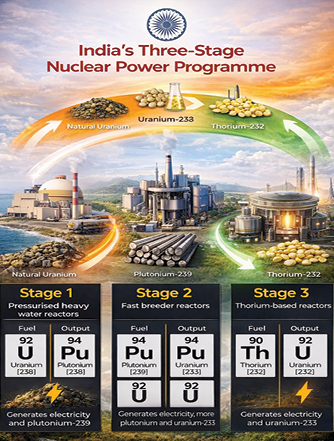
The solution was the three-stage nuclear programme. In the first stage, India deployed Pressurised Heavy Water Reactors (PHWRs), using natural uranium to generate electricity while producing plutonium-239 as a by-product. The second stage–the one India has now entered–uses this plutonium in fast breeder reactors to generate more fissile material than they consume. The third stage envisions reactors powered by uranium-233, derived from thorium-232, enabling a virtually inexhaustible domestic fuel cycle. What is remarkable is not just the scientific clarity of this design, but the political continuity behind it. Jawaharlal Nehru placed early faith in Bhabha’s vision, and despite sanctions following 1974 and 1998, regimes like the Nuclear Suppliers Group (NSG) restrictions, and discriminatory frameworks such as the Nuclear
Non-Proliferation Treaty (NPT), successive governments–from Indira Gandhi and Rajiv Gandhi to Atal Bihari Vajpayee, Manmohan Singh, and Narendra Modi–shielded and sustained the programme. The 2008 India–US Civil Nuclear Agreement (123 Agreement), uranium supply agreements with countries like Kazakhstan, Canada, and Australia, and calibrated engagement with global regimes allowed India to navigate sanctions, partial treatments, and technology denial while retaining strategic autonomy.
Stage Reactor Type Fuel Input Output Strategic Purpose
Stage I PHWR (Pressurised Natural Uranium Plutonium- 239 + Build plutonium base
Heavy Water Reactor) (U-238) Electricity
Stage II Fast Breeder Reactor Plutonium-239 + More Plutonium + Multiply fuel
(PFBR) U-238 U-233 + Electricity
Stage III Thorium-Based Reactors Thorium-232 Uranium-233 + Long-term energy
(AHWR – future) Electricity independence
For decades, however, this remained a doctrine more than a deliverable. India commissioned PHWRs steadily, but the transition to Stage II proved far more difficult than anticipated. The PFBR, whose construction began in October 2004 at Kalpakkam, Tamil Nadu, was intended to be the decisive step. Initially projected to achieve criticality by 2010–11,
it instead took more than twenty years, finally crossing the threshold in April 2026. The financial trajectory mirrors the timeline: from an original estimate of ₹3,482 crore, the cost escalated to approximately ₹8,181 crore by the time of criticality.
Behind this long journey stands an entire ecosystem of institutions and individuals, each performing a distinct but interconnected role. The Department of Atomic Energy (DAE) has functioned as the central policy and strategic anchor, ensuring continuity of vision and shielding the programme from political fluctuations. The Bhabha Atomic Research Centre (BARC) has served as the intellectual core, advancing reactor design, fuel cycle innovation, and materials science. The Indira Gandhi Centre for Atomic Research (IGCAR), particularly at Kalpakkam, has been the technological crucible where fast breeder reactor concepts were translated into engineering systems.
On the operational front, the Nuclear Power Corporation of India Limited (NPCIL) has managed reactor construction and grid integration, while Bharatiya Nabhikiya Vidyut Nigam Limited (BHAVINI) was specifically created to implement the fast breeder programme, with PFBR as its flagship.
Equally critical has been the contribution of individuals across generations. Visionaries like Homi Bhabha defined the strategic direction, Vikram Sarabhai ensured continuity, and Raja Ramanna steered the programme through sensitive phases of technological consolidation. In later decades, leaders such as Anil Kakodkar and Srikumar Banerjee advanced indigenisation, reactor development, and policy articulation. Beneath these names lies a vast workforce of engineers, reactor physicists, metallurgists, safety experts, and technicians who solved problems at the cutting edge of science and engineering.
When Homi Bhabha articulated the three-stage programme in the 1950s, the timelines he envisioned-though ambitious—were far more compressed than what eventually unfolded. The expectation was that Stage I (natural uranium-based PHWRs) would mature within two to three decades, enabling a transition to Stage II breeder reactors by the late 1970s or 1980s. Stage III, centred on thorium utilisation, was expected to follow in the subsequent decades, positioning India for long-term energy independence by the early 21st century. In reality, the trajectory stretched significantly. Stage I itself stabilised only by the 1990s, with India achieving a consistent PHWR fleet. The Fast Breeder Test Reactor (FBTR), originally planned for the 1970s, achieved criticality only in 1985. The Prototype Fast Breeder Reactor (PFBR), whose construction began in 2004 and was expected to be operational by 2010–11, reached criticality only in 2026. More than six decades after the original vision, India has only now entered Stage II in operational terms, while Stage III remains a future objective. Such delays have often been interpreted as administrative inefficiency. In reality, they reflect the inherent complexity of the technology India chose to pursue.
Yet the PFBR’s importance lies not merely in its engineering difficulty, but in what it does. Unlike conventional reactors, which consume fissile material, a fast breeder reactor is designed to produce more fissile material than it uses. The PFBR’s core, fuelled by plutonium, is surrounded by a blanket of uranium-238. When exposed to fast neutrons, this blanket material is converted into additional plutonium-239. In simple terms, the reactor multiplies fuel. It can also, in later configurations, convert thorium-232 into uranium-233, laying the groundwork for the third stage of the programme.
At the same time, the strategic implications of such reactors cannot be ignored. Plutonium-239, central to breeder reactors, is also the material used in nuclear weapons. This dual-use nature has historically driven global concerns around proliferation. India, however, has consistently maintained a doctrine of responsible nuclear stewardship, including a declared No First Use policy and strong export control mechanisms.
Globally, this places India in a narrow cohort. Fast breeder reactor technology, once pursued aggressively during the Cold War, was largely abandoned by advanced economies due to cost, safety, and complexity concerns. France’s Superphénix reactor struggled with extremely low load factors and was shut down in 1998. The United States exited the programme decades earlier. Today, Russia’s BN-800 reactor remains operational, while China is investing in similar designs. With PFBR reaching criticality in 2026, India joins this small but strategically significant group.
Despite its technological success, however, the economic question remains central-and uncomfortable. Nuclear power in India has historically struggled to compete on cost. Electricity from conventional PHWRs in India is typically estimated in the range of ₹3.5 to ₹4.5 per kWh.
Coal-based power remains in a similar band of ₹3 to ₹5 per kWh, depending on logistics and fuel linkage. Renewable energy has dramatically altered the equation: solar tariffs have fallen to ₹2 to ₹3 per kWh, with some bids dipping even lower.
In contrast, electricity from fast breeder reactors like the PFBR is expected to fall in the range of ₹6 to ₹8 per kWh, potentially higher when full lifecycle costs are considered. This makes breeder-based power significantly more expensive than renewables and costlier than conventional nuclear and coal. However, this comparison captures only short-term economics. Over a multi-decade horizon, breeder reactors extend fuel availability dramatically, reducing dependence on imported uranium and insulating the system from global price shocks. For commercial viability, India will need fleet standardisation, reduced construction timelines (from 10–12 years to 5–6 years), integrated fuel cycle efficiencies, and innovative financing mechanisms.
Alongside economics, environmental and safety considerations remain central to nuclear power’s long-term viability. Fast breeder reactors carry specific risks–sodium coolant fires, industrial accidents, and radiation hazards in case of containment failure. While India has built strong safety redundancies, including multi-layered containment systems and passive safety features, public concerns remain valid. Nuclear waste management adds another layer of complexity. Spent fuel must be cooled for decades before reprocessing, and high-level waste requires secure storage for thousands of years. India’s strategy relies on a closed fuel cycle–reprocessing spent fuel to extract usable material and reduce waste volume–but long-term geological repositories remain a future requirement. These environmental considerations are critical when comparing nuclear power with renewables, which, while intermittent, do not carry comparable long-term waste risks.
There is also a sequencing reality embedded within the three-stage programme that is often misunderstood. Thorium is frequently presented as India’s immediate energy solution. In practice, it is the final stage of a long chain. Thorium-232 is not itself fissile; it must be converted into uranium-233 within a reactor environment that requires plutonium to initiate the process. This means that India must first build a robust plutonium economy through reactors like the PFBR before thorium can be meaningfully utilised. In that sense, India is prioritising fuel security before fuel sustainability.
The timeline of the PFBR reinforces this layered dependency. From the initial projection of 2010–11, revised expectations moved through 2012, 2014, 2017, 2020, 2022, and eventually 2024, before criticality was achieved in 2026. For over a decade, the reactor existed in a state of near-completion. Each delay reflected not a single point of failure, but the cumulative effect of integrating a complex system-of-systems–reactor design, fuel fabrication, sodium handling, safety validation, and regulatory approval.
By March 2024, when fuel loading began, the project crossed a point of no return. Core loading meant that fissile material had been physically inserted into the reactor, transitioning it from a construction project to an operational system.
By 2026, with criticality achieved, the reactor had moved from engineering uncertainty to validated physics.
Looking ahead, India’s nuclear ambitions are framed by scale. With current capacity at under 10 GW, reaching 100 GW by 2047 will require adding 4–5 GW annually, far beyond historical rates. A mix of PHWRs, fast breeders, and SMRs will drive this expansion, supported by policy reforms, private participation, and technological innovation. Multiple futures remain possible–from rapid expansion to constrained growth–but the determining factor will not be technology alone, but institutional execution.
After more than two decades of construction, redesign, delay, and relentless iteration, India’s fast breeder reactor has finally gone critical–transforming a long-held doctrine into operational reality. Yet, the significance of this moment extends far beyond the 500 MWe reactor at Kalpakkam. It is not the culmination of a journey, but the crossing of a threshold. The real test now lies ahead: whether India can move from demonstrating capability to delivering scale–whether it can build not one reactor, but a system; not an achievement, but an architecture. The success of the three-stage programme will ultimately be judged not by scientific validation alone, but by its ability to translate vision into sustained, system-wide execution.
What emerges from this journey is not a story of speed, but of persistence. India has entered the second stage of its nuclear programme not through rapid breakthroughs, but through decades of continuity, resilience, and institutional endurance. In an era defined by short-term gains, this long-cycle commitment stands out. It is this endurance–across governments, institutions, and generations–that will determine whether the thorium promise finally materialises as a cornerstone of energy independence, or remains, as it has for decades, a horizon that is always visible, yet never fully reached.
