

 Login
Login
Articles
Edge Computing Market: The Burgeoning Growth Explained
Sub Title : Decentralised computing powers faster, secure, real-time military and civilian systems
Issues Details : Vol 20 Issue 1 Mar – Apr 2026
Author : By Tanjila Inamdar
Page No. : 50
Category : Military Technology
: March 21, 2026
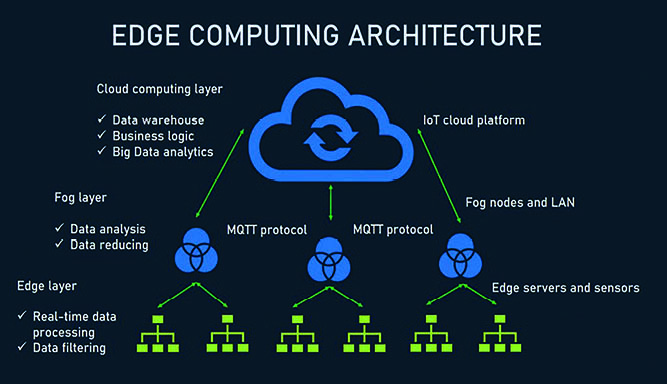
Edge computing is transforming modern industry by bringing intelligence closer to machines, enabling faster decisions, lower downtime, and smarter automation. As manufacturing embraces real-time data and AI-driven systems, the edge is emerging as a decisive factor shaping productivity, competitiveness, and future industrial growth.
Meta Description: With strong government support, proven real-time applications, and a steady rise in automation demands, the industrial edge market offers something rare in tech. Let’s explore how edge computing is sculpting the modern manufacturing industries.
The heartbeat of modern industry is no longer just machines; it’s data. On shop floors once ruled by manual control and long decision loops, edge computing is now quietly taking charge. It’s like giving every machine a local brain, and that’s unlocking a whole new level of performance. The global edge computing market is projected to hit USD 547.16 billion by 2035, according to Research Nester, and IoT adoption is also increasing. In this scenario, shifting from cloud-based to edge-based is not one of the options; it’s the only option remaining.
Edge computing is not just a trend to follow for the investors and industry leaders; it’s actually the key to increasing efficiency and creating a stronger domain. However, factories are cutting more than 30% to 50% of their downtime by using edge computing. The question isn’t whether to adopt edge-enabled IoT, it’s how fast it can be incorporated before competitors pull ahead.
Real-Time Decisions, Zero Delays: How Edge Computing is Reshaping Industrial IoT
Backed by rising automation budgets, global government support, and increased safety standards, the edge in IIoT is becoming one of the more grounded and low-risk tech sectors out there. So, while the tech world often chases what’s shiny, smart investors are starting to look closer at what’s solid. And in the industrial world, that solid bet might just be sitting right at the edge.
With Edge Computing, Latency is No Longer an Issue
For years, cloud-based IIoT faced the biggest flaw: lag. Edge brings computation on‑premise, slashing latency down to single‑digit milliseconds. Take Tesla’s Gigafactories, where edge nodes enable real-time quality checks, cutting defect rates by 30%. Or PepsiCo, using edge AI to monitor fryer temperatures instantly, preventing batch failures. Let’s check out how different industries are using edge to increase efficiency by avoiding lag.
Automotive Industry: Tata Communications’ launch of its CloudLyte platform in May 2024 can be taken as an example here. It offers edge infrastructure and managed services tailored for manufacturing and the auto sectors. A recent report highlights how edge computing, combined with 5G, will unlock up to USD 500 billion in value from connected-car use cases by 2030. From autonomous emergency braking to smart traffic management, the edge is becoming essential for real-time safety and performance. The report also notes that edge workloads will grow from 5% to 30% of total automotive computing by the end of the decade.
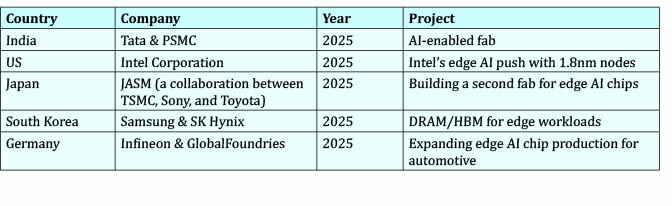
Semiconductor Industry: In semiconductor fabs, edge nodes detect anomalies in milliseconds, preventing costly downtime. What’s new happening in the industry using edge computing? Let’s discover!
With global edge investments crossing USD 176 billion in 2022, the market is heating up, and latency is no longer the bottleneck.
Manufacturers Are Investing in Big Numbers: And It’s Just the Start
Factories are betting high on edge computing. In 2024, global edge investments reached around USD 232 billion, whereas the experts predicted the rise to nearly USD 261 billion in 2025. TSMC, a semiconductor giant, has allotted almost 15% of its digital transformation budget to edge-enabled predictive maintenance. Why? Because this can cut down its unplanned downtime by more than 40%.
Further, recently, a survey was done on Smart Manufacturing. According to that report, more than 78% of global manufacturers allocate 20% of their improvement budgets to edge-enabled systems. From predictive maintenance in auto plants to real-time quality control in food processing, edge is driving agility. India’s ₹10,300 crore IndiaAI Mission is fueling edge-ready infrastructure. Investors are watching CAPEX trends rise, and with approximately 85% of execs expecting continued growth, the edge market’s just warming up.
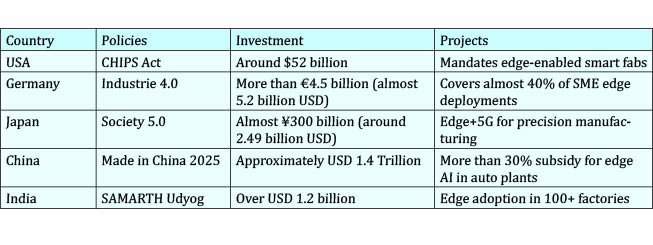
Industrial Automation: Government Take on Smart Manufacturing
Hefty investments by governments across the world to strengthen edge-driven IIoT, a lower-risk domain for long-term investors, demonstrate the importance of edge. Subsidies and cluster-based support help MSMEs integrate automation affordably. Large industrial nodes are being developed with plug-and-play infrastructure. Here’s what the top countries are doing to participate in this revolution;
With more than 70% of automation incentives now requiring IIoT integration, these policies are actually the roadmap to success. For manufacturers and tech providers, keeping up with government policies means exploring risk-mitigated growth.
Summing Up
Edge computing isn’t just solving yesterday’s latency and security headaches; it’s unlocking tomorrow’s smart factories, autonomous supply chains, and self-optimizing production lines. With strong government support, proven real-time applications, and a steady rise in automation demands, the industrial edge market offers something rare in tech. It gives a high-growth space backed by real utility and stability. For those looking at where future-proof investments still exist in tech, this edge seems both sharp and secure.
Report Link –https://www.researchnester.com/reports/global-edge-computing-market/1945
