

 Login
Login
Articles
Hybrid Electric Drives: Shaping Survivability of Combat Platforms
Sub Title : Hybrid power trains reduce the electronic and thermal signature, thus increasing survivability of the platforms
Issues Details : Vol 20 Issue 2 May – Jun 2026
Author : Lt Gen NB Singh, PVSM, AVSM, VSM
Page No. : 40
Category : Military Technology
: June 1, 2026
Background
The impact of drone technology on the survivability of tanks and Infantry Combat Vehicles (ICVs) is currently the most disruptive shift in land warfare since the introduction of the tank itself. The battlefield has become “transparent,” making traditional massed armoured manoeuvres extremely hazardous. The primary threat is no longer just the “golden shot” from another tank, but the constant presence of low-cost, high-precision threats from above, that has eliminated the “fog of war” for armoured columns. Vehicles are often detected 10–20 km before reaching the front line, allowing for pre-emptive strikes. Data up to 2025 from major conflicts has indicated that up to 65% to 75% tank losses were attributable to drones. Drones specifically target the thin skin of combat platforms like turret top, engine deck and the rear besides hitting tracks to first immobilise and then deliver the kill shot. Furthermore, the energy crisis caused by the Iran war also points towards the impelling need for the military to explore alternate sources of energy.
The survivability for combat platforms has shifted from “armour thickness” to “multi-layered denial.”
AI-Driven Evasive Manoeuvring is being tested in some nations as the human reaction time (approx. 0.5–1.0 seconds) is often too slow to dodge an FPV drone moving at 150 km/h. Some developments being considered are :-
Torque-Vectoring Powertrains. Next-gen IFVs are utilizing electric drive or advanced hybrid-electric Drives(HED). These allow for instantaneous peak torque to individual wheels or tracks, enabling a heavy vehicle to “jerk” or pivot much faster than a traditional diesel engine could accelerate from an idle state. HED technology is already challenging ICE based vehicles as a cleaner alternative to fossil fuels. The US Army has set a goal for a full electric tactical vehicle (ETV) by 2050. Rolls Royce Power Systems and ZF have been commissioned to develop a hybrid electric propulsion system for European Main Ground Combat System (MGCS).
Automated Evasion Prompts. New fire-control systems (like those being tested for the M1E3 Abrams) integrate 360° sensors with the driver’s interface. If a drone is detected on a terminal high-speed path, the system provides a “visual cue” or haptic feedback (vibrating the steering yoke) to prompt an immediate, optimal evasive turn or sudden braking.
Tactical Advantages of ETVs
The environmental advantages and cost savings of zero emission vehicles such as better fuel economy, lower O&S costs and reduced emissions are well known and make a strong case for all non-tactical GS vehicles, staff cars, buses, etc to go hybrid or fully electric as soon as possibleAs the Indian military aspires to go hi tech, power requirements at the edge will rise and HEDs/BEDs can address these. In the drone-saturated landscape of 2026, the shift toward Electric Tactical Vehicles (ETVs) and Hybrid Electric Drives (HED) is not just an environmental choice- it is a critical tactical evolution. Here are some specific tactical advantages :
The “Silent Watch” (Electronic Survival).Traditional diesel engines must idle to provide power to the vehicle’s electronics (radios, jammers, APS, and optics). This creates a loud acoustic and high thermal signature that drones can easily spot from kilometres away.
Engine-Off Operation. HED systems allow engine off operations – a tank or IFV can run all mission systems – including high-draw AI processors and active protection radars – solely on battery power for 6 to 12+ hours. It also facilitates signature erasure i.e. without an idling engine, the vehicle becomes “thermally cold” and “acoustically dead,” making it nearly invisible to the infrared (IR) and acoustic sensors used by loitering munitions.
“Escape Boost” & Instant Torque. Internal combustion engines have a “lag” as they rev up to provide peak torque. In a drone environment, the difference between a hit and a miss is measured in milliseconds.
Instantaneous Acceleration. Electric motors accelerate instantaneously by providing 100% of their torque at near zero RPM. If an incoming FPV drone is detected, an HED-equipped vehicle can “jerk” forward or backward instantly, moving the hull out of the drone’s terminal flight path. Systems like those on the XM30 allow what is called Sprint mode.
Energy for Non Kinetic Weapons. Drones are cheap; missiles are expensive. To fix this “cost-exchange” problem, 2026-era platforms are moving toward Directed Energy Weapons like high-powered lasers and high-power microwave emitters. A hybrid drive acts as a massive power source with an onboard generator (often producing 100kW+ of exportable power).
Logistics & Resilience. In a drone-saturated zone, fuel convoys are “easy kills.” Reducing the “logistics tail” improves the survivability of the entire unit. Hybrid drives can improve fuel efficiency by 20% to 35% thus allowing extended operating range. This allows combat platforms to stay “forward” for days without needing refuelling. For the final 2–5 kilometres of an approach, a hybrid vehicle can switch to All-Electric Mode and enable silent manoeuvring. A comparative analysis of diesel and HEDs is given below:-
Comparison: Diesel vs. Hybrid Electric
(Tactical View)
Feature Standard Diesel Hybrid Electric (2026)
Acoustic Signature Constant “Drone” Silent (Electric) / Low (Hybrid)
Thermal Signature High (Exhaust/Engine Block) Low (Battery-only “Cold” mode)
Reaction Time Engine Lag (1-3 seconds) Instant Torque (0 seconds)
Onboard Power Limited (Alternator-based) High (Battery/Generator-based)
Logistics Frequent Resupply Needed Extended “Lurk” & Sprints
XM30 Mechanised Infantry Combat Vehicle (MICV)
The XM 30 MICV, the successor to the M2 Bradley – is intended to be a “digital-first” platform specifically engineered to survive the drone-heavy battlefields of the future. Its “plug-and-play” digital spine allows the vehicle to act as a high-speed computer on tracks, processing sensor data and executing tactical missions with only a two-person crew. Its hybrid-electric drive is not just a feature; it enables performance of high-risk “reconnaissance by fire” and stealth scouting to enhance survivability. It offers a number of operational advantages on the battlefield :-
High-Risk Scouting (The “Ghost” Mode). The “Optionally Manned” designation means the XM30 can be operated by a crew of two (driver and commander) or entirely autonomously. In high-threat areas (like an FPV drone “kill box”), the crew can dismount and control the vehicle from a protected position up to several kilometres away. The XM30 then acts as a robotic point man, moving ahead of the manned formation to trigger enemy drone strikes or reveal hidden ATGM positions. By manoeuvring autonomously, XM30 troops can carry out tactical baiting of the enemy to reveal their “drone nests.”
Silent Watch & Thermal Stealth. The HED is the “cloak” that allows the optionally manned features to be effective. While performing scouting missions, the XM30 can sit in a treeline for 6–10 hours in silent watch mode as a Cold Sentry. It draws power from its high-capacity batteries to run its 3rd-Gen FLIR sensors and AI-driven drone detection systems without ever starting its main engine. Traditional diesel engines can be heard by acoustic drone sensors from over a kilometres away.
Powering the “Drone Devourer”. The XM30 is designed to “devour” drones using its 50mm XM913 autocannon, but this requires massive electrical power. The 50mm cannon uses programmable airburst munitions to shred drone swarms. The high-speed tracking radars and the electronic fusing required for these shells are powered by the HED’s massive onboard generator. The hybrid drive provides enough exportable power to eventually mount directed-energy weapons to melt FPV drones.
Reduced Crew, Increased Awareness. The transition from a 3-man Bradley crew to a 2-man XM30 crew is made possible by AI. Employing an AI Co- Pilot, when the vehicle is in its optionally manned/autonomous mode, an AI-assisted fire control system scans for 360° drone threats. It “filters” the environment, only alerting the remote operators to high-probability threats. The XM30 is designed to act as a command node and control its own sub-drones.
Future Armoured Platforms in the Indian Context.
In our context, given the operational imperatives of deploying combat platforms at the LAC and the repeated realization that foreign systems are not able to meet the operability and reliability requirements of operating in terrain and weather conditions prevalent in the Himalayas, it is important that a local initiative to build bespoke platforms for the Army is launched. GCVs have to operate in extreme conditions (rough terrain, sand, snow, heavy loading, high-speed manoeuvres) that conventional drive trains will not be able to account for. Multi domain operations prioritizes resilience and speed often accepting higher costs for greater survivability. This requires a complete re-engineering of new platforms centred around survivability; aiming to achieve capability overmatch. The primary systems of any futuristic combat platform would ideally comprise:-
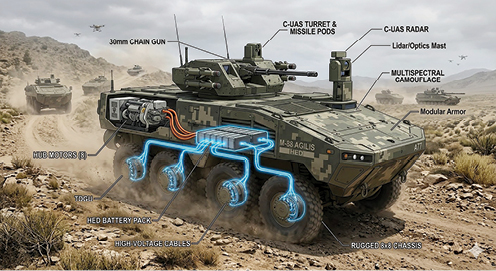
Mobility System-Hybrid-Electric Drive (HED).With the intent of improving overall fleet survivability, combat platforms should be capable of extensive off-road mobility. Recent experience in Ukraine shows that traveling on roads increases the likelihood of being hit. The severe loss of mobility in high altitudes that afflicts most platforms is well known. The answer lies in giving a de novo look to this vital vulnerability. The “heart” of combat platforms could be a HED, which replaces the traditional ICE based propulsion system. The power source could be a diesel engine coupled with a high-output integrated starter-generator. Energy storage could be provided by a high-capacity lithium-ion battery pack that enables Silent Watch as well as Silent Mobility. A hydro pneumatic suspension coupled with high speed reverse would allow the platforms to adopt the dash and cover method and back out of a drone trap.
Survivability & Protection System. Integrated Protection Suite. A tank`s survivability now depends majorly on its Electronic Warfare (EW) suite and Active Protection Systems (APS) rather than just the thickness of its steel. Using the concept of the survivability onion, platform survivability can be increased manifold employing an Integrated Protection Suite (IPS) that combines passive armour with electronic warfare systems. It would comprise:
- APS. Hard-kill interceptors designed to shoot down incoming ATGMs and loitering munitions.
- Passive Armor. A modular, “kitted” armour suite (applique armour) that can be swapped in the field to match the threat level.
- EW Subsystem. Integrated jammers that create a localized “frequency denial” bubble around the vehicle to stymie FPV drones.
- Signature Management. Multispectral camouflage panels that reduce the vehicle’s visibility to infrared and radar-equipped drones.
- Battery Pack. Making the battery pack a part of the protection system is an idea worth exploring.
Lethality System- The “Air-Dominance” Suite. The primary mission of future combat is to provide operational overmatch against both ground armour and aerial drone swarms. The main armament thus should be extremely reliable, prevent jams and incorporate dual feed mechanism to switch from armour piercing to airburst ammunition. The secondary armament could be an anti tank missile or small suicide drones. It is time the Army considers anti tank missile as a tradeable option depending on mission and terrain considerations. It would significantly impact cost and complexity of the platform; such gold plating is best avoided. Instead, it needs to focus more on precision targeting using FLIR and AI target detection and recognition systems.
Digital Architecture. Future combat platforms need to be built from the ground up on a Modular Open Systems Architecture employing a common data bus that allows all electronics (radios, sensors, weapons) to share information instantly. An autonomous navigation suite that allows the vehicle to drive itself along pre-mapped routes is desirable. A Robotic Command & Control (C2) system would allow crew to control UGVs or tethered drones directly from their touchscreens.
Crew & Dismount Compartment. The crew has to be housed using the citadel concept, sitting in a reinforced “cockpit” or recovery “capsule” in the hull rather than the turret, increasing survivability if the turret is struck.
The Road Ahead
Electrification of vehicles appears to be the future for both military and civilian vehicles as it can help tame the climate crisis. While many may argue that military vehicles may not be impacted by the imperatives of climate change in view of the smaller numbers involved, it is now emerging that with the heavy attrition of men and metal that is being demonstrated in present day conflicts, EVs may in fact drive innovation to create the operational overmatch needed against superior adversaries. If imported platforms continue to remain the preferred option, we will always end up operating with a capability deficit, obsolescent sub-systems developed elsewhere, touted as indigenous finding their way into the inventory. Instead what may be desirable is to upgrade vintage systems to address emerging risks and set our gunsights on incubating an indigenous next generation tactical combat vehicle eco system that guarantees operational overreach and strategic assurance through supply chain resilience and technology security. It can`t resemble the present day indigenous drone eco system where a brutal reality check reveals shallow foundations. Barring the structure (air frame), the brain (AI chips), muscles (magnets, motors), heart (battery cells), eyes (sensors), nerves (communications) have huge import dependencies.
The manifold operational advantages that EV/HEDs offer in addressing emerging threats of drones and unmanned systems on the battlefield, makes a compelling case for development of low emission electric vehicles for the military. Battery powered vehicles can replace 3x towed generators which is a win-win from both operations and logistics point of view. The Army may consider the following:-
– A commitment to lead by example in the country`s effort to Go Green.
– Look at deploying a tactical hybrid drive electric vehicle by 2035.
– Strive for an all electric non tactical fleet in two decades say by 2040.
– Go for fully electric tactical vehicles by 2047-2060.
A pilot project to develop a 400 hp HED for an ICV may be taken up by the Army to facilitate indigenous development of HED and associated sub systems like electric motor, generator, vehicle control unit, battery pack with BMS, inverter, controllers, final drives, etc. Once successful, the technology could be used to upgrade a fleet of 500 odd BMPs during overhaul. It will finally resolve the crucial issue of severe degradation of mobility of combat vehicles in high altitudes; an operationa vulnerability that has come to stay since the 1962 operations at Rezang La. Being modular, HED technology offers the unique advantage of rapid scaling up to 800, 1200 or 1600 hp systems to power next generation combat vehicles as well as civilian applications like buses, trucks, earth moving and mining equipment.
While the present strategy may not include MBTs being too heavy to be on full battery power, HED is still an option for better trafficability and survivability.
Lt Gen (Dr) N B Singh, PVSM, AVSM, VSM, ADC (retd) is a former DGEME, DGIS and Member Armed Forces Tribunal.
