

 Login
Login
Articles
India and the Iran War
Sub Title : Securing Energy Lifelines in a Missile-Dominated Gulf
Issues Details : Vol 20 Issue 1 Mar – Apr 2026
Author : Ashwani Sharma, Editor-in-Chief
Page No. : 23
Category : Geostrategy
: March 21, 2026
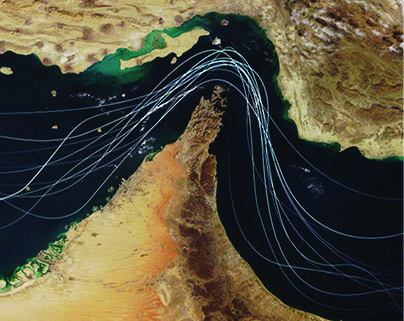
The Persian Gulf may be geographically distant, but its stability is critical to India’s economic and energy security. That reality makes the Indian Ocean and the Gulf a single interconnected strategic theatre for India.
For India, the ongoing conflict involving Iran, Israel, and the United States is not merely a distant geopolitical event. It strikes at the heart of India’s strategic vulnerability- its dependence on Gulf energy and the security of the sea lanes that sustain its economy. At the centre of this challenge lies the Strait of Hormuz, the narrow maritime corridor through which a substantial portion of India’s crude oil imports pass. India imports more than 80 percent of its crude oil requirements, and a large share of that supply originates in the Gulf region. Any disruption to tanker traffic in the Strait of Hormuz therefore has immediate implications for India’s energy security, inflation levels, and economic stability.
The Iran war has already demonstrated how vulnerable this maritime artery can be. Iranian naval forces and affiliated groups possess the capability to disrupt shipping through a combination of sea mines, anti-ship missiles, drones, and fast-attack craft. These asymmetric maritime tactics are designed not necessarily to defeat large naval forces but to raise insurance costs, deter commercial shipping, and create uncertainty in global energy markets.
For India, the implications are both economic and military. Rising oil prices directly affect India’s trade balance and domestic fuel costs. At the same time, disruptions to shipping routes place new pressure on the Indian Navy to ensure the safety of sea lanes stretching from the Arabian Sea to the Gulf. Over the past decade, India has quietly strengthened its ability to operate in this region. Anti-piracy patrols in the Gulf of Aden and regular deployments in the Arabian Sea have already given the Indian Navy valuable experience in maritime security operations. The current crisis, however, raises the prospect of more demanding missions such as convoy escorts for merchant shipping, maritime surveillance, and protection of Indian-flagged tankers.
Another important dimension of the conflict is the vulnerability of Indian citizens and commercial interests in the Gulf. Millions of Indian nationals live and work across the region, particularly in countries such as the United Arab Emirates, Saudi Arabia, and Qatar. Any major regional escalation could require large-scale evacuation operations similar to those undertaken during previous crises in West Asia. Strategically, the Iran war also reinforces the importance of India’s long-term investments in diversified energy supply, strategic petroleum reserves, and maritime domain awareness. India has already begun building emergency oil reserves and expanding energy partnerships with multiple suppliers, but the current conflict underscores the urgency of these efforts.
At a broader level, the crisis highlights a fundamental truth of modern geopolitics which is – energy security and maritime security are inseparable. For a country like India, whose economic growth depends on uninterrupted energy imports, the safety of distant sea lanes is not an abstract strategic concern but a core national interest.
The Iran war may ultimately end through diplomatic negotiation or military exhaustion. Yet the lessons it offers for India will endure. The conflict is a reminder that in a world where missiles, drones, and naval mines can threaten global shipping routes, the protection of maritime lifelines must remain a central pillar of India’s national security strategy.
