

 Login
Login
Articles
India’s Quantum-AI-Cyber Defence Triad
Sub Title : Integrating quantum, AI, and cyber for next-generation national security.
Issues Details : Vol 20 Issue 1 Mar – Apr 2026
Author : Lt Col Manish Kokel, (Retd)
Page No. : 53
Category : Military Affairs
: March 21, 2026
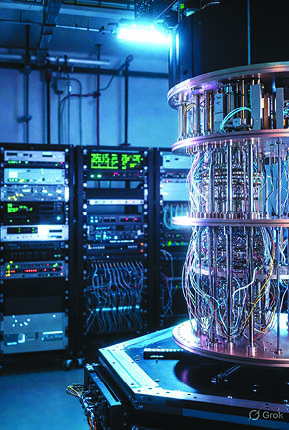
India’s National Quantum Mission marks a pivotal step in building indigenous capabilities to counter emerging threats from quantum computing, AI-driven cyber operations, and evolving warfare. This article introduces the Quantum–AI–Cyber Defence Triad, an integrated strategic framework to enhance India’s quantum preparedness, AI-enabled cyber defence, and operational resilience amid global technological competition.
The convergence of quantum computing, artificial intelligence (AI) and cyber warfare is reshaping the foundations of military power and national security. Quantum computing threatens to undermine existing cryptographic systems, while AI accelerates the speed and sophistication of cyber operations. Recognising the strategic implications of these technologies, India has launched the National Quantum Mission (NQM) to develop indigenous quantum capabilities.
The ensuing article proposes the concept of a Quantum–AI–Cyber Defence Triad as a strategic framework for integrating quantum preparedness, AI-enabled cyber defence and operational cyber resilience. By assessing India’s preparedness and comparing global approaches, the study highlights critical doctrinal, institutional and technological gaps.
Emerging Technologies and the Transformation of Warfare
The character of warfare in the twenty-first century is increasingly shaped by information dominance and technological superiority. While kinetic capabilities remain essential, modern militaries operate in an environment where cyberspace, artificial intelligence and emerging technologies are decisive elements of power. Cyberspace has effectively become a fifth operational domain alongside land, sea, air and space. Within this evolving strategic landscape, quantum computing represents a potentially disruptive technological leap. Unlike incremental improvements in computing power, quantum technologies may fundamentally alter the balance between cyber offence and defence.
Quantum computing derives its capability from the principles of superposition and entanglement, enabling it to solve certain mathematical problems exponentially faster than classical computers. This capability threatens widely used public-key cryptographic systems that secure military communications, satellite networks and sensitive government data.
Artificial intelligence further intensifies this transformation. AI-driven cyber systems can analyse massive datasets, identify vulnerabilities and conduct automated cyber operations at unprecedented speed. When combined with quantum-enabled cryptanalysis, the result could be cyber attacks that are faster, more scalable and harder to defend against. This technological convergence has strategic implications. Decision-making timelines during crises may compress dramatically, increasing the risk of miscalculation and escalation. As a result, cybersecurity must be viewed not merely as a technical function but as a core strategic capability within national defence planning.
India’s Strategic Context
India’s rise as a major power has been accompanied by increasing dependence on networked military systems, digital infrastructure and space-based assets. Secure communications, satellite links and digital command networks form the backbone of modern military operations.
However, much of India’s existing infrastructure still relies on classical cryptographic systems that were designed long before quantum threats were anticipated. The long service life of military platforms means vulnerabilities embedded today may persist for decades.
At the same time, India faces technologically capable adversaries that are investing heavily in emerging technologies. China has prioritised quantum technologies within its military–civil fusion strategy, while the United States and its allies are accelerating research into post-quantum cryptography and AI-enabled defence systems.
In this environment, dependence on external technology in areas such as cryptography and cyber defence presents serious risks. To address this challenge, the Government of India launched the National Quantum Mission (NQM), aimed at advancing quantum computing, communication, sensing and materials research. While the mission represents a significant step toward technological self-reliance, its integration with defence planning remains limited.
The Quantum–AI–Cyber Defence Triad
To address emerging threats, this study proposes the concept of a Quantum–AI–Cyber Defence Triad as an integrated framework for national cyber defence. The triad consists of three mutually reinforcing components:-
Quantum Preparedness. This includes the adoption of post-quantum cryptography (PQC) and the development of quantum-secure communication systems. These technologies aim to protect military communications and critical infrastructure against future quantum-enabled attacks.
AI-Enabled Cyber Defence. Artificial intelligence can significantly enhance cyber defence by enabling automated threat detection, anomaly analysis and rapid response mechanisms. AI-driven systems can monitor complex networks and identify malicious activity in real time.
Cyber Operational Resilience. Cyber resilience refers to the ability of military systems to continue functioning under sustained cyber pressure. This requires robust command-and-control architectures, redundancy and rapid recovery capabilities.
The central argument of the triad framework is that these three components must develop together. Over-investment in one domain while neglecting others may create vulnerabilities. For example, advanced AI-driven cyber defence cannot compensate for weak cryptographic systems vulnerable to quantum attacks.
Post-Quantum Cryptography and Military Vulnerabilities
Modern military systems depend heavily on cryptography. Secure encryption protects command networks, satellite communications, intelligence dissemination and digital authentication processes.
Quantum computing threatens this foundation. Once sufficiently powerful quantum computers emerge, they could break widely used cryptographic algorithms, allowing adversaries to decrypt sensitive communications or impersonate trusted entities.
A particularly serious concern is the strategy known as “harvest now, decrypt later.” Adversaries may collect encrypted data today with the intention of decrypting it once quantum computers become available. This poses long-term risks to national security, as classified information could be exposed years after it was transmitted.
Critical military systems that could be affected include:
- Command-and-Control networks
- Satellite communications (SATCOM)
- Intelligence systems
- Weapon platform digital architectures
Transitioning to post-quantum cryptography is therefore essential. PQC algorithms are designed to resist quantum attacks and can often be implemented on existing digital infrastructure. However, migrating military systems to PQC requires extensive planni, testing and coordination.
In India’s case, the absence of a comprehensive defence-led PQC migration roadmap represents a significant vulnerability.
Global Approaches to the Quantum-AI-Cyber Nexus
A comparative analysis of global approaches reveals several strategic patterns.
United States. The United States has adopted a defence-led integration model. The Department of Defense is actively planning for post-quantum cryptographic transition and integrating AI into cyber defence operations. Early preparation and strong institutional coordination are central features of the US approach.
China. China emphasises military–civil fusion, integrating civilian research with national security objectives. Large-scale investments in quantum communication infrastructure have positioned China as a global leader in secure communications.
NATO and the European Union. NATO and EU strategies emphasise collective resilience and standardisation. Member states coordinate their efforts to develop common cryptographic standards and strengthen cyber defence across allied networks.
Implications for India. India’s current approach under the National Quantum Mission remains primarily civilian research-driven, with relatively limited defence integration. While this approach strengthens long-term research capacity, it risks slowing the transition from innovation to operational capability.
Strategic Gaps in India’s Defence Ecosystem
Despite significant progress in emerging technologies, several structural challenges remain.
- Doctrinal Gaps. India currently lacks a clearly articulated military doctrine addressing quantum-enabled cyber threats. Existing cyber doctrines focus primarily on traditional cybersecurity rather than the disruptive implications of quantum computing and AI convergence.
- Institutional Fragmentation. Quantum and cyber initiatives are spread across multiple ministries, research institutions and defence organisations. This fragmentation complicates coordination and slows implementation.
- Legacy Systems. Many military platforms were designed decades ago and rely on outdated cryptographic architectures. Upgrading these systems to post-quantum standards is technically complex and resource-intensive.
- Human Capital. India faces shortages of specialists with expertise spanning quantum science, artificial intelligence and military cyber operations.
- Acquisition Constraints. Traditional defence procurement processes are not well suited to rapidly evolving technologies such as AI and quantum computing.
Policy Recommendations
To operationalise the Quantum–AI–Cyber Defence Triad, several policy measures are considered as necessary.
Develop a National Level Defence-Centric Strategic Doctrine. India should articulate a National Level Defence-Centric Strategic Doctrine explicitly addressing quantum threats, AI-enabled cyber operations and cyber resilience. This would provide a conceptual framework for capability development.
Establish a Defence Quantum Coordination Mechanism. A dedicated institutional body should coordinate quantum-related research, defence requirements and technological implementation.
Integrate AI into Cyber Defence Operations. AI-driven tools should be deployed within military cyber units to enhance threat detection, situational awareness and response speed.
Strengthen Human Capital. Professional military education should incorporate emerging technology awareness, while specialised career tracks for cyber and quantum experts should be established.
Conclusion
The convergence of quantum computing, artificial intelligence and cyber warfare represents a profound shift in the nature of military power. These technologies are not isolated innovations but interconnected forces shaping the future strategic environment. India’s National Quantum Mission provides an important technological foundation. However, technological progress alone is insufficient. Effective defence preparedness requires integration of technology with doctrine, institutions and operational planning.
The Quantum–AI–Cyber Defence Triad offers a strategic framework for achieving this integration. By combining quantum preparedness, AI-enabled cyber defence and operational resilience, India can safeguard its command-and-control systems, strengthen cyber deterrence and maintain strategic autonomy.
