

 Login
Login
Articles
Interview : Prof Rajeev Ahuja, Director, IIT, Ropar
Sub Title : A conversation on IIT Ropar’s journey, its research and innovation ecosystem, and its emerging role in shaping India’s defence capabilities.
Issues Details : Vol 20 Issue 4 Sep– Oct 2026
Author : Editorial Team
Page No. : 18
Category : Regular Features
: September 23, 2026
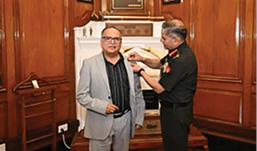
Prof Rajeev Ahuja is Director of IIT Ropar since April 2021 and Professor of Computational Materials Science at Uppsala University, Sweden. A globally renowned computational materials scientist, he has over 30 years of research experience in energy materials, batteries, hydrogen technologies, sensors, condensed matter physics, and high-pressure physics.
A Ph.D. from IIT Roorkee (1992), Prof. Ahuja has authored 1,250+ research papers, with over 59,000 citations and an h-index of 114. He has supervised more than 30 Ph.D. scholars and 35 postdoctoral researchers.
He is a Fellow of the Royal Society of Chemistry, Fellow of the American Physical Society, and member of the Royal Society of Sciences of Sweden. His honours include the Wallmark Prize, Benzelius Prize, APS Beller Lectureship, IIT Roorkee Best Alumnus Award, and the Chief of the Army Staff (COAS) Commendation Card.
In a freewheeling question-and-answer session with Prof Rajeev Ahuja, Director, IIT Ropar, South Asia Defence & Strategic Review (Defstrat) had the opportunity to gain valuable insights into one of India’s youngest IITs, its evolving research and innovation ecosystem, and its growing contribution to India’s defence ecosystem. Excerpts from the conversation follow.
DEFSTRAT: The global geostrategic environment is changing rapidly. What does this transformation mean for India’s defence preparedness and technological self-reliance?
Director IIT: Honestly, the pace of change is staggering. The contemporary security environment is characterized by rapid technological disruption, multidomain competition and increasingly complex threats. Artificial Intelligence, autonomous systems, cyber capabilities, advanced materials, space technologies, secure communications and robotics are redefining the very character of warfare.
For India, this transformation presents both a challenge and an opportunity. We must progressively move from a technology-consumption paradigm towards one of technology creation, technology ownership and technological sovereignty. This requires sustained investment in high-quality research, deep-tech innovation and strong partnerships between Academia, the Armed Forces, Startups, MSMEs and Industry.
Defstrat: How can a premier technical institution such as IIT Ropar contribute to these emerging national-security requirements?
Director IIT: IIT Ropar’s strength lies in its combination of academic excellence, multidisciplinary research and engineering capability. Our research ecosystem encompasses areas such as Artificial Intelligence and Machine Learning, robotics, autonomous systems, cyber-physical systems, advanced materials, quantum communications, electronics, sensing, energy technologies and data-driven systems.
“Foundational Research is the Mother of Innovation”. Therefore, the objective is not merely to write research papers and show technological demonstrations in individual laboratories but to bring different disciplines together to find mission-oriented innovative solutions.
As stated in Bhagavad Gita “Research is the Dharma of Academia.”
Defstrat: What makes IIT Ropar’s research ecosystem particularly relevant to defence innovation?
Director IIT: Being a young IIT, we had the advantage that our take off was oriented towards a modern research & innovation outlook. Our emphasis has been on interdisciplinary, mission-driven research supported by academic rigour, laboratory infrastructure and collaboration with external stakeholders. We also believe that research should have pathways towards application. Our larger vision is to ensure that high-quality academic research can generate prototypes and deployable solutions that address national and global challenges.
There is considerable scope across various technology domains in IIT Ropar that offer the greatest opportunities for collaboration between Academia, Industry and the Armed Forces. These domains are :-
- Artificial Intelligence and Machine Learning
- Autonomous and unmanned systems
- Drones and Counter-UAS
- Robotics and autonomous ground systems
- Cybersecurity and cyber defence
- Space and satellite technologies
- Quantum communications
- Electronic warfare-related technologies
- Advanced materials and manufacturing
- Energy storage and power systems
- Sensors and electro-optics
- Digital twins and simulation
- Battlefield decision-support systems
- Predictive maintenance and condition monitoring
- Human–machine teaming
A modern defence problem rarely belongs to a single discipline. The ability to bring together researchers from engineering, computing, materials, electronics, energy and other domains is therefore critical. For example, an autonomous platform may require expertise in AI, computer vision, communications, control systems, mechanical engineering, materials and cybersecurity. A multidisciplinary research environment enables these capabilities to converge around a single operational objective. The emphasis should increasingly be on systems integration. Future military capability will depend on how multiple technologies work together rather than on any isolated technological component(s).
Defstrat: How is IIT Ropar contributing to Defence Research & Innovation?
Director IIT: Towards creating a robust defence ecosystem in IIT Ropar, we have established a Defence Research & Innovation Foundation (DRIF). This is a Section 8 Non-Profit organization within IIT. This platform serves as the premier single point contact within IIT to act as the critical strategic bridge uniting the Indian Armed Forces, Academia, and the Defence industry. This unique model is the first of its kind amongst the IITs. The aim is to leverage research excellence for breakthrough defence solutions. The DRIF management is composed of select IIT faculty and senior retired veterans (as Professors of Practice) from the three services. Presently, it is being steered by the former ARTRAC Army Commander, Lt Gen SS Mahal (Retd), PVSM, AVSM, VSM. It primarily focusses on three verticals namely; a Skilling pathway for education and reskilling for Armed Forces personnel, a Technology Development vertical for advancing research-based innovation & solutions in AI, drones, cybersecurity, robotics, and emerging domains and a Start-ups & Manufacturing vertical for incubation of start-ups and industry partners with a related Technology Business Innovation Foundation (TBIF).
Over the past two years, we have met with considerable success. Recently, we have been awarded two prestigious Army Technology Projects on niche domains of National importance. Given their strategic nature I would not go into specifies. Many cutting-edge projects in civil engineering, especially multi resilient weather proof technologies; AI/ML, Deep Tech, special textiles, cyber security and auto spectrum management & communications have been delivered to the Army. In the upskilling domain, we have so far trained 650 plus Armed Forces Personnel for critical in-service/post-service technical roles in cyber, drones, entrepreneurship and material management. We have also inked about 50 MoUs with leading defence industry partners for collaboration and co-production.
Defstrat: How can the Armed Forces and the Industry become genuine partners in this ecosystem?
Director IIT: The Armed Forces must view the Academia and Industry as co-creators in the innovation process. Collaborative R&D, joint intellectual-property frameworks, testbeds and academia -industry participation can help ensure that research is grounded in real-world constraints. Besides, the Armed Forces need to develop faith in this ecosystem. There is a need to foster a certain level of trust that the Academia and Industry partnership will deliver. While the Academia devotes critical knowledge and intellectual rigour to defence research the Industry contributes manufacturing capability, quality assurance, supply chains, systems integration, certification, scale and lifecycle support. These twin capabilities have to be brought into the development process at an appropriate stage rather than only after a technology has been proven. “Better to perform one’s own duty, even imperfectly, than to perform another’s duty perfectly.” (Bhagavad Gita 3.35) – Academia must focus on its svadharma: advancing indigenous defence knowledge rather than imitating others.
Defstrat: How important are dual-use technologies in creating a sustainable defence innovation ecosystem?
Director IIT: Dual-use technologies are extremely important because many of the technologies transforming defence are simultaneously transforming civilian sectors.
AI, drones, robotics, secure communications, cybersecurity, sensing, energy technologies and advanced materials can have applications across defence, industry and society. Technologies developed for demanding military environments can contribute to disaster management, homeland security, critical infrastructure protection and other national applications
A strong dual-use ecosystem also gives startups a broader market opportunity, helping them achieve commercial sustainability while retaining the ability to address strategic requirements.
Defstrat: How can India move towards being self-reliant in defence to becoming a global source of defence technologies in the future?
Director IIT: India must aspire beyond self-reliance towards global technological leadership in selected areas. This requires excellence in fundamental research, strong intellectual property creation, advanced engineering, world-class manufacturing, robust testing infrastructure, industry partnerships and rapid translation of research into products.
India possesses enormous scientific and entrepreneurial talent. The combination of Indian scientific talent, defence experience, cost effectiveness and manufacturing capability can become a significant strategic advantage. The opportunity is to create an ecosystem that allows this talent to work on problems of national and global significance.
Defstrat: What do you feel is the best contribution of IIT Ropar towards the Indian Armed Forces till now?
Director IIT: We have delivered many projects to the Indian Armed Forces across the length and breadth of the country in many domains, however, the one thing I feel is the best contribution from IIT Ropar is the upskilling of personnel of all the three services to assist them in learning new technologies and making them updated with the current science and technology scenario globally. We are proud to be the first IIT to offer M Tech degree for the rigorous technical courses being undertaken by their officers in Category ‘A’ institutions of the Armed Forces. We are also helping in the re-settlement of soldiers by offering them new age technology courses, as we feel a soldier is a precious resource of the nation even post-retirement. There are many ex-servicemen who are doing yeoman service in their areas and we are happy to contribute to their growth through the DG Resettlement courses.
Defstrat: What are the future plans of IIT Ropar to help our Armed Forces in their endeavour to be technology driven and compete with the best armies in the world.
Director IIT: I have interacted a lot with Security Forces across the globe while working with the Uppsala University in Sweden, where I have spent about 32 years of my life carrying out research work. I have also extensively interacted with the Indian Armed Forces over the past couple of years. One thing I can say with conviction is that our Indian Armed Forces are one of the best in the world. However, as you know that the character of warfare is ever evolving and the technologies are changing very fast and hence there is a need of constant learning and updating of our equipment for future warfare. We at IIT Ropar are constantly working with all the three Services to give impetus to new technologies development, upgradation of current equipment and indigenization through various innovation routes like the Army Technology Board, Technology Development Funds, iDEX, ADITI, Meher Baba Competition and IR&D. You will be glad to know that with the support of Ministry of Education and the Honorable Minister of Education we are also creating an IIT Ropar Research Park to foster innovation.
DEFSTRAT: What message would you like to give to India’s young researchers, engineers and entrepreneurs who wish to contribute to National Security?
Director IIT: Young researchers should think beyond publications and individual projects and ask how their knowledge can address significant national challenges.
Closing Thoughts
The message is simple: “Innovate boldly, pursue excellence and remain connected to real-world problems.
The emerging defence innovation model is no longer about isolated institutions working independently. It is about creating a connected ecosystem in which academic excellence generates knowledge, defence expertise provides operational direction, entities like DRIF enables translation, startups provide agility, industry provides scale, and the Armed Forces provide the ultimate test of relevance.
The larger ambition is to create an innovation pipeline in which India’s scientific and technological capabilities translate into operational capability, economic value and strategic autonomy.
“The future of defence innovation will belong to ecosystems, not isolated institutions, where academic excellence, operational experience, entrepreneurial energy and industrial capability converge to create deployable solutions for a self-reliant and technologically empowered India.”
“Academia is the the Arsenal of Innovation.”
