

 Login
Login
Articles
Iran’s Pakistanisation!
Sub Title : The Rise of the IRGC and the Future of the Iranian State
Issues Details : Vol 20 Issue 2 May – Jun 2026
Author : Defstrat Editorial Team
Page No. : 27
Category : Geostrategy
: June 1, 2026
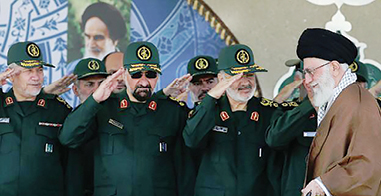
The question being increasingly asked in strategic circles is whether Iran is undergoing a transformation similar to Pakistan’s i.e. a state where formal political institutions exist, but real power increasingly resides with a military-security establishment. The comparison is not perfect, yet it is becoming difficult to ignore.
For decades, Iran was best understood as a theocratic republic. Ultimate authority rested with the Supreme Leader and the clerical establishment, while elected presidents and parliaments managed day-to-day governance. The Islamic Revolutionary Guard Corps (IRGC) was originally created after the 1979 Revolution as a guardian of the revolution, intended to protect the Islamic system from both internal and external threats. Over time, however, the IRGC evolved into something much larger. It became a military force, an intelligence agency, an economic conglomerate, a political power broker and the principal instrument of Iranian influence across the Middle East. Analysts have long described it as a “state within a state.”
The recent war and the prolonged confrontation with Israel and the United States appear to have accelerated this process. Multiple reports suggest that real authority has increasingly shifted from clerical institutions towards the military-security apparatus centred on the IRGC and the Supreme National Security Council. Even where formal structures remain intact, decision-making on security, foreign policy and internal control appears increasingly dominated by military figures.
This is exactly how the Pakistan parallel emerges. Pakistan’s political system is often described as a hybrid order. Civilian governments come and go as elections are held as per schedule and the political parties compete as they would in any democracy. Yet the Army retains decisive influence over national security, foreign policy, nuclear policy and often major domestic issues. Prime Ministers govern, but within parameters established by the military establishment.
Iran appears to be moving toward a somewhat similar model, though some differences remain. In Pakistan, the Army became dominant because civilian institutions were weak and repeated military interventions created a tradition of military oversight. In Iran, the IRGC’s rise stems from ideology, revolution and war. It was never merely a military organisation; it was created specifically to defend the revolutionary state. Unlike Pakistan’s Army, which has established increased legitimacy from nationalism and territorial defence, the IRGC derives legitimacy from protecting the Islamic Revolution and the regime itself. Yet the outcomes increasingly resemble one another.
Both institutions have developed vast economic empires. Pakistan’s military controls extensive business interests through military foundations and enterprises. The IRGC similarly possesses influence across construction, energy, banking, transport, telecommunications and strategic industries. Economic power reinforces political influence and provides a degree of autonomy from civilian oversight.
Both institutions also dominate strategic decision-making in their respective countries. In Pakistan, India, Afghanistan, nuclear policy and major security questions remain heavily influenced by the Army. In Iran, policy toward Israel, the United States, regional proxies, missile development and nuclear issues increasingly falls under the influence of the IRGC and its security elites.
There is, however, one distinction. Pakistan’s military, having learnt its lessons through a number of previous coups, generally seeks to intervene to preserve the existing state structure, while wielding power. The IRGC, on the other hand, is an ideological organisation. It sees itself not only as a defender of Iran but also as the guardian of a revolutionary project. That makes it potentially more assertive and less predictable than a conventional military establishment. In fact, Iran, thus, may not be becoming another Pakistan. It may be evolving into something more akin to a military-theocratic state where clerical legitimacy remains useful but actual power increasingly resides with a security elite.
Recent developments appear to support this interpretation. Observers note that wartime conditions have strengthened hardliner factions, weakened reformist voices and increased the role of military commanders in governance. The clerical establishment remains important symbolically, but the centre of gravity is shifting. Reuters recently described a situation in which the IRGC have effectively seized wartime power, with clerical authority increasingly functioning as a source of legitimacy rather than direction.
History offers a useful lesson. States under prolonged external pressure often become more militarised. Pakistan and Egypt (to some extent, even Israel) all witnessed periods where security institutions acquired extraordinary influence because the nation perceived itself to be under constant threat. Iran now faces a similar environment of sanctions, conflict, proxy wars, economic hardship and repeated confrontations with powerful adversaries. Under such circumstances, security institutions naturally gain influence.
The danger for Iran is that military dominance can provide short-term stability while creating long-term rigidity. Security institutions are often effective at maintaining order but less effective at addressing economic stagnation, social discontent and technological transformation. Iran’s young population, economic challenges and periodic unrest cannot be managed indefinitely through security measures alone.
The broader implication is that the Middle East may be witnessing the emergence of a new Iran, one in which the clerics remain on the stage, but the generals increasingly remain in charge. Whether that process culminates in a Pakistani-style hybrid system or a uniquely Iranian military-revolutionary state remains uncertain. What seems increasingly clear, however, is that the balance of power inside Iran is shifting. The age of clerical predominance may not be ending entirely, but it is increasingly sharing space with an institution that possesses guns, intelligence networks, economic resources and a growing claim to political authority. In strategic terms, Iran is not becoming Pakistan. It is becoming Iran’s own version of a military-political state, one in which the IRGC may soon be the single most powerful institution in the country.
For India, this transformation deserves close attention. A more IRGC-dominated Iran would likely be more nationalistic, more security-centric and more resistant to Western pressure. It may also become less predictable in regional affairs. Relations with Pakistan, the Gulf states, China, Russia and India could increasingly be viewed through a strategic-security lens rather than a diplomatic one.
