

 Login
Login
Articles
Kabul Quagmire
Sub Title : Deteriorating Afghanistan- Pakistan relationship and its impact on India
Issues Details : Vol 19 Issue 5 Nov – Dec 2025
Author : Dr Amit Sharma
Page No. : 31
Category : Geostrategy
: December 5, 2025
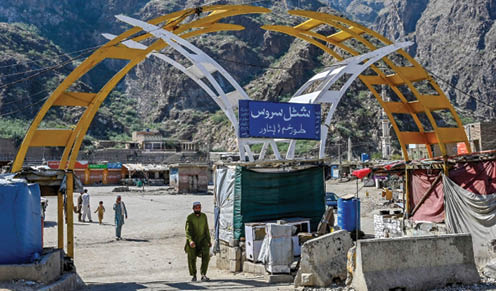
Afghanistan’s frontier is once again aflame, and the rivalry between India, Pakistan and the Taliban is shaping a volatile regional landscape. Kabul’s shifting alignments, Pakistan’s domestic pressures, and India’s renewed engagement now intersect in a complex and rapidly evolving geopolitical contest.
Torkham, October 2025. The boom gate dropped with a metallic thud and the line of melon and pomegranate trucks stopped in place. Pakistani customs staff waved drivers back, Afghan fighters with new unit badges watched from the ridge, and automatic bursts cracked over a dispute that was not really about paperwork. In the same news cycle Kabul accused Pakistan of airstrikes in the capital and in Paktika, Islamabad said it had only chased terrorists who had crossed over, and almost the entire 2,700 kilometre Durand Line, from Robat Qila to the Wakhan notch, went on alert. The timing was hard to miss. Afghanistan’s acting foreign minister, Amir Khan Muttaqi, was in New Delhi on a UN 1988 Sanctions Committee waiver that India had quietly supported, and on that very week External Affairs Minister S. Jaishankar said India would upgrade its Kabul technical mission to a full embassy, three years after August 2021. Kabul read this as diversification, India called it humanitarian led re engagement, and in Islamabad the message was unmistakable, Pakistan’s long enjoyed monopoly on Afghan access and the notion of strategic depth was eroding.
Islamabad expected the opposite after the Taliban took Kabul in August 2021 following the hurried US withdrawal. Pakistan assumed a friendly Emirate would rein in the TTP, stop attacks from Afghan soil, and free a quiet western flank to refocus on India. Instead, from 2022 the TTP resurged across Khyber Pakhtunkhwa and Balochistan, hitting police stations and CT sites in Dera Ismail Khan, Lakki, Tank and Bannu, and by 2024–25 Pakistan’s counter terror grid was overstretched. Kabul then argued that ISKP had shifted from fringe actor to direct challenger for authority inside Afghanistan, and, because some cells and logistics sat in Pakistan, Taliban officials accused elements in Pakistan of letting ISKP survive as a counterweight to the Emirate. Islamabad denied it, but the perception outran the denial, and soon every cross border clash, every Pakistani strike presented as counter TTP work, and every ISKP bomb in Afghanistan was read through that darker lens.
Language moved next. By mid-October 2025, Pakistani officials dropped “interim government” and began calling Kabul the “Taliban regime,” even suggesting Afghanistan would “soon be liberated” under a “people’s representative government.” Quietly, Islamabad also hosted anti-Taliban figures to test a political front. Kabul noticed, as did others. Moscow removed the Taliban from its banned list, recognized them in July 2025, and hosted them in October to restate no Western bases. India advanced its own engagement while Pakistan was tied up at Torkham. The more Islamabad hinted at regime change, the more room the Taliban had to court India, Russia, Qatar, Turkey, Europe, and increasingly the United States for technical, humanitarian, and connectivity ties.
Inside Pakistan, the week of border fire doubled as a domestic message. GHQ and the coalition Govt saw the frontier fold into politics as KP, exhausted by checkpoints, raids and funerals, endured yet another closure cycle. The DI Khan police-station raid (Feb 2024), coordinated gun-and-grenade attacks across districts (Aug 2025), and the Ratta Kulachi police-complex truck bomb (Oct 2025) were still raw. So when Islamabad told Kabul to act on the TTP and Kabul replied that Pakistan should first fix its own militancy vectors and take ISKP seriously, that reply sounded plausible abroad. Kabul could also point to ISKP’s July 2023 bombing of the JUI F rally in Bajaur, and say it was grappling with a more ideological and transnational enemy. From Kabul’s vantage, Pakistan sometimes tolerates ISKP pressure on the Emirate, which is reason enough not to hand over every TTP commander on demand.
Balochistan shows the same collision in a tighter frame. A resource-driven insurgency and the unresolved center–province hierarchy now plug into the Afghan loop as BLA and allied strikes in Awaran, Kech and Bolan, and hits on Chinese-marked targets near Gwadar and Lasbela, force Islamabad to reassure Beijing. China has answered with tighter CPEC movement protocols, a higher security premium, and, after Dasu and Karachi, blunt reminders that money follows protection, which lands on budgets already strained by IMF-mandated tariff hikes and theft reduction, and on Rawalpindi citing India’s sharper red lines and Operation Sindoor held in reserve to resist defense cuts. More rupees go to CPEC security and deterrence, squeezing development and starving canal lining, metering and storage that might have softened India’s late-2025 suspension of key Indus Waters Treaty mechanisms, an act that exposed years of underinvestment and a festering Sindh–Punjab fight over Taunsa–Panjnad diversions and Cholistan canals. Then Kabul announced a Kunar dam in late October 2025, which India immediately backed and offered to help build, a project that, if it proceeds, could become Pakistan’s toughest upstream challenge in decades.
Around Afghanistan the outside crowd has thickened, shrinking Pakistan’s veto. Russia recognised the Taliban in July 2025, hosted them in October, and restated the Moscow Format line against Western basing, giving Kabul political oxygen and channels for energy, grain and security talks. China never left, kept trilaterals on TTP, border logistics and Chinese worker protection, and, via Amu Darya work. It revived Mes Aynak talks and signalled investment if the Emirate guarantees safety. Each attack on Chinese staff drew sharper messages to Islamabad, reinforcing that CPEC needs a calmer, not hotter, frontier. Europe remains the main humanitarian purse and the guardian of rights, so deportations and long Torkham closures quickly show up in Brussels, exactly where Pakistan seeks IMF and trade relief. The United States still holds sanctions, waiver and banking levers and pursues durable aims, limit China’s economic grip, especially in copper and rare earths, and retain influence in Central Asia. Occasional probes about asking control of Bagram airbase or counter terror access looked like tests of regional tolerance, not imminent basing. Many in the region think some Pakistani coercive pressure on Kabul suits Washington if it yields a more predictable, less ideological government, while Qatar tries to reach the same end through talks. This also helps explain why, in October 2025, Washington quietly extended the Chabahar waiver it had reimposed in September, keeping a non Karachi lifeline for Afghan supplies and preserving leverage over both Kabul and Islamabad while claiming balance.
Qatar and Turkey are the only practical managers in this crowd. Since 2021 they have kept Kabul airport running, Qatar supplying equipment and its protecting power role for US interests, Turkey providing security and technical templates acceptable to insurers. After the October 2025 firefights they convened two rounds of Pakistan–Afghanistan talks and, despite Islamabad’s warnings of dire consequences, kept both sides in the room by shuttling between capitals and Doha suites. The result is a holding formula, a pause on cross border strikes, contact points to log incidents, fixed windows for UN and medical flights, and a paper understanding that future high value pursuits inside Afghanistan should run through joint channels rather than unilateral drones. This is a framework of engagement, not a settlement, and it can tip quickly either toward cooperation or confrontation. The Taliban pledge that Afghan soil will not host anti Pakistan activity was more optics than enforcement, but it buys time, signals responsibility to Europe, Washington and Beijing, and gives mediators a hook for the next round. If Doha and Ankara harden this into hotlines and fixed mechanisms, they will have the beginnings of a border management regime that neither side can sign bilaterally; if it collapses, Pakistan will take it as licence to escalate, Afghanistan will call it proof of coercion, TTP and ISKP will exploit the gap, and Washington will file another quiet data point for a more responsive Kabul.
Pakistan’s domestic fabric is already taut. KP lives in near-permanent emergency; Balochistan views “development” through disappearances and CPEC security; PoK and Gilgit-Baltistan erupt over tariffs, inflation and electoral representation; sectarian wounds from Quetta to Parachinar reopen with each ISKP-style strike; a thin, tariff-laden, non-solar Pakistani middle class is squeezed out. Each strand limits Islamabad’s shock-absorption. Shut Torkham and Peshawar traders bleed, videos ricochet through Gulf/UK diasporas that remit ~9% of GDP, PoK crackdowns and water rows land on British MPs’ desks influenced by British-Mirpuris, and donor capitals quiz Pakistan even as it seeks IMF patience and refugee forbearance. Keep Torkham open after Afghan fire, and the opposition cries capitulation. Room for calibrated response shrinking for Islamabad.
Pakistan is fighting to control the Afghan narrative while balancing the federation. Kabul claims leverage over Pakistan’s domestic politics, pointing to the October 2025 TLP Gaza-ceasefire marches that stalled Islamabad, and thus speaks firmer when refusing CT demands. Pakistan, believing ISKP pressure suits some in Afghanistan, flirts with “liberation” talk and hosts anti-Taliban figures. India’s return in Afghanistan gives Kabul non-isolation and Russia a democratic foil; China’s security asks force border calm; Europe’s rights-linked aid compels explanations for deportations and closures. Qatar and Turkey offer a ladder that needs softer rhetoric to hold. The United States keeps the financial valves, seeks a say on minerals and connectivity, wants a Central Asia toe-hold, and, for now, lets Doha test the talking route. Every external move hits a domestic nerve, and every domestic move is instantly international.
That is the real Kabul quagmire here, not a trap inside Afghanistan but a net of interlocking dependencies around Pakistan. If Islamabad relies mostly on coercion, airstrikes, mass expulsions and prolonged closures, it will get applause from some internal constituencies. Loud anti Kabul rhetoric and experiments in opposition grooming will add to that approval. But these steps will also drive the Taliban further toward Moscow, Beijing, Turkey and now New Delhi. They will make lenders and investors nervous and deepen fatigue in KP, in Balochistan and in PoK. If instead it works through the Qatari and Turkish channels, publishes transparent water data and accelerates irrigation and storage so that India’s Indus suspension cannot be turned into a weapon, shows CT results in KP against real ISKP and TTP facilitators, and critiques Taliban policy without denying the Emirate’s existence, then it can trade predictability for breathing room. That option still exists, but every time the gate at Torkham slams shut it becomes a little narrower.
For India, this turbulence has opened a narrow but usable corridor where prudence can still shape outcomes. New Delhi has already reentered Kabul through humanitarian lanes and technical engagement. It also moved to restore a full embassy san recognition, leaned on UN mechanisms to keep channels lawful, and kept Chabahar and the air freight corridors alive to reduce Pakistan’s veto on access. This return is built on two decades of non military presence that Afghans still remember, the Salma Dam in Herat, the new Parliament building in Kabul, the Zaranj Delaram road that tied western Afghanistan to the Iranian route, the 220 kV Pul e Khumri Kabul transmission line, thousands of scholarships for Afghan students in Indian universities, and a very large number of medical visas that brought Afghans to Delhi for treatment between 2001 and 2021. That record created a people level cushion that survived the US withdrawal in August 2021, even though at that moment many observers wrote India off and Pakistan’s establishment celebrated as if strategic depth had returned, complete with the ISI chief’s early flight to Kabul which was read as a victory lap. India did pull out all its staff then and it did look as if the Afghan space had been lost. Yet, within months, Taliban found useful India again, when the Taliban needed wheat, vaccines, medicines, and a partner that could speak to the UN, to the World Bank and to Gulf capitals without attaching difficult political conditions. That quick climb back was not improvised, it flowed from lessons New Delhi had drawn from Taliban 1.0 and, especially, from the humiliating IC 814 experience in 1999 when sitting on a high moral pedestal and refusing any contact with the then Taliban government meant India had no leverage in Kandahar. The Indian system appears to have internalised that in Afghanistan it is better to have a thin, principled, humanitarian line open than to have no line at all, because military interventions by others have repeatedly failed while schools, hospitals, roads and power lines have continued to buy goodwill.
India has therefore paired its current outreach in Kabul with its Pakistan policy of firm red lines against cross border terrorism by Pakistan, Operation Sindoor as a standing deterrent, and raised strategic pressure by suspending key Indus Waters Treaty mechanisms. If Qatar and Turkey can entrench a border management scaffold, India gains a safer space to trade wheat, medicines and power equipment, to discuss the Kunar basin and grid links with Afghans who want alternatives to Karachi, and to exchange intelligence on ISKP and TTP spillovers that threaten India and Afghan alike. If the scaffold collapses and Pakistan escalates, India’s presence becomes both shield and sensor, useful for evacuation logistics, humanitarian continuity and quiet deconfliction, but also exposed to rhetorical and kinetic risk if anti India actors find oxygen. It is also true, though unfortunate for ordinary Afghans and for Pakistani Pashtuns, that a prolonged Pakistan Afghanistan confrontation would leave India facing a Pakistan busy elsewhere and therefore less able to project nuisance outward; in Pakistani doctrinal terms a visible loss of strategic depth. Russia’s recognition of the Emirate, China’s security demands inside Pakistan, America’s desire to keep a foot in the Afghan door through sanctions design, mineral ambition and limited waivers like the one on Chabahar, and Qatar and Turkey’s patient shuttle diplomacy together tilt the board toward a regional bargain that prizes stability, which suits India so long as Kabul keeps its terror assurances and Delhi can show that engagement serves Afghans rather than a regime. Even if Pakistan were somehow to midwife a post Taliban arrangement that was less friendly to India, New Delhi can still take confidence from the depth of its humanitarian and people to people links, because those links keep India in play irrespective of who sits in the Arg, and they give India leverage to say to any Kabul ruler that recognition and fuller cooperation will come only when movement on women’s education, inclusion and counter extremism is visible. The likely Indian play remains incremental and transactional, build projects that touch ordinary Afghans, keep banking routes lawful, use multilateral cover to avoid premature recognition, and let performance validate presence while Pakistan’s internal strains limit its veto power. The scenarios are therefore bounded rather than binary, a steady creep of practical ties if the frontier cools and donors stay engaged, a holding pattern of humanitarian minimalism if skirmishes return, and a rapid contraction only if Kabul allows anti India groups breathing room or if the Pakistan Taliban confrontation tips into a wider shooting war. In each case India’s relevance flows from three levers it already wields, predictable aid and connectivity that Afghans can feel, credible deterrence that Pakistan cannot ignore, and a diplomatic habit of working through rules and mediators that others can live with, which together allow India to keep Afghanistan’s door open without trapping itself inside the room.
