

 Login
Login
Articles
Large Slow Moving Drones Relevance in Contested Environment
Sub Title : Traditional UAVs and drones which performed well in a neutral environment will not survive and perform in a contested battlespace
Issues Details : Vol 20 Issue 2 May – Jun 2026
Author : Air Marshal Anil Chopra, PVSM, AVSM, VM. VSM (Retd)
Page No. : 29
Category : Military Affairs
: June 1, 2026
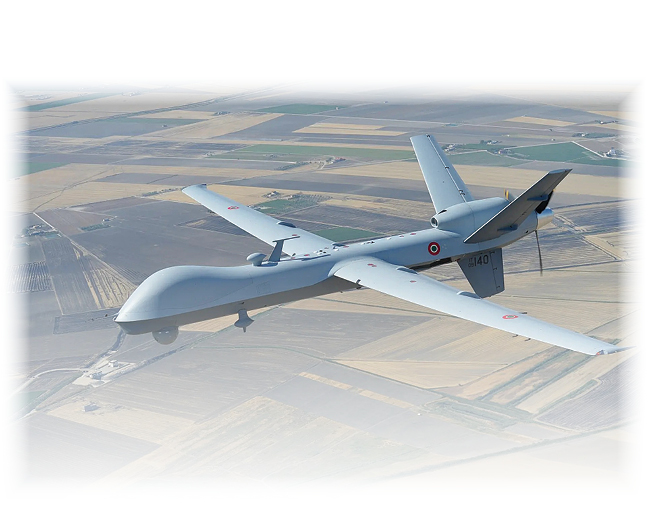
Recent conflicts from Ukraine to the Middle East have forced militaries to reassess the survivability of large, slow-moving unmanned platforms. As attrition mounts and air defences grow sharper, this article examines whether legacy ISR drones like the MQ-9 still retain operational relevance in future contested battlefields
The world seems to be fixated with drones after their initial success in Ukraine and the Iran War. On the other side the Pakistani drones were a dismal failure against India during the “Op Sindoor.” The counter-drone systems have evolved quickly and their success rate is close to 95 percent. Yet Loitering Munitions and Kamikaze drones have found significant place in inventories of modern militaries, perhaps rightly so.
Large slow-moving MQ-9, and Heron, class drones were successful in uncontested environment in Iraq and Afghanistan, but same is not true in contested air space. Iran shot back and shot them down. Multiple Israeli IAI Heron (including Heron TP/Eitan) drones were shot. Operation Epic Fury has seen extraordinarily heavy UAV losses. They have also been easy targets in a contested environment as has been seen in Black Sea near Ukraine and attacks by the Houthis in the Red Sea.
The MQ-9 Reaper, once the pride of America’s drone fleet, has been especially affected; at least 24 drones have been shot down in the Middle East since the onset of the Iran conflict. At a price tag of $30 million each, the cost of the lost Reaper drones to the US Air Force (USAF) is roughly $720 million in total, higher than the cost of the E-3 Sentry destroyed on the ground, the high-end MQ-4C Triton drone lost in early April, or the multiple aircraft destroyed during the rescue of “Dude 44,” the pilot and weapons systems officer (WSO) of the F-15E Strike Eagle shot down inside Iran.
Perhaps even more important than the fiscal cost of losing the drones is the attrition rate, which exposes the limits of legacy drones operating in hostile airspace, even in an environment in which the United States has largely achieved air superiority.
MQ-9 Reaper Drone
The MQ-9 Reaper was first introduced to the USAF in 2007, with an emphasis on Intelligence, Surveillance, Reconnaissance (ISR) and strike roles. It cut its teeth during the two-decade War on Terror, spending thousands of hours over the Middle East, Afghanistan, and Pakistan. Along with the MQ-1 Predator drone, it became emblematic of American drone strikes against suspected militant targets. Over 300 have been built. At 36 ft 1 in (11 m) length, and 65 ft 7 in (20 m) wingspan, it has a huge radar signature, and at a top speed of 300 mph (482 km/h), and typical cruising speed 194 mph (313 km/h), it could be a sitting duck in highly air defence intensive environment.
In addition to seven hard-points for weapons and other payloads, the Reaper is also equipped with EO/IR targeting system and synthetic aperture radar. The satellite link allows for remote piloting. The purpose of the platform is to provide persistence and precision, and excels against targets without the ability to meaningfully fight back. However, as Epic Fury has indicated, the drone sorely lacks in survivability against modern air defence systems. The dozens of losses reflect a layered threat environment for which the Reaper is poorly suited.
Reaper crew sitting in an ops room in the USA can control the drone and sensors flying 1000s of kilometres away through satellite based communication links. It can hunt for targets and observe terrain using multiple sensors, including a thermographic camera. One claim was that the on-board camera is able to read a license plate from 3.2 km away. An operator’s command takes 1.2 seconds to reach the drone via a satellite link.
The MQ-9 can be dismantled and packed in less than eight hours, fly it anywhere in the world aboard a C-17 Globemaster III, and then have it ready to fly in another eight hours to support special operations teams at places with no infrastructure.
The General Atomics Aeronautical Systems drone is in service or used by Belgium, the United Kingdom, Denmark, India, Italy, Spain, the Netherlands, Poland, the United States, France, and Japan.
India’s MQ-9 Contract
India and the United States had signed the ₹32,000 crore ($3.8 billion) agreement on October 15, 2024, for the acquisition of 31 Predator MQ-9B drones and the establishment of a Maintenance, Repair, and Overhaul (MRO) facility in India. Out of the 31 drones, 15 will go to the Indian Navy (IN), and 8 each to the Indian Army (IA) and the Indian Air Force (IAF). The drones are being bought under the US Foreign Military Sales contract.
This procurement numbers were based on a tri-service agreement, after a comprehensive study by the Indian military. The drones will significantly enhance the operational capability of the Indian armed forces across land, sea, and air. As per the Government of India (GoI) release, the Predator drones will be stationed at four key locations: INS Rajali near Chennai, Porbandar in Gujarat, and two airbases in Uttar Pradesh – Sarsawa and Gorakhpur. The Drones will be supplied by 2027.
General Atomics has offered “to provide consultancy to Indian entities” to develop an advanced UAV under the deal. General Atomics is also establishing a Global MRO facility in India. The assembly of the drones is to be done in India. By value, 30 percent of the sub components will be sourced from Indian companies though there will be no technology transfer under the agreement. The deal also includes the purchase of 170 AGM-114 Hellfire missiles, 310 GBU-39 glide bombs, navigation systems, sensor suites, mobile ground control systems and future integration of Indian weapon systems like NASM-SR anti-ship missiles.
India Losses a Reaper Drone
An Indian Navy-leased MQ-9B SeaGuardian drone ditched into the Bay of Bengal off the coast of Chennai on September 18, 2024, following an unrecoverable technical snag during a routine surveillance mission. The incident was deemed a “controlled ditching” after the High Altitude Long Endurance (HALE) unmanned aerial vehicle (UAV) failed a technical reset.
This drone was one of two MQ-9Bs leased by the Indian Navy in 2020 to enhance ISR capabilities. The drones are operated and maintained under a Contractor Owned Contractor Operated (COCO) model by General Atomics. Under the contract, General Atomics is expected to replace the lost drone to maintain mandated flight hours.
Reaper Class Drones – Relevance India
Operationally, the Reaper is still very relevant for peacetime persistent ISR efforts, or in low-threat, permissive environments. It could be great for India to fly peacetime ISR missions along the western and northern borders, and much more in the Arabian Sea, Bay of Bengal, and northern Indian Ocean. Its service ceiling is approximately 13,000 meters, and its maximum endurance reaches up to 24 hours, allowing operations in the Himalayas.
These will have little role for the Reaper during conflict with China or Pakistan. Their roles will be taken over by cheaper, more expendable systems that offer volume over quality, or stealth for enhanced survivability. The Reaper was a dominant platform for a generation of US wars, but Epic Fury has exposed its limits.
ISR Alternatives in Near Space and LEO
Alternatives to traditional ISR exist in Near Space (stratosphere) and Low Earth Orbit (LEO) focus on increased persistence, lower latency, and greater resilience against counter-space threats, with technologies like high-altitude balloons, solar-powered drones, and small satellite constellations. Near Space is typically operating between 20 km and 100 km, and offers a “high ground” that is closer to targets than LEO, improving resolution while avoiding the legal complexities of sovereign airspace.
High-Altitude Platform Systems (HAPS) includes unmanned aerial vehicles (UAVs) and lighter-than-air platforms (balloons/airships) capable of persistent, months-long surveillance. Solar-powered, high-endurance drones such as China’s Venus-50 offer continuous monitoring with dual-fuselage designs that utilize solar energy.
India’s DRDO is developing stratospheric airships for long-endurance reconnaissance, mapping, and communications, acting as a bridge between airborne and space platforms. Advanced manoeuvrable hypersonic platforms in near space pose severe detection and interception challenges to air defence systems. LEO and “New Space” ISR are moving toward distributed, low-cost constellations rather than relying on fewer, expensive large satellites. Proliferated LEO (pLEO) Constellations include small satellite networks, such as SpaceX’s Starshield. These offer high-revisit rates, improved resilience against anti-satellite (ASAT) weapons, and global coverage.
Commercial small, synthetic-aperture radar (SAR) satellites, such as those operated by ICEYE, provide high-resolution, day-night, cloud-penetrating imagery that is increasingly available as a commercial or military service. Integrated multi-orbit Architectures combine LEO for high-resolution imaging with MEO/GEO for persistent surveillance, linked together through optical, space-based, real-time data backhaul.
Also evolving are AI-enabled persistent ISR using software-defined satellites that integrate optical communications to move and analyse data faster. The key benefits of all these over traditional ISR include enhanced survivability, attritable (lower cost/expendable) systems make it difficult for adversaries to eliminate the entire ISR network, whereas a few large satellites are high-value targets. Also LEO satellites and HAPS provide significantly lower latency than satellites at higher altitudes (GEO), enabling real-time battlefield management. High-endurance drones and smaller satellites cost significantly less to build and launch compared to traditional surveillance platforms.
To Summarise
The lessons from recent wars is that the future is in low cost survivable platforms. MQ-9 and Heron class drones are good for peace-time ISR, but cannot survive in contested environment. At the field level (Battalion) the FPV (First Person View) drones are best for tactical reconnaissance and surveillance in asymmetric warfare.
Stealth drones like China’s carrier-capable GJ-21 and India’s “Ghatak” which will fly at higher speeds, would certainly have higher survivability. Ultimately greater action will evolve in Near-Space and in LEO orbits. Of course the world will start countering such platforms with existing anti-ballistic and anti-satellite weapons. Directed Energy Weapons (DEW) are also evolving to knock of small satellites and/or burn the electro-optical payloads.
USAF has already told the US Congress that they do not wish to acquire MQ-9 class drones anymore. India must also re-think its own development plans and concentrate on newer ISR options.
Indian Armed Forces already have the Israeli IAI Heron (MALE) and IAI Searcher UAS, and IAI Harop and Harpy Loitering Munitions. India’s DRDO is also developing UAS. India needs a large number of first-person view (FPV) drones and kamikaze attack drones. Manned Unmanned Aircraft Teaming (MUMT) is an area of action.
Adani Elbit Advanced Systems India Limited is producing Hermes-900 UAVs in India. Many start-ups have entered drones and counter drone manufacturing. These include Newspace Research & Technologies, Paras Aerospace, Throttle Aerospace, WB Electronics India Pvt Ltd, IdeaForge, General Aeronautics, Redwing Labs, Dhaksha Unmanned Systems, UrbanMatrix Technologies, Thanos Technologies, and Auto Micro UAS, among many others.
USAF is already training a large number of drone pilots and operators who will sit in the Ground Control Station (GCS). India will have do the same. Recent wars have brought out that drone inventories have to be huge. US Armed Forces require nearly 100,000 drones a year for peace-time training itself. Service HQs are placing large drone orders already. The IAF now has a dedicate branch looking after drone operations and maintenance.
Iran is already producing close to 25 HESA Shahed 136 drones a day. Similar manufacturing levels will be required in India one day. Drone stocking policies have to be worked out.
India needs to accelerate the development of DRDO Ghatak stealth UCAV. Also many drone start-ups are importing drone sub-components. The Drone Federation of India (DFI) and other defence industry bodies like Society of Indian Defence Manufacturers (SIDM) have to continuously interface with the Government and Industry to promote indigenous drone and component production in the country. UAS is the future. Time to Act is now.
