

 Login
Login
Articles
Mechanised Forces Seminar
Sub Title : A detailed report on the symposium with lasting takeaways
Issues Details : Vol 19 Issue 5 Nov – Dec 2025
Author : Ashwani Sharma, Editor-in-Chief
Page No. : 18
Category : Military Affairs
: December 5, 2025
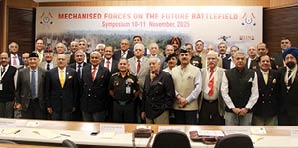
Cavalry Memorial Seminar : Mechanised Forces on the Future Battlefield – 10-11 November 2025
The November 2025 Cavalry Memorial Symposium represented an important step forward in the intellectual journey of the Cavalry Officers’ Association. What began years ago as a memorial lecture has now grown into a serious professional forum that brings together serving officers, veterans, defence technologists, researchers, industry partners and military thinkers. This year’s theme, “Mechanised Forces on the Future Battlefield,” struck a deep chord because it reflects the heart of India’s ongoing military transition.
The global backdrop for this seminar is one of dramatic military change. Conflicts in Eastern Europe, the Middle East and the wider Indo-Pacific have shown that modern land warfare is no longer limited to tanks and infantry fighting within a narrow battlespace. The battlefield today is highly transparent and contested, with technology shaping every action. Multi-domain operations where land forces work alongside air, cyber, space and electronic capabilities are now the norm. Robots, autonomous systems and a host of unmanned platforms have begun to alter how reconnaissance, logistics and strike tasks are carried out. Precision fires reach deep into rear areas, influencing operations long before contact. Electronic warfare and information operations have grown powerful enough to affect detection, deception and survivability.
Amid this rapid change, the seminar reminded everyone of a core truth, that is, decisive results on land still require soldiers and platforms capable of seizing, holding and dominating ground. Mechanised forces remain central to this ability. They provide a unique mix of protection, firepower and mobility. Their importance has not reduced with new technologies; instead, the emerging battlefield demands that mechanised forces become more intelligent, faster and more survivable. The main challenge is ensuring that these forces maintain combat superiority while operating under constant surveillance and threat from drones, loitering munitions, sensors and electronic attacks.
One of the strongest themes of the symposium was the disruptive rise of unmanned aerial systems and loitering munitions. Lessons from recent conflicts show how inexpensive drones, when used in large numbers, can saturate airspace, identify troop movements and conduct precise strikes at very low cost. For armoured formations, this means the air above them is no longer guaranteed to be safe. Mechanised columns must now assume persistent observation and potential attack from above. This makes layered air defence, better counter-drone measures and improved signature management across visual, thermal, radar and electronic spectrums, an urgent requirement.
Closely linked to this is the fast-growing concept of manned–unmanned teaming (MUM-T). The discussions highlighted that MUM-T is no longer a far-off idea but an immediate reality. Armoured vehicles, attack helicopters and infantry fighting vehicles are increasingly expected to task and control unmanned assets for surveillance, targeting and strike. When paired with AI-based decision tools, this ability improves survivability and gives commanders greater reach. It also allows dispersed forces to shape the battlefield before closing in for decisive action.
Another major theme was electronic warfare and deception, which are now fundamental to surviving on the future battlefield. The seminar underlined that forces must remain invisible, unpredictable and electronically protected. Tools such as spoofing, jamming, decoys, camouflage and electromagnetic discipline will be as important as armour plating. A tank must not only survive a physical hit; it must survive in the information and electronic domains as well.
The seminar also placed India’s mechanised modernisation within the broader reform efforts of the Indian Army. Integrated Battle Groups, theatre command structures, the growing use of indigenous platforms and greater coordination with space, cyber and air assets are reshaping the Army’s operational philosophy. Mechanised forces must adapt to this joint and networked environment. Their doctrines, structures and training systems will have to adjust to exploit strengths across all domains.
One of the most valuable aspects of the event was the blend of experience and future vision. Veterans brought historical lessons, serving officers described today’s operational pressures, and technologists and industry leaders showcased upcoming systems. This mix created a rich and balanced discussion that helped frame the path ahead.
The pre-conference interactions added further substance. These discussions looked closely at drone saturation, deception strategies, the challenges of operating in a transparent battlefield, and the need for faster procurement in a time of rapid innovation. Many of these insights are likely to inform the Army’s future doctrine and capability development.
In the end, the 2025 Cavalry Memorial Symposium delivered a clear message i.e, Mechanised Forces remain central to decisive land warfare, but their nature must evolve to match the demands of a new era. The Cavalry fraternity which once made the historic shift from horses to tanks now stands prepared to move towards autonomous systems, AI-enabled warfare and seamless multi-domain integration. This symposium helped set the intellectual and capability direction for India’s mechanised forces in the years ahead.
Sessions and Discussions
The symposium started on 10 Nov ( Pre Conf Day) with the Deputy Chief of Army Staff (IS&T),
Lt Gen Rakesh Kapoor, AVSM, VSM, Opening Address on ‘The Changing face of TBA in Future Battlefield’ and set the stage for deliberations over the next two days. The key message from him was that the tactical battlespace is transforming into a fluid, multi-domain environment dominated by precision, speed, AI, drones, EW and narrative warfare. Traditional depth is disappearing, air-littorals are contested, and technology now defines combat power. India must invest in C5ISR, autonomous systems and next-generation AFVs to retain battlefield overmatch. He left the audience with an apt quote of Sun Tzu – ‘Just as Water retains NO Constant Shape, so doesn’t Warfare, there are NO Constant Conditions.” Therefore, predicting the future is going to be very difficult. But we must catch these trends that are taking place & must keep evolving.
Presentation by T4 (Technology Think Tank). T4 is a newly launched Think Tank focusing on issues related to technology and its application in various fields. The presentation made during the Mechanised Forces Symposium covered two main aspects – evolution of warfare and interplay with military technology since WWII, and impact of technology on the modern-day battlefield. The first part highlighted the fact that from the 1940s till the turn of the century progress in military capability remained largely linear – more of the same in larger numbers. After the Gulf wars and around the turn of the century, digital revolution and advent of AI brought in revolutionary changes, and highlighted that the countries which recognized and adopted the change, raced ahead. The next important observation is that the present times offer another opportunity to skip a tech generation and get ahead of the curve.
Part II of the presentation dealt with the Impact of Technology on the modern-day battlefield with emphasis on Mechanised forces. Taking examples from recent and ongoing conflicts, the presentation reflected upon several technological advances and their effect. It included the role of UAS, Standoff distance wars, democratization of firepower and its implications on the TBA, relevance of munitions versus platforms. Reflections included certain points to ponder, amongst them, relevance of protected mobility for all, increasing use of UAS for manoeuvre and battlefield transparency were some of them. It also surmised that doctrine must drive technology absorption.
Session I: Performance Parameters of Future Tanks and ICVs
The session was on Performance Parameters of Future Tanks and ICVs, Chaired by Maj Gen CS Mann, AVSM, VSM, ADG Army Design Bureau. In his Opening remarks, Gen Mann outlined a number of initiatives related to Armoured Vehicles and said that Tanks remain vital despite cheap alternatives, evolving from the Iron Triangle to a “Steel Hexagon” of lethality, survivability, autonomy, adaptability, connectivity and agility. Future AFVs will be digital, networked, sensor-rich and modular. Indigenous critical technologies like engines, APS, power packs, AI, UGVs and stealth are essential to ensure true battlefield overmatch.
The session contained three presentations from the industry which are briefly discussed below:
Allison Transmission India. Mr Vinod Nair representing Allison made a crisp presentation. In brief, Vinod opined that AFVs will continue to play central role in maneuver roles in MDOs of future. Tanks will not merely be “direct firing” platforms engaging or dealing with enemy armour formations, instead they will become self-contained networked, mobile, and protected platforms.
Allison Transmission will continue to be the world’s foremost companies offering world class solutions for conventional, hybrid and pure electric powertrains for tracked and wheeled vehicles. The facility in Chennai has already achieved localization of more than 40 percent for various wheeled 4X4, 8X8, 10X10 wheeled vehicles and are on track to adopt similar path for ILT and FICV transmissions. Allison Transmission will also continue to invest and build upon more than 2000 Crores already invested in India for “Make In India – Make for the world”.
Astra Rafael. Brig H Ravi of Astra Rafael made a presentation on ‘High Capacity Line of Sight (HCLOS) Bridge technology by ARC’. Astra Rafael Comsys Pvt Ltd (ARC) is at the forefront of innovation. ARC’s flagship offering for tactical communication is the BNET family of SDRs supporting voice & data exchange.
As operations scale and diversify, new challenges emerge viz connecting isolated networks/HQs and exchanging large data volumes. HCLOS addresses these challenges with a duplex link having 40 km range with 100 Mbps data rate. Uniqueness of the solution is – single device functions, both as a MANET SDR and HCLOS Bridge – ARC’s BNET V SDR.
Saab India. Col Alex Jacob presented a comprehensive overview of “Saab Survivability & Battlefield Systems,” outlining key technologies that enhance the protection, awareness and connectivity of mechanised forces. His talk focused on five major solutions:
He began with the Laser Warning System (LWS), noting that nearly 70% of modern targeting chains begin with a laser. Without an LWS, a tank crew may never know they are being ranged or designated. Saab’s fully passive sensor suite integrates with BMS and smoke launchers to enable quick evasive action.
- The Mk 2 variant offers 7.5° accuracy—sufficient for timely smoke deployment.
- The Mk 4 provides 1° precision, enabling exact localisation of threat direction for counter-fire.
Both versions integrate easily with current and future platforms such as FRCV, Light Tank, WH AFV and FICV, and are slated for series production in India.
The Mobile Camouflage System (MCS) tackles the challenge of modern multi-spectral detection.
Traditional camouflage works only in the visual band, while today’s sensors operate across UV, visual, NIR, thermal IR and radar. Saab’s 3-D MCS reduces signatures across all these bands without affecting the vehicle’s function. It is terrain-adaptable, requires no platform modification and has been proven on more than 10,000 vehicles worldwide. It also lowers internal temperatures by 10–12°C.
Addressing the rapidly growing drone threat, Jacob introduced Nimbrix, a compact IR-guided Counter-UAS missile designed for manoeuvring drones in the 2–5 km range. At under 1 m and 3 kg, it is easy to deploy under stress and can be fielded as single launchers or as 4×3 cassettes on vehicles, giving a troop the ability to defeat up to 36 drones. It integrates smoothly with existing C2 and radar networks.
He then highlighted the combat-proven RBS-70 VSHORAD system, effective from 200 m to 8 km against aircraft and attack helicopters. With 94% reliability, laser beam riding guidance, no lock-on requirement and fast deployment, it remains a dependable air-defence option.
Finally, he presented Deploy Net, a portable tactical 5G network designed for fast-moving operations. Two soldiers can set it up within minutes, supporting up to 10,000 users and covering 100 km². It enables secure PTT/PTV, C2/GIS, IoMT and high-speed data, and works seamlessly with rugged devices under strong cyber protection.
Together, Saab’s suite- LWS Mk 4, MCS, Nimbrix, RBS-70 and DeployNet offers India a significant leap in survivability, counter-drone capability and networked warfare.
Session II: Impact of Drones, MUMT and EM Spectrum on Mechanised Forces Operations
Session II was chaired by Lt Gen AB Shiivane, PVSM, AVSM, VSM, former DGMF with Maj Gen Prem Raj, SM, VSM, ADG Mech Inf, Brig Rajesh, DDG AC and Mr Vivek Mishra of Raphe mPhibr as discussants.
Lt Gen Shivane in his Opening Remarks, emphasised that the battlefield is shifting from a physical, visible fight to an invisible, multi-domain battlespace defined by technology, precision, drones, EW and cognitive warfare. AFVs remain relevant but must evolve and become networked, adaptive, data-driven and integrated with manned–unmanned teaming to generate combat advantage in a connected kill-web environment.
The discussion examined the tactical, operational and strategic impact of three linked trends: the mass combat use of UAVs (ISR and loitering/strike), accelerating manned–unmanned teaming (MUM-T), and the rising centrality of deception – electronic, informational and physical. The aim is to frame quick, India-specific recommendations for the Army (especially mechanised forces) and, more broadly, the other services and defence industry.
Recent conflicts have shown the urgency. Cheap, expendable drones have forced doctrinal, tactical and procurement shifts, while MUM-T has increased lethality and survivability by blending human decision-making with unmanned reach and persistence.
11 Nov 2025, Conference Main Day
Gen Ashok Mehta, President Cavalry Officers Association started the proceedings with his welcome Address. In brief, he said “It is an honour to open this year’s Cavalry Memorial Seminar, a forum that has grown from a commemorative lecture into a meaningful platform for professional reflection and forward thinking. Our theme “Mechanised Forces on the Future Battlefield” is especially relevant as the character of war undergoes rapid and far-reaching change.
Across contemporary conflicts, we see battlefields shaped by multi-domain operations, AI-enabled decision systems, autonomous and unmanned platforms, precision strike capabilities, and intense electronic and information warfare. These trends demand faster mobility, higher survivability and greater firepower from land forces. Yet one enduring reality remains: decisive control of terrain still rests on mechanised formations capable of seizing, holding and dominating ground.
India’s mechanised forces stand at an important moment of transformation. We are moving toward more agile armoured formations, integrated battle groups, deeper jointness across air, cyber, space, drone and missile domains, and the incorporation of indigenous, technology-driven platforms. This seminar serves as a space where operational experience, strategic insight, technological advances and institutional knowledge converge.
Our pre-conference discussions highlighted crucial lessons on UAS threats, battlefield transparency, deception, and the demands of high-tempo armoured operations. As we proceed, the aim is simple- to refine our understanding of the future battlefield and shape a credible roadmap for India’s mechanised forces. The strength of this forum lies in its professional candour, diversity of expertise and collective commitment to staying ahead of change.
Keynote Address by the COAS
This was followed by the Keynote Address by the Chief of the Army Staff, General Upendra Dwivedi, PVSM, AVSM. It was an impressive address during which the Chief clearly laid out Indian Army’s modernisation plans, the Mechanised Forces in particular. Touching upon a number of issues, the address presented a forward-looking and candid assessment of how mechanised warfare is being reshaped by technological acceleration, multi-domain integration and the changing geometry of the battlespace. It argues that warfare is shifting from a visible, linear battlefield to an invisible, technology-driven battlespace defined by new actors, new tools, new targets and new rules. Mass remains relevant, but mass effect, not massed platforms will dominate future conflict.
The Army Chief emphasised that future warfare will be fought across converging domains land, air, maritime, cyber, space, electromagnetic and cognitive. This convergence requires orchestration and synchronisation of effects, making C5ISR the backbone that binds the kill-web together. Mechanised forces must therefore evolve from platform-centric to system-of-systems constructs, functioning more like a layered Carrier Battle Group spread across a volumetric tactical space rather than a flat battlefield.
Every domain alters mechanised operations – land mobility and fire; air littorals dominated by drones, C-UAS and UCAVs; maritime littorals enabling coastal fires; space providing persistent ISR and SATCOM; cyber shaping C2 protection and information gain; and the EM spectrum driving jamming, SIGINT and deception. Influence operations and cognitive warfare will increasingly decide perceptions of victory.
The future mechanised force will combine tanks, light tanks, autonomous platforms, drone carriers, rocket forces, artillery, aviation, EW, cyber and information warriors, networked, modular and flexible. Command philosophy will balance centralised control with decentralised execution while navigating periods of technological eclipse.
Terrain challenges from riverine zones to super-high altitude demand new mobility solutions. Lessons from Ukraine reinforce the importance of combined arms at the lowest level, asymmetric battlefield equalizers, and deep civil–military fusion for logistics, infrastructure and technology. Survivability will come from APS, signature management, decoys, modular armour, unmanned systems and EM-hardened platforms. Future AFVs must trade some steel for sensors, processors and resilience. Leadership, especially adaptive junior leaders, will be decisive.
Ultimately, the Army’s transformation must occur with “velocity of relevance,” breaking silos and embracing jointness to build true multi-domain formations by 2032.
Special Address by DG AC
Lt Gen PP Singh, AVSM, DG Armour opened up on a nostalgic note, recalling 36 years of service and mentors across every rank, before turning to the real purpose of the symposium on ‘how to prepare mechanised forces for today’s and tomorrow’s wars, and not how to employ them’. He noted that many in the room are already masters of tactics; the harder task is “walking the talk” on design, technology, integration and procurement, where every step forward meets bureaucratic and technical pushback.
He traced how the Army’s focus swung from sub-conventional operations and CI/CT to a renewed emphasis on conventional, high-intensity conflict as Armenia-Azerbaijan, Russia-Ukraine, Israel-Hamas and Op Sindoor unfolded. These wars show there is no fixed playbook, no neat “four-day” or “ten-day” war, and no single doctrine. All five generations of warfare now coexist, from massed armour to AI-enabled kill chains. For India, territory remains the currency of victory; boots and tracks together will still decide outcomes on land.
Against this backdrop, the question is where mechanised forces stand and how India, having lost time in the industrial and digital revolutions, can still leapfrog. The answer lies in a clear vision to 2047- a transition over the next five years, absorbing new technologies, reorganising structures and HR, shifting doctrine towards networking, digitisation, MUM-T and AI-enabled cross-domain manoeuvre.
Practically, this means empowering existing platforms while redesigning future ones. The old “Iron Triangle” of protection, mobility and firepower is becoming a “Steel Hexagon” that adds lethality, adaptability, autonomy, connectivity and survivability. Tanks remain relevant but must form part of a system-of-systems “combat cloud”, with drones, loitering munitions, swarm systems and extended surveillance ranges. Reorganisation, new trades, specialised NTE operators and eventual reduction in tank numbers per unit are envisaged as doctrine evolves.
In short, The DG emphasised that the Mechanised forces are being re-imagined for a complex, multi-domain battlespace. He presented a realistic roadmap which is ambitious, but exactly the kind of thinking India needs if it wants its mechanised forces to stay central to India’s territorial defence.
Mobility Solutions for Mech Warfare by RENK
RENK is a leader in mobility solutions, including transmissions, suspensions, final drives, and power electronics. It can provide transmissions for vehicles ranging from 16 -70 tons with a hybrid option called EVO. The presentation on RENK’s capabilities was made by Col Ravi Sinha and Mr Ulrich Oefle. The main issues included the Hydro Mechanical Powertrain (HMPT) is an automatic cross-drive steering transmission. Almost 16 the,000 units have been delivered to multiple customers/applications, including the Zorawar (Indian Light Tank) Prototype which is under user trials. Based on the modular concept, it has proven to deliver >10,000 km service life between overhauls. Oil and filter changes are the only scheduled maintenance. It also has an option to be hybridised, taking the power rating from 800 hp to 1000 HP.
RENK Horstman suspensions are in service globally on wheeled and tracked platforms for all weight classifications from 5-70T.
Session III – Enhancing Survivability and ISR
Lt Gen Vipul Shinghal, AVSM, SM, DCIDS (DOT) chaired the seesion which included two industry presentations followed by a Panel discussion. Gen Shinghal opened the session by acknowledging the depth of expertise on the panel and framed the discussion around the linkage between ISR and survivability. Good ISR, he argued, enables early threat detection, and survivability then rests on three fundamentals: not being seen, not being hit, and surviving a hit. Signature management, kinetic protection, and tactical employment all matter.
He stressed that a tank must never be viewed as fighting alone. Its survivability depends on a layered ecosystem – from higher-echelon air defence and artillery to squadron-level counter-UAS systems. The tank’s task remains unchanged which is to close with and destroy the enemy. Ensuring the tank reaches that point is the responsibility of commanders at multiple levels. However, he cautioned against burdening the tank with every new capability simply because industry is eager to sell systems. A four-man crew cannot operate a platform overloaded with drones, loitering munitions, AD weapons and sensors. Tanks need self-protection, but must remain focused, not become multi-role monstrosities.
Lessons from foreign wars are useful, he said, but India must design its mechanised doctrine for its own context, the Western and Northern borders. Survivability is not only about equipment; it is shaped by operational art which includes battlefield shaping, air-threat suppression, electronic warfare, sequencing of operations, dispersion versus concentration, and mutual support.
In closing, he outlined the panel’s key questions- How should armoured formations ensure survivability today? What makes a tank more survivable? How should ISR be redesigned for the new battlefield? And what training and tactical adaptations are still required to keep mechanised forces effective in an evolving threat environment?
The two presentations made by the industry were about ISR and Survivability respectively.
All-around Observation System (AOS)
Mr Joshua Rajkumar, CEO MEMCO Associates presented the AOS, a surveillance and situational awareness solution designed for battle tanks, armoured vehicles, and any platform requiring a 360° view in closed or limited exterior-access environments for defence and homeland security applications. The system integrates visual cameras and IR sensors with real-time data processing to provide continuous monitoring across diverse operational conditions. Its compact, rugged, and easily replaceable design enables deployment across various vehicle platforms.
AOS features advanced image stabilisation to deliver stable panoramic imagery through pixel-level correction of camera shake caused by lens distortion and vehicle motion. Multiple images are accurately aligned by correcting lens distortion and projecting them onto a virtual sphere, creating a seamless and clear 360° view that enhances early threat detection, target tracking, and decision-making. With modular architecture and scalable features, AOS ensures reliable performance, operational flexibility, and seamless integration into modern security networks.
Signature Management: Key to survival
Ms Veddika Dalmia, Chief Strategy Officer, Hyper Stealth Technologies presented solutions on Signature Management developed by her company Hyperstealth. Modern warfare has been fundamentally transformed by the proliferation of sensors, drones, and real-time intelligence, making traditional camouflage and tactics increasingly ineffective. Today, every movement—whether of vehicles, soldiers, or equipment—is tracked continuously, turning each asset into a potential target. In this environment, survivability and mission success hinge on signature management and the ability to actively deceive and confuse enemy sensors and algorithms.
Hyper Stealth Technologies provides India’s first and only fully indigenous suite of complete stealth solutions, designed to make military assets undetectable across the entire electromagnetic spectrum, including visible, infrared, thermal, radar, and ultraviolet. This comprehensive capability extends to all types of platforms – armored vehicles, UAVs, ships, sites, and personnel. The product range includes multi-spectral camouflage nets, integrated mobile systems, inflatable decoys, sniper suits, and advanced coatings.
These solutions have demonstrated the ability to increase survival probability in combat by over 40%, enable tactical surprise, protect high-value assets, and create force multiplication effects through advanced deception. In an age where being seen is synonymous with being targeted, these technologies are essential for “protecting the protectors”.
Panel Discussion. The Panel discussion that followed was centered around survivability and ISR. With Gen Shinghal having given adequate preamble, the experienced and highly qualified panelists added their views on the subject. Col varun started with a brief presentation on how the units and field formations are adopting technologies and tactics to enhance survivability, especially from emerging threats. Brig Navneet Tanwar, Brig CD ‘A’ detailed how the Indian Army is seized of the issue related to platforms’ survivability and outlined various programmes and measures to overcome the threat. Mr Sanjeev Bhola, Chief General Manager, AVNL shared his vast experience enumerated steps that the industry in general, and AVNL in particular is adopting to enhance situational awareness of A vehicle crews and also offer better survivability through conventional and modern methods. Brig Ashis Bhattacharya, Senior Advisor SIDM, called for a top down approach to ensure seamless ISR. He cited the example of Google Maps as an efficient one , wherein, it gathers inputs from global sensors and dishes out to each user exactly what he needs and seeks. Overall a very well rounded session on ISR and survivability.
Session IV: Leadership in an Era of Changing Warfare
As the character of warfare is undergoing profound transformation. The battlefields of the future are likely to be saturated with robotics, autonomous systems, long-range precision fires, AI-enabled decision making, cyber effects, and unmanned platforms operating at standoff ranges. In such an environment the traditional expectation that commanders physically expose themselves at the forward line may no longer be tactically viable or operationally necessary. This raises a critical question for the Indian military and is thus the topic of discussion :- How must our leadership style adapt to remain effective in a battlefield increasingly shaped by technology, speed, and multi-domain complexity
The final session of the two-day event brought together distinguished veterans and serving leaders in an engaging conversation moderated by senior defence journalist Sandeep Unnithan. The fireside chat featured Lt Gen A.K. Singh, PVSM,AVSM,SM,VSM,former LG (A&N) and GOC-in-C Southern Command, Lt Gen Sanjiv Langer, PVSM,AVSM,former Member AFT and DG DIA, Brig U.B.S. Dhillon, and Brig Sumit Sharma.
The discussion lived up to the expectations of a high-profile gathering, offering an honest, insightful and sometimes provocative exchange of ideas. The panel held the audience in rapt attention as they debated whether the future demands a “wolf-warrior” style of leadership shaped by the tempo and transparency of modern warfare, or whether traditional command philosophies remain relevant.
While opinions varied, the broad consensus was clear- officers of the Indian Army have always led from the front, and that core ethos will endure. What will change is not the spirit of leadership but its expression, adapted to a more technology-dense, data-driven and multi-domain battlespace. Leaders will need to integrate human judgment with technological tools, maintain situational awareness across wider domains, and inspire confidence even when physical proximity to the front line may not always be possible.
The session served as a fitting finale, thought-provoking, grounded in experience, and forward-looking, capturing the essence of how leadership must evolve while remaining anchored in the values that define the Indian Army.
Valedictory Address
The closing remarks were delivered by Lt Gen Rahul R Singh, AVSM,VSM, Deputy Chief of the Army Staff (CD&S). He expressed his gratitude to the COA for the privilege to be part of this journey and to speak before so many stalwarts who have shaped mechanised warfare in the Indian context. The General Officer complimented the Cavalry Officers’ Association and all speakers for an excellent, thought-provoking event. Excerpts from his address:-
“The breadth of issues discussed and the quality of participation reflected the intellectual strength of our Armoured community. Over two days, we saw a remarkable blend of veteran wisdom, operational experience and industry innovation, reminding us that the future battlefield will demand not only technological superiority but also adaptive leadership, jointness, and a willingness to challenge convention.
The Chief’s address on Cross-Domain Operations set the tone, highlighting the shift from a platform-centric to a network-centric approach. Victory will increasingly depend on seamless integration of sensors, shooters, new-generation technologies and decision-makers across land, air, cyber, space and the electromagnetic spectrum.
Yesterday’s discussions on drones, MUM-T, deep tech, EMS operations and survivability, and today’s focus on ISR, protection and leadership, underline that these are not abstract ideas but operational imperatives. My recent interaction with Russian armoured commanders reinforced this – future survivability will depend on multi-layered protection, intimate cooperation with infantry and drones, and adaptation to a saturated threat environment.
Our Army stands at the cusp of transformation. Mechanised forces are moving from the Iron Triangle to the “Steel Hexagon” defined by agility, electronic resilience and multi-domain synchronisation. The Cavalry must once again lead this evolution. Going forward, we must embrace change boldly, deepen industry–academia partnerships, and nurture agile, aggressive leaders who can produce battle-winning outcomes in complex environments.
My compliments to the organisers for an outstanding event. Let us convert these ideas into action in design, doctrine and training and ensure that our mechanised forces remain what they have always been: the decisive arm of victory”.
The Vote of Thanks was delivered by Col Ashwani Sharma (retd), Editor, South Asia Defence & Strategic Review, who thanked all participants for their insightful contributions and expressed confidence that the deliberations would continue beyond the seminar, eventually shaping meaningful policy decisions at the appropriate level.
