

 Login
Login
Articles
Ramjet Artillery: Extending the Reach
Sub Title : New propulsion technologies promise longer-range, faster, and more lethal artillery.
Issues Details : Vol 20 Issue 1 Mar – Apr 2026
Author : Dr Amit Sharma
Page No. : 46
Category : Military Technology
: March 21, 2026
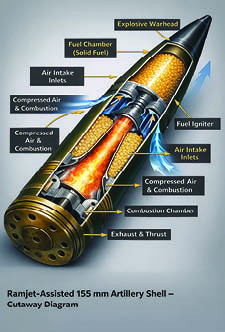
India’s successful testing of ramjet-assisted artillery ammunition signals a major shift in the evolution of tube artillery. By combining sustained propulsion with existing gun platforms, ramjet shells promise deeper reach, faster engagement, and a new balance between cost, precision, and operational depth in modern warfare.
Joseph Stalin famously described artillery as the “God of War,” recognising its unmatched ability to shape battlefields through reach, persistence, and destructive mass. Since the earliest days of organised warfare, ranged weapons have consistently dominated battle outcomes — from ancient siege engines and massed archery formations that broke fortified cities, to Napoleon’s concentrated grand batteries that reshaped European warfare, to the devastating artillery barrages of the Second World War that defined operational breakthroughs.
More recent conflicts, including the Battle of Asal Uttar during the 1965 Indo-Pak War, the Kargil conflict of 1999, and the ongoing Russia–Ukraine war, have repeatedly reinforced the decisive role of long-range fires in determining tactical momentum and operational depth. India quietly reaffirmed this enduring military principle during 2024–2025, when developmental trials of ramjet-assisted 155 mm artillery shells were conducted at the Pokhran Field Firing Range in Rajasthan.
From Rockets to Ramjets: Evolution of Air-Breathing Artillery Propulsion
Ramjet propulsion represents one of the most elegant ideas in high-speed aerodynamics. Proposed by French engineer René Lorin in the early twentieth century, the ramjet eliminates mechanical compressors by using forward motion itself to compress incoming air. Before ramjets entered artillery thinking, the evolution of modern artillery projectiles has been driven by a persistent attempt to extend range, improve lethality, and enhance engagement efficiency without fundamentally altering existing gun platforms. Early improvements relied on aerodynamic refinements such as extended range full bore shells and boat-tail shaping. Rocket assisted projectiles marked the next significant advancement by providing short bursts of propulsion after muzzle exit, extending engagement range but at the cost of payload volume and limited propulsion duration.
The modern 155 mm artillery projectile therefore represents a carefully balanced integration of structural casing, explosive payload, fuze assembly, rotating band, aerodynamic shaping, and stabilising base design. Over time, designers have progressively modified this architecture to accommodate drag reduction mechanisms, propulsion modules, and guidance systems while attempting to preserve payload mass and structural stability.
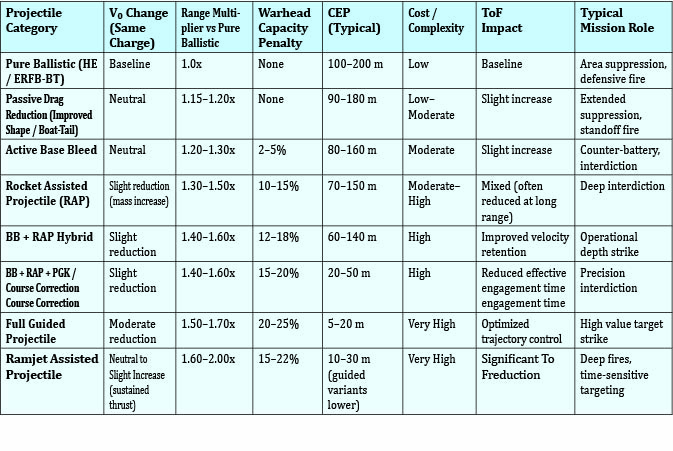
When evaluated under identical firing conditions, these projectile technologies form a clear performance progression, summarised in Table 1. Pure ballistic shells define the baseline performance envelope, relying entirely on muzzle energy and aerodynamic efficiency. Passive drag reduction shells extend engagement range modestly without altering muzzle velocity or payload capacity. Active base bleed projectiles further increase reach by reducing aerodynamic drag while maintaining similar launch characteristics. Rocket assisted projectiles introduce additional thrust, significantly expanding operational range but reducing warhead volume due to propulsion system integration.
As illustrated in Table 1, each successive category improves range, accuracy, or engagement flexibility but introduces trade-offs in payload, cost, and system complexity. This technological ladder reflects artillery’s gradual transformation from massed firepower toward precision, deep-strike capability. However, it also reveals inherent limitations in propulsion endurance and velocity retention that constrain the effectiveness of extended-range ballistic and rocket-assisted projectiles, thereby creating the operational and technological space for sustained propulsion concepts such as ramjet artillery ammunition.
Assumptions: Same gun, barrel, charge zone, weather, target distance baseline comparison.
Why Each Shell Category Still Matters in Modern Warfare
Despite the technological progression toward powered and guided projectiles, each artillery shell category retains doctrinal relevance. Pure ballistic shells remain essential for high-volume fire missions where cost efficiency and sustained logistical supply dominate tactical requirements. They support suppression, defensive fire plans, and area denial operations where numerical weight of fire remains decisive.
Rocket assisted and hybrid projectiles expand artillery’s operational envelope into domains previously dominated by rocket artillery. These rounds enable deep interdiction of logistics nodes, command centres, and mobile formations. Guided and course-corrected shells transform artillery into a precision engagement system capable of striking high-value targets with reduced collateral risk. Their role becomes particularly critical in urban environments and counter-infrastructure operations where target discrimination is essential.
The layered employment of these categories ensures artillery retains versatility across tactical, operational, and strategic fire missions.
Why Ramjet Artillery Becomes Necessary
The comparative ladder of artillery projectiles reveals persistent gaps that modern battlefields increasingly expose. Conventional ballistic and drag-reduction shells remain limited by energy decay, restricting effective deep fires against mobile and time-sensitive targets. Rocket assisted shells improve reach but provide propulsion only briefly, after which velocity decay resumes, extending flight time and reducing engagement effectiveness. Guided munitions improve accuracy but do not fundamentally alter propulsion efficiency or sustained velocity retention.
Ramjet propulsion addresses these limitations by providing sustained thrust across much of the projectile’s flight path. By eliminating oxidiser mass and utilising atmospheric oxygen, ramjet shells achieve superior propulsion efficiency relative to rocket assisted rounds. Sustained velocity reduces time of flight, compresses enemy reaction windows, and increases lethality against time-sensitive targets. Ramjet propulsion also offers improved energy retention across extreme range envelopes, enabling artillery to engage deeper operational targets without requiring new launcher platforms.
Though several engineering factors make ramjet artillery difficult to implement in calibres below 155 mm, the single most decisive constraint is the requirement for very high initial velocity, typically close to Mach 2, for reliable ramjet ignition and sustained combustion. Ramjets depend on forward motion to compress incoming air, and without sufficient muzzle velocity, stable air intake and fuel combustion cannot occur. Larger calibre artillery systems naturally generate higher muzzle velocities and provide better mass stability during flight. Modern 155 mm guns such as ATAGS and other 52-calibre systems typically achieve muzzle velocities in the range of 820–950 m/s, which approaches or exceeds Mach 2 under favourable atmospheric conditions. By comparison, 105 mm artillery systems generally achieve muzzle velocities around 490–700 m/s, while 120 mm mortar systems typically operate between 300–600 m/s. These lower velocity regimes struggle to sustain reliable ramjet airflow compression and combustion stability. Therefore, 155 mm calibre artillery provides the optimal balance between launch energy, internal volume, and aerodynamic stability necessary for practical ramjet projectile integration.
Ramjet Artillery Technology Maturity (2025–2045)
The development of ramjet artillery follows a predictable maturation trajectory that extends beyond propulsion success toward operational reliability and doctrinal integration. Between 2025 and 2030, the focus lies on survivability, ignition reliability, and propulsion stability. Gun-launched projectiles experience extreme acceleration forces, rotational stresses, and thermal loads that challenge fuel grain stability and inlet airflow management. This phase emphasises validating ignition sequencing, combustion stability across varying atmospheric conditions, and structural endurance under launch stress.
From 2030 to 2035, the emphasis transitions toward production standardisation and fire control integration. Manufacturing tolerance control becomes critical because minor dimensional variations can significantly affect propulsion efficiency. During this stage, advanced ballistic modelling, muzzle velocity measurement systems, and meteorological data integration enable reliable trajectory prediction. Storage life certification and safety validation also become central as ramjet ammunition transitions from prototype status to deployable inventory.
Between 2035 and 2040, the technology evolves toward enhanced accuracy and networking. Course correction and guided variants emerge to ensure effective engagement across extended ranges. Integration with ISR networks, UAV reconnaissance platforms, and battlefield data fusion systems becomes essential. Electronic warfare resilience and navigation redundancy become design priorities as contested electromagnetic environments become standard features of modern conflict.
From 2040 to 2045, ramjet artillery is expected to diversify into specialised variants optimised for mission profiles. High-velocity variants may prioritise reduced time of flight for counter-battery missions, while endurance-optimised variants could emphasise maximum reach for interdiction roles. Industrial supply chains mature to support large-scale production, and export viability emerges as an economic multiplier.
Structural and Operational Constraints
Despite its promise, ramjet artillery introduces substantial engineering and operational challenges. The integration of propulsion systems within compact projectile architecture reduces available payload volume and complicates internal structural design. Combustion stability remains sensitive to airflow conditions, particularly in high altitude environments where reduced oxygen density affects thrust efficiency.
Thermal loads generated by sustained propulsion impose stringent material requirements, increasing manufacturing complexity. Fire control modelling becomes more demanding because propulsion introduces dynamic thrust variables absent in purely ballistic trajectories. Storage and transportation safety requirements are also more stringent due to integrated fuel components.
Cost remains another constraint. Ramjet shells are inherently more expensive than conventional ammunition, limiting their use to high-value targets and specialised missions.
Ramjet versus Hypersonic Artillery: The Next Technological Contest
Future artillery research increasingly explores hypersonic projectile concepts designed to achieve extremely high velocities through advanced propulsion or electromagnetic launch technologies. Hypersonic artillery promises reduced time of flight and enhanced penetration capability but introduces extreme thermal stress, guidance challenges, and high system costs.
Ramjet artillery occupies a pragmatic middle ground. While not achieving hypersonic velocities, ramjet shells provide sustained propulsion, extended reach, and manageable engineering complexity within existing artillery infrastructure. Hypersonic systems may dominate specialised strategic strike roles, but ramjet artillery offers scalable operational deployment. In practical military planning, ramjet propulsion is likely to complement rather than compete with hypersonic concepts, providing affordable deep fires while hypersonic systems remain premium precision strike assets.
India’s Battlefield Geometry
The doctrinal impact of ramjet artillery is particularly significant for India due to its diverse operational theatres and dual-front security challenges. Against Pakistan, ramjet shells expand deep fire capability across plains and desert sectors characterised by intense artillery duels and rapid relocation cycles. Reduced time of flight compresses enemy displacement windows and enhances counter-battery effectiveness. Longer engagement range allows Indian batteries to operate from safer stand-off distances, reducing exposure to retaliatory fire and lowering logistical vulnerability.
Against China, altitude and terrain dominate operational planning. Ramjet shells provide enhanced reach in mountainous environments where forward gun deployment is restricted by terrain and infrastructure limitations. Although thin air reduces ramjet thrust efficiency, reduced aerodynamic drag partially offsets performance losses. The ability to strike logistics convoys, reinforcement columns, and communication nodes deep within mountainous corridors provides significant operational leverage.
Table 3- Indian 155 mm Gun Compatibility with Ramjet Ammunition
Gun System Barrel Length Operational Strength with Ramjet Theatre Relevance
ATAGS / VAJRA 52 Cal High muzzle velocity supports Plains, desert deep strike
ramjet ignition
Dhanush 45 Cal Moderate compatibility, requires Mixed terrain
optimized projectile design
Bofors FH-77 39 Cal Limited ignition margin vs modern Legacy deployment
systems
M777 Ultra-Light 39 Cal Critical for mountain mobility but High altitude warfare
Howitzer requires ramjet tuning
Future Indigenous TBD Key enabler for distributed ramjet Himalayan theatres
ULH deployment
Barrel length and gun platform compatibility further influence doctrinal employment. Longer barrel 52-calibre systems provide improved muzzle velocity and ignition margins for ramjet projectiles. Ultra-light howitzers remain essential for mountain warfare mobility, but India must expand indigenous ultra-light artillery development to fully exploit ramjet ammunition potential. Ramjet artillery also strengthens sensor-to-shooter integration. Reduced time of flight increases the value of real-time targeting and ISR fusion, allowing artillery to engage fleeting targets before relocation.
In India’s evolving artillery doctrine, ramjet shells reinforce Stalin’s assertion by transforming artillery from a weapon defined by massed firepower into one defined by sustained reach, tempo dominance, and deep strike adaptability. By integrating propulsion innovation with digital fire control, indigenous platform development, and theatre-specific doctrine, India positions its artillery arm to remain the decisive force multiplier across future battlefields.
The author, based in Delhi, is a defense researcher focused on military strategy and emerging threats through analytical writing
