

 Login
Login
Articles
Space Weather and Climate Change
Sub Title : Rarely spoken of, but weather phenomenon in space and climate change have a major impact pn operations
Issues Details : Vol 19 Issue 6 Jan – Feb 2026
Author : Samrat Pravin Patel
Page No. : 53
Category : Military Technology
: January 22, 2026
Introduction
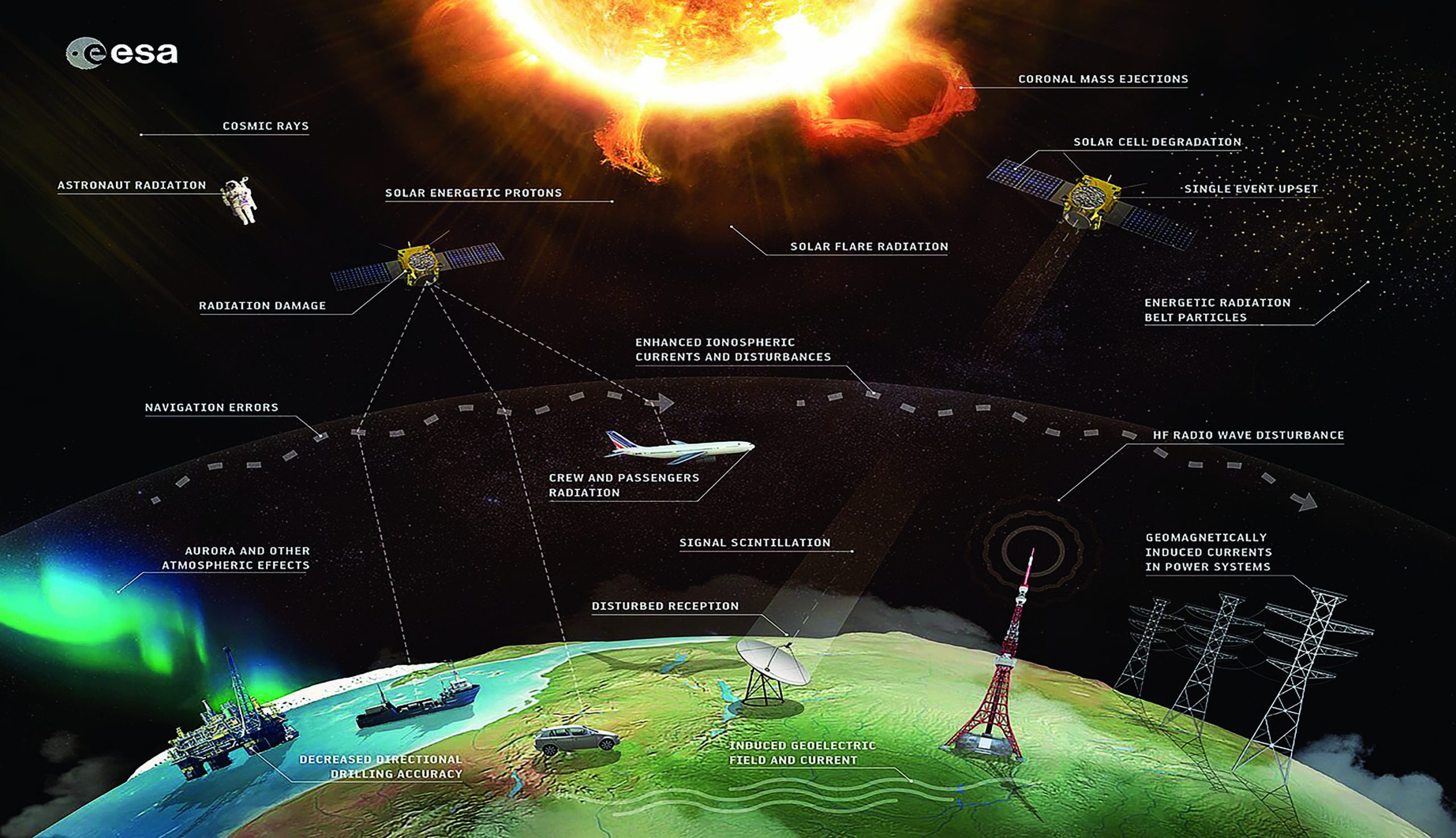
Space weather encompasses a complex array of phenomena originating from solar activity, including solar flares, coronal mass ejections (CMEs), solar wind variations, cosmic rays, and the resulting geomagnetic storms that affect Earth’s magnetosphere and atmosphere. These phenomena interact with Earth’s climate systems through multiple pathways, creating cascading effects that extend far beyond their immediate electromagnetic impacts. India’s defence infrastructure spanning the Indian Army’s terrestrial operations, the Navy’s maritime domain awareness, and the Air Force’s aerial superiority missions faces unprecedented compounded risks from the intersection of space weather events and climate change. As India increasingly relies on sophisticated satellite-based systems for navigation, communication, and reconnaissance, understanding these interconnected threats becomes critical for national security planning.
Variations in Solar Irradiance and Army Operations
Solar irradiance variations, driven by the 11-year solar cycle, significantly influence Earth’s climate patterns, particularly affecting monsoon systems that are crucial for India’s agricultural and military logistics. The Indian Army’s operational readiness depends heavily on predictable seasonal patterns for troop mobility, border security operations in the Himalayas, and disaster relief missions across the subcontinent. Solar irradiance fluctuations can alter atmospheric heating patterns, disrupting the delicate balance of monsoon circulation systems on which the Army relies for operational planning. The Army’s logistical challenges become particularly acute in Northeast India and flood-prone regions, where altered rainfall patterns complicate supply chain management and troop deployment. Border operations along the Line of Actual Control (LAC) in the Himalayas are especially vulnerable, as unpredictable weather patterns can isolate forward posts and compromise communication links. The cascading effects of solar-induced climate variability directly affect the Army’s strategic mobility and operational effectiveness, necessitating enhanced forecasting capabilities and adaptive logistics planning.
Cosmic Rays and Air Force Operations
The controversial” Svensmark effect” posits that variations in cosmic rays influence cloud formation through ionization processes in the atmosphere; however, this mechanism remains the subject of scientific debate. For the Indian Air Force, cloud variability presents significant operational challenges affecting reconnaissance missions, unmanned aerial vehicle (UAV) surveillance operations, and precision targeting capabilities. The Air Force’s growing reliance on satellite-based navigation systems, including India’s NavIC constellation, underscores the importance of understanding these atmospheric coupling effects. Cloud seeding operations and weather modification efforts during monsoon seasons can be complicated by cosmic-ray-induced atmospheric changes, thereby affecting the Air Force’s ability to support agricultural and disaster management operations. The unpredictability of cloud-cover patterns also affects aerial refueling operations, formation flying, and the effectiveness of electro-optical surveillance systems. These challenges necessitate enhanced atmospheric modeling capabilities and adaptive mission-planning protocols that account for space-weather-induced atmospheric variability.
Atmospheric Coupling and Naval Operations
Geomagnetic storms heat the upper atmosphere, altering atmospheric density and disrupting jet stream patterns, thereby affecting weather systems across the Indian Ocean region. The Indian Navy’s operations in the Arabian Sea and Bay of Bengal are particularly vulnerable to these effects, as satellite drag degrades the precision of maritime navigation systems and disrupts weather forecasting capabilities essential for naval deployments. The Navy’s increasing dependence on satellite-based communication and navigation systems makes these space weather effects a critical operational concern. Unpredictable cyclone patterns in the Bay of Bengal and the Arabian Sea, potentially intensified by the interaction between climate change and space weather, pose significant challenges to naval operations and coastal defense strategies. The Navy’s ability to provide humanitarian assistance and disaster relief during extreme weather events depends on accurate forecasting systems that can be compromised by space weather-induced atmospheric disturbances. These vulnerabilities underscore the need for resilient communication systems and enhanced space weather monitoring capabilities to support maritime operations.
Threats to Defence and Space Assets
India’s defense capabilities increasingly depend on space-based assets, particularly ISRO’s satellite constellation, including the NavIC navigation system, which provides critical positioning services for all three defense services. Space weather events pose direct threats to these orbital assets through radiation damage to electronic components, solar panel degradation, and orbital perturbations that can lead to operational failures. The Aditya-L1 mission, India’s first dedicated solar observatory, represents a crucial step toward understanding and predicting these threats. Ground-based defense infrastructure is vulnerable to geomagnetically induced currents (GICs), which can overload power grids, threatening command centers, radar installations, and communication networks. Aviation navigation systems experience degraded performance during ionospheric disturbances, affecting Air Force operations and potentially compromising mission success. The loss of climate-monitoring satellites undermines India’s environmental intelligence capabilities, which are crucial for the Army’s disaster-response operations and the Navy’s coastal-defense planning.
Case Studies and Historical Precedents
The 2003 Halloween Storms provide a relevant parallel for India’s growing satellite fleet, demonstrating how extreme space weather can simultaneously affect multiple orbital assets and ground-based systems. The historical Carrington Event of 1859 offers insights into the potential catastrophic impact on India’s power grids and defence communications infrastructure, with modern technological dependencies making contemporary systems even more vulnerable. The 2022 Starlink incident, in which dozens of satellites were lost due to increased atmospheric drag during a geomagnetic storm, provides crucial lessons for India’s expanding low-Earth-orbit constellations and planned expansion of the NavIC system. Each of these incidents demonstrates the cascading effects of space weather on military readiness, ranging from communication disruptions to navigation system failures. The interconnected nature of modern defense systems means that a single space weather event can simultaneously affect Army logistics, Navy navigation, and Air Force operations, highlighting the need for comprehensive resilience planning across all defense services.
Gaps in Understanding and Preparedness
Scientific uncertainty regarding cosmic ray-climate interactions remains a significant challenge for defense planning, as the mechanisms linking space weather to terrestrial climate systems are not fully understood. India’s defense planning often treats climate change and space weather as separate issues, leading to policy fragmentation that leaves critical vulnerabilities unaddressed. Current forecasting limitations, particularly regarding polar coverage gaps, hinder real-time readiness assessments; however, India’s polar missions, including Chandrayaan and Aditya-L1, can help bridge these knowledge gaps. The fragmented approach to space weather and climate resilience leaves the Army, Navy, and Air Force exposed to compound risks that could simultaneously affect multiple operational domains. Limited coordination between civilian space weather research and military operational requirements further exacerbates these vulnerabilities, underscoring the need for integrated planning approaches that account for the full spectrum of space weather impacts on defense operations.
Solutions and Recommendations
Enhanced monitoring capabilities should leverage data from ISRO’s Aditya-L1 mission to develop integrated defense forecasting systems that can provide early warning of space weather events. Resilient infrastructure development must include radiation shielding for satellites, hardening of naval communication systems against electromagnetic interference, and protection of Army field bases against geomagnetically induced currents. Interdisciplinary research initiatives should integrate DRDO, ISRO, and defense services into joint task forces focused on space-weather resilience and climate-adaptation strategies. International cooperation through UNOOSA frameworks and Indo-Pacific defense partnerships can help build regional resilience against space weather threats while sharing costs and expertise. Defense-focused resilience requires both immediate technological upgrades and long-term strategic foresight that considers the evolving threat landscape. Investment in indigenous space weather monitoring capabilities, including ground-based magnetometer networks and ionospheric monitoring systems, will enhance India’s ability to protect its defense assets and maintain operational readiness during extreme space weather events.
Conclusion
Space weather and climate change represent interconnected threats that pose significant risks to India’s defense infrastructure across all operational domains. The compounding effects of these phenomena require urgent attention and integrated planning across the Indian Army’s terrestrial operations, the Navy’s maritime missions, and the Air Force’s aerial capabilities. India’s defense resilience will ultimately depend on successfully combining advances in space science, climate intelligence, and military strategy into a comprehensive framework that addresses both immediate operational needs and long-term strategic challenges. The nation’s investment in space-based monitoring systems such as Aditya-L1, coupled with enhanced international cooperation and interdisciplinary research, positions India to lead in developing innovative solutions to emerging security challenges.
Samrat is an established researcher and technology consultant in Small Satellite Space Technologies, Sustainable Computing, UAV/IoT Robotics and Radio Frequency Technologies.
References
Baker, D., Li, X., Pulkkinen, A., Ngwira, C., Mays, M., Galvin, A., … & Simunac, K. (2013). A major solar eruptive event in July 2012: Defining extreme space weather scenarios. Space Weather, 11(10), 585-591. https://doi.org/10.1002/swe.20097
Biswas, S., Bhaskar, A., Raghav, A., Kumar, A., Ghag, K., Thampi, S., … & Yadav, V. (2025). Pinching of ICME Flux Rope: Unprecedented Multipoint Observations of Internal Magnetic Reconnection during Gannon’s Superstorm. The Astrophysical Journal, 991(1), L15. https://doi.org/10.3847/2041-8213/adfe60
Das, S., Ahmed, A., & Karmakar, P. (2025). A theoretical model analysis for non-thermal solar plasma fluctuations.. https://doi.org/10.21203/rs.3.rs-6843637/v1
George, A. (2024). A Short Review on India’s Interplanetary Missions. AAJ, 2(1), 138-147. https://doi.org/10.61359/11.2106-2403
Gogoi, B., Kumar, A., Kartik, A., & Nirmala, S. (2018). Velocity and Acceleration of NavIC Satellites using Broadcast Ephemeris. International Journal of Mathematical Engineering and Management Sciences, 3(3), 294-300. https://doi.org/10.33889/ijmems.2018.3.3-021
