

 Login
Login
Articles
Standards for the Future Battlefield
Sub Title : When technology is evolving faster than doctrine, the battlefield may be the wrong place to impose rigid standards.
Issues Details : Vol 20 Issue 4 Sep– Oct 2026
Author : Milind Sharma
Page No. : 9
Category : Military Technology
: September 23, 2026
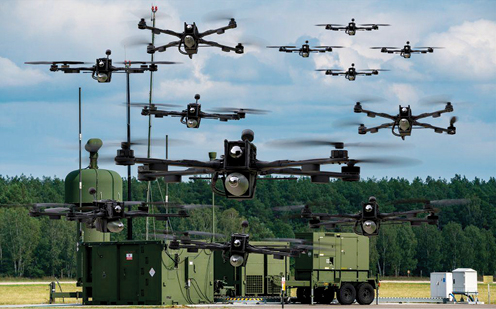
The Indian Army is moving rapidly towards networked, autonomous and AI-enabled warfare. Yet the technologies required to make these systems work together are evolving just as quickly. The challenge is to achieve interoperability without prematurely locking India into obsolete standards.
Recent discussions have focused on the creation of common systems for interfacing between the next generation of robotic systems that are rapidly being procured by the Army. This discourse has many forms: seminars on interfaces for integrated counter-UAS, common operating pictures for robotics systems, and drone-swarming software. On the surface, these might all seem distinct from one another. But they all share an important feature – they’re all systems with embedded computers and networked communications. This common link is at the core of the next generation of military technology, and makes them really just different expressions of the same general system.
Why so much fuss over creating these common standards, systems, operating pictures, and interfaces? Because everyone intuitively understands that the Army is going to have a multitude of suppliers, and that the products of each have to ‘just work’ with the products of all. The importance of this cannot be overstated. The next generation of defence infrastructure will constantly sense, process, and share information, which autonomous drones will receive and act on. This sensor-to-effector loop will form the spine of the armies of the future. And so, military professionals at all levels have repeatedly debated and considered options with the industry, trying to reach agreement; to no avail.
The approach thus far has been top-down. Discuss, decide, then mandate interfaces and enforce their compliance by private industry. The issue is that both the technology and the doctrine governing its use in warfare are extremely new and rapidly evolving. It is essentially impossible to mandate any stable agreement here that also stays at the cutting edge of the technology. Obsolescence isn’t the only outcome to fear. Worse still is the possibility of specifying an incorrect architecture. Ask a dozen experts their opinions on what these standards for networked communications in defence robotics should look like, and you’ll receive as many differing answers. Consider that widespread drone warfare only began in 2022, following the full-scale invasion of Ukraine, and that for most of the time since, both the drones and the countering systems have been fairly simple. By deduction, then, any expert in the field would have had only a couple of years to gather this expertise, and most of these experts live in Ukraine, Europe or the US.
What needs to be done is a system of rapid, repeated iteration. The Army should begin by setting out what it requires these systems to accomplish. Private industry should develop its best attempts at addressing these needs. Intense, competitive testing and evaluation should follow, at Army ranges that recreate the expected operational conditions. Through this competitive process, winning technologies and architectures will emerge. The best systems should be awarded contracts. Over successive trials, reality itself would’ve helped to shape the common standards for the Army. At this point, the Army and industry would have developed a far greater understanding of the technology and the doctrine. Now the process of legislating and formalising could begin, and it could do so with reason and evidence at its back. This might seem unorthodox to the Army, but there is already precedent.
In the United States, private companies such as Anduril and Palantir led the development and deployment of open-architecture, networked-computing, open-interface systems for defence. This was underway long before the US Army brought them into any official programme. The Army, independently realising the importance of these technologies, created the Next Generation Command and Control (NGC2) programme, and then brought Anduril and Palantir into it. The approach was explicit and intentional. In June 2025, Joseph Welch, then deputy to the commanding general of Army Futures Command, created a four-page statement of needs that “describes the problem instead of dictating the solution”. He described how the resolution of the problem would be an “emergent technical architecture” based on evidence from evaluations. General James Rainey, then commanding Army Futures Command, articulated how reliance on a single commercial integrator could surrender too much control over supplier choices, but that the Army acting as technology integrator had also failed. He advocated, instead, for the industry to create competitive teams, present solutions, and undergo iterative evaluations. Teams led by Anduril and Lockheed Martin then worked with the 4th and 25th Infantry Divisions respectively to develop and test their systems. On 22 June 2026, the US Army announced a common data-layer baseline informed by ten months of operational feedback, combining capabilities from Anduril, Palantir, and Raft. This offers India a practical recipe for refining a shared architecture through operational experience.
SAPIENT, the UK-developed interface standard for autonomous sensing and data fusion, often raised in these discussions, also deserves consideration. Its history is instructive. As early as 2015, Dstl and its partners were demonstrating working systems with live sensors and targets. Later, multinational exercises evaluated connections between equipment from different suppliers. SAPIENT’s credibility rests on the foundation of that practical work. The Indian Army may use it or something similar as a starting point, but SAPIENT is primarily a set of interface definitions. NGC2 is a far better model for how the Army should tackle this, with the solution being a system that it can procure, and not just a series of technical interfaces for sensors to communicate.
The Indian Army should put this approach into practice:- Fund competing systems, place them with soldiers, and make the next decision based on the evidence those trials produce. Give Indian industry responsibility for developing the technical answers, and hold it responsible for performance. This technology, and the doctrine governing its use in war, are still certainly in their adolescence. That presents an incredible opportunity: Race ahead now, and we may find ourselves ahead of most. But in this age of AI, things move fast, and the future is nearer than ever.
Milind Sharma is a passionate, young robotics engineer dedicated to shaping the future of intelligent machines and autonomous systems
