

 Login
Login
Articles
The European Theatre: The Myth of the Backyard
Sub Title : The Ukraine war is dismantling not only armies on the battlefield but also the long-held geopolitical myth of Russia's unquestioned dominance over its neighbourhood
Issues Details : Vol 20 Issue 3 Jul – Aug 2026
Author : Col KL Viswanathan (Retd)
Page No. : 62
Category : Geostrategy
: July 28, 2026
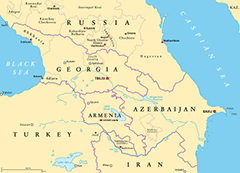
The Russia-Ukraine war has reshaped far more than Europe’s security landscape. Beyond the battlefield, it has accelerated geopolitical realignments across the Caucasus and Central Asia, challenging long-held assumptions about Russia’s influence and exposing the limits of traditional spheres of power.
The Russia–Ukraine war is now well into its fifth year. Fighting continues along multiple sectors of the front, with neither side able to secure a decisive breakthrough. How long Ukraine can sustain the war and on what terms it may eventually end, remains an open question.
But the more revealing story may no longer lie on the battlefield alone. For decades, regions such as the South Caucasus, the Black Sea basin, and Central Asia have been described, often casually, as Russia’s “backyard.” It is a phrase that has persisted across policy circles, strategic commentary, and even academic discourse. But it is worth asking: was that frame ever accurate?
These are not extensions of Russia. They are sovereign states – Azerbaijan, Armenia and Georgia in the Caucasus, and the Central Asian republics that emerged after the collapse of the Soviet Union. To describe them as a “backyard” is not a neutral observation; it reflects a particular strategic mindset. That mindset is now under visible strain.
Erosion behind the frontlines
The Ukraine war has exposed more than a military miscalculation. The assumption that Kyiv would fall within days was only one layer. Beneath it lay a deeper belief; that the wider post-Soviet space would remain passive, aligned or, at the very least, inert. That assumption is steadily fraying.
Across the Caucasus, the shift is already visible. The long-running conflict over Nagorno-Karabakh, once a key lever of Russian influence, has effectively been resolved on terms that Moscow did not dictate. For years, Russia maintained a careful balance between Armenia and Azerbaijan, supplying arms to both while ensuring that neither achieved decisive dominance. The conflict was not merely a dispute; it was also a mechanism of influence. That mechanism has now broken down.
Azerbaijan, backed decisively by Turkey, acted at a time when Russia was deeply consumed by Ukraine. The result was not merely a military outcome but a geopolitical signal. For perhaps the first time in decades, Moscow lacked both the bandwidth and the leverage to intervene meaningfully in what had long been regarded as its sphere of influence.
Rather than reverting to dependency, the region is recalibrating. Armenia, disillusioned with Russian security guarantees, has begun diversifying its defence partnerships, including a notable turn towards India. At the same time, a cautious process of normalisation between Armenia and Azerbaijan is emerging, driven less by Russian mediation than by regional pragmatism. Russia is no longer the indispensable arbiter.
The rise of parallel Influences
Other actors have steadily filled the space. Turkey’s partnership with Azerbaijan is no longer simply political; it has become structural, encompassing energy, trade, connectivity and defence cooperation. For Ankara, the Caucasus is central to its strategic and economic ambitions. For Baku, Turkish support provides both strategic depth and political assurance.
Central Asia is undergoing a similar transformation. The region is no longer operating within a single axis of influence. Instead, the Central Asian republics are pursuing increasingly diversified foreign policies, balancing relationships with Russia, China, the United States, Europe, Türkiye, India and other regional partners.
This is not defection. It is diversification. It reflects a broader geopolitical reality: these states are acting not as extensions of a power centre, but as sovereign actors navigating an increasingly multipolar environment.
The limits of Power
The war in Ukraine has also forced a reassessment of Russia itself. Had Vladimir Putin been able to secure a decisive military victory, he would almost certainly have done so already. The prolonged nature of the conflict suggests not strategic patience alone, but strategic constraint. Russia today is not the power it once appeared to be.
Its prolonged military engagement in Ukraine has stretched its capabilities and diverted attention from other theatres. Even in regions where it once exercised dominant influence, from the Caucasus to parts of the Middle East, its ability to shape outcomes has become more limited. Syria, once a cornerstone of Russia’s regional reach, has likewise illustrated the limits of sustained power projection. Influence, when overextended, becomes increasingly difficult to sustain.
Even within the post-Soviet space, Russian influence was never as absolute as it often appeared. It rested on a combination of historical legacy, economic dependence, security arrangements and, at times, coercion. Institutions such as the Collective Security Treaty Organization sought to formalise that order as Russia’s answer to NATO. But influence imposed is rarely influence secured.
The Narrative Battle
There is also a parallel contest, less visible, but equally significant. In many parts of the world, particularly across the Global South, a lingering perception persists that post-Soviet states aligning more closely with the West are not acting independently but merely serving external interests. Political developments in countries such as Georgia or Ukraine are therefore often portrayed as externally engineered rather than domestically driven.
Yet such interpretations overlook a fundamental reality. These are not passive arenas of great-power competition. They are sovereign political communities with their own histories, identities and strategic choices. To deny their agency is to reinforce the very logic behind the notion of a “backyard.” It is the same logic that assumes proximity creates entitlement. It does not.
A war of Endurance and Exposure
On the battlefield, the conflict has become one of attrition. Territorial gains remain limited, costly and incremental. Neither side has secured a decisive advantage. What began as a war of manoeuvre has evolved into a prolonged contest of endurance.
Beyond the battlefield, however, something more consequential is unfolding.
The Ukraine war is not merely testing military strength; it is exposing the fragility of long-held geopolitical assumptions. It is revealing that spheres of influence, often treated as immutable facts, may in reality be far more contingent, and far more contested.
In Conclusion. So, is it accurate to describe the Caucasus or Central Asia as Russia’s “backyard”? No. At best, it reflects how Russia has historically viewed its neighbourhood. At worst, it is a convenient shorthand that obscures sovereignty and legitimises hierarchy. What we are witnessing today is not simply the weakening of Russian influence. It is the collapse of a way of seeing the world. The story is not that the “backyard” is slipping away. It is that it never quite existed in the way many imagined.
