

 Login
Login
Articles
The Fourth Gulf War
Sub Title : The Iran – Israel-US conflict signals escalation, complexity, and global consequences.
Issues Details : Vol 20 Issue 1 Mar – Apr 2026
Author : Ajay Singh
Page No. : 20
Category : Geostrategy
: March 21, 2026
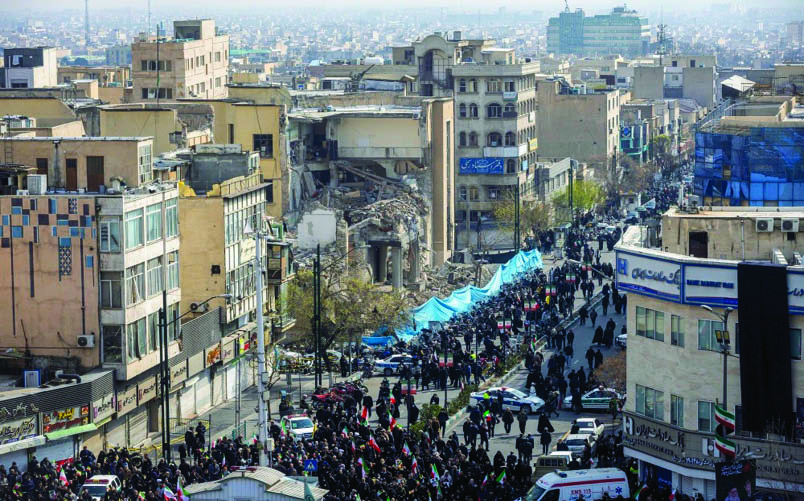
The US–Israel offensive against Iran has triggered a rapidly escalating regional conflict with uncertain objectives and far-reaching consequences. As missile exchanges, economic shocks and maritime disruptions intensify, the war risks destabilising the Middle East, reshaping global energy markets and prolonging strategic uncertainty worldwide.
The First Gulf War launched by the USA in 1991 after Iraq’s invasion of Kuwait, helped establish a permanent US presence in the Middle East. The second in 2003, removed Saddam Hussein and destabilized Iraq permanently. The third one, launched by USA-Israel against Iran, now threatens to unhinge the Middle East – and perhaps the world – irrevocably.
The invasion of Iraq in 2003 was based on the false premise of it possessing Weapons of Mass Destruction. It was later proved unfounded, but served as a convenient excuse for war. This war too, is based on similarly unfounded premises. The aim is presumably to prevent Iran from obtaining nuclear weapons. But Iran had agreed to it way back in 2015 when it signed the US-Iran Nuclear deal, which was torn up by Trump. Even in the ongoing talks at Geneva, Iran agreed to stop production of fissile material, and even hand over its small stock of 60% enriched uranium. Even as the talks were underway, the US had built up its largest ever naval armada in the Gulf, including the aircraft carriers USS ABRAHAM LINCOLN and USS GERALD FORD and 16 other surface ships. The talks, if anything, were only a smokescreen for an inevitable attack US-Israel attack on Iran.
But then this attack was long in coming. Ever since the Ayatollahs overthrew the Shah and came into power after the Iranian revolution of 1979, they have followed an unceasingly hostile policy against USA and Israel – ‘The Great Satan’ and ‘The Little Satan.’ Iran’s support for its proxies – Hamas, Houthis, Hezbollah and the Shia militia in Syria and Iraq enabled it to wage a gradual war against Israel and even Saudi Arabia, without direct involvement. Its pursuit of a nuclear program was an existentialist threat to Israel, and also a concern to its Sunni rival, Saudi Arabia. Removing the regime has been a long-stated US-Israeli aim, but the Ayatollahs held on grimly, suppressing dissent even within its own people. The turning moment for the Middle East came with the Hamas attacks on Israel on 07 October 23. Israeli retaliation saw the crushing of Hamas and most of Gaza; the elimination the Hezbollah leadership in Lebanon through explosive-laced pager; the crippling of the Houthis and a change of regime in Syria, a gradual weakening of Iran’s proxies. Iran was next on the cards. An exchange of missiles and rockets erupted in October 24, following Israel’s assassination of the Hamas Chief, Ismail Haniyeh in Teheran. This was fortunately defused in time, but a larger conflict erupted in June 25 when Israel launched a surprise attack on Iran’s nuclear and military facilities triggering a 12-day exchange of missile and drone attacks. Israel attacked the nuclear plants of Fordow, Natanz, Isfahan and Qom with the coup de grace provided by the US ‘OPERATION MIDNIGHT HAMMER’ attack on the deep underground plant at Fordow, using B2 Bombers armed with GBU – 57 bunker buster bombs. All this was just setting the stage for the wider conflagration to follow. When violent riots, protesting rising prices and inflation broke out across Iran in December 25, they were put down with a very hand and immense casualties, giving the US and Israel another excuse for the inevitable attack on Iran.
OP EPIC FURY
At 9 am on 28th Feb, the USA and Israel hit Iran’s nuclear and missile facilities, IRGC bases, Air and Naval assets across the country. In the first wave of attacks itself, they succeeded in eliminating the entire senior leadership, including Ayatollah Ali Khamenei; General Mohammed Pushpar, the commander of the IRGC; General Aziz Zadeh, the defense minister, the head of its National Defence Council, the director of its aerospace forces and the interior minister.
US and Israeli agencies have been tracking Khamenei for months, using insiders, monitoring data from CCTV cameras on roads and parking spaces, listening into conversations by infiltrating the local cellular networks and following the movements of his driver and personal staff. The attack on Khamenei was planned the previous night, but was shifted when Israeli intelligence discovered that a meeting of top officials was to take place the next morning near his residence. At 9.40 a.m. Blue Sparrow missiles launched by Israeli fighters hit the compound, killing the entire senior leadership in the meeting.
The targeted killing of Khamenei brings out the main agenda – regime change of the Ayatollahs. Trump urged the Iranian people to “Take over your government”, hoping to incite a popular uprising. There had been instances of cheering amongst the Iranians on hearing the news of Khamenei’s death, but they were largely isolated. Instead, US action had the opposite effect. Indiscriminate US attacks, including a Tomahawk strike on a girls’ school that killed over 150 children, inflamed public anger. The Assembly of Experts, a 88 member gathering of clerics that chooses the Supreme Leader – immediately anointed Mojtaba Khamenei, his second son, as the successor. Reports suggested that Mojtaba was himself targeted on the very next day, disfigured and severely injured. But the battle continued, and if anything, it only hardened the regime and got the people squarely behind it.
The US aim of regime change seems difficult to achieve, but does the US really have any clear aims for the war? They have severely underestimated Iran, and not thought of the long-term consequences, including the destabilizing of the Middle East and the global economic consequences of this unwarranted war. If anything, it has only pushed revelations of the Epstein files, and Trump’s own links with the it to the back pages.
Iran’s Response
Iran has hit back violently, in spite of initial losses. Iranian drones and missiles have hit 17 US military bases across the Middle East – including Prince Sultan Air Base in Saudi Arabia, Al Udeid airbase in Qatar; Al as Salem in Kuwait, Al Dhafra in UAE, the headquarters of the US Fifth Fleet at Bahrain and even the US Embassy in Baghdad and Kuwait, causing their evacuation. They have attacked the nations bordering the Persian Gulf, striking as far as Turkey, Cyprus and Azerbaijan. Missiles have also hit Israeli cities, penetrating its famed Iron Dome air defenses. They have even hit crucial hubs like data centers, and desalination plants, which provide over a third of the drinking water to most Gulf nations expanding the war across the Middle East.
Iran’s attack on its neighbors was followed by an apology and the clarification that they were only attacking US targets in the region. Their strategy is simple. They hope to draw the neighbors into the fray, impose economically costs, and also highlight the perils of US presence in the region. The longer the war goes on, the more difficult will it be to sustain it. As it is, there is little support, even within the USA or its allies for this needless war. As US casualties, and economic costs rise, the pressure to end it will increase. The loss of its KC-135 Stratotanker and crew has raised howls of protest, and further losses will intensify public opinion. The USA is burning its way through $2 Billion a day to wage the war. Cheap expendable drones and missiles, have to be countered by sophisticated AD missiles, costing ten times as much and both the USA and Israel are fast expending their resources.
Iran has another trump card – its dominance over the Straits of Hormuz , the 104-mile-long corridor through which one fifth of the world’s oil transits. The targeting of tankers and disruption of this crucial shipping artery has led to oil rising to $100 a barrel, which can go as high as $150 if the war goes on longer. This has been compounded by the US attack on Iran’s Kharg Island – a 8-kilometer-long rocky outcrop in the Persian Gulf through which 80 percent of Iran’s oil is refined and exported. This can cause permanent damage to global energy supplies and shave around 1.5- 3 percent of the world’s GDP. India too is feeling the heat. The stock market has plummeted, the Rupee has weakened, and gas shortages are affecting the common man. An increase in just $1 per barrel of crude oil raises the import bill by around $1.5 Billion, and rising fuel prices will cause inflation, lead to shortages, and impact everything from cooking gas to fertilizers. Ironically, it is Russia that has come to the world’s rescue, by promising to increase shipments of oil which is now being lapped up by energy starved economies in Europe and Asia.
The war expanded into the Indian Ocean with the sinking of IRIS DENA, an Iranian frigate which was torpedoed by a US submarine off the coast of Sri Lanka. Lebanon too has seen renewed clashes, with the Hezbollah resuming firing rockets and missiles and Israel continuing its bombing of Beirut and incursions in South Lebanon. The Houthis too have entered the fray. Even though Iran has sustained immense losses, and its most of its antiquated aircraft and naval vessels have been destroyed, it still holds a plentiful supply of drones and missiles that it can use to inflict damage across the region. China, in spite of its own energy concerns – could be the unlikely gainer in this conflict. The US attention has been diverted from the Indo-Pacific, the main theater of operations.
What Next?
The war is fast becoming a test of staying power. The US does not seem to have any clear end-state in mind and regime change may not be possible unless they put boots-on-ground – which they will not risk. They have tried to use the Kurds and the Balochs to raise their own specter of ethnic separatism within Iran, but so far have not succeeded. Nor have the Iranians risen in revolt. If anything, the Ayatollahs have become even more obdurate. They have put three conditions to end the conflict – recognition of Iran’s legitimate rights, payment of reparations for war damage, and international guarantees against further attacks. Trump has demanded ‘COMPLETE AND UNCONDITIONAL SURRENDER.’ Both sides may be unable to attain their demands, but eventually the shooting will stop and both sides declare victory. But the long-term consequences will remain. Iran will be sorely degraded, but an angry, hardened regime could still succeed in holding on to power. Like with North Korea, it could decide that the only guarantee of security is nuclear weapons. But a considerably weakened Iran could sink into instability and internal turmoil – like Iraq. All this could add to the insecurity of the most volatile and energy-rich region of the world.
We can only hope that the Nobel Peace Prize coveting President calls off the action and some measure of normalcy returns. But then what is next? Cuba or North Korea? The turbulence will keep rocking the world, with little signs of abating.
