

 Login
Login
Articles
The Impact of The Iran War
Sub Title : How the ongoing war in West Asia is impacting the entire world in numerous ways
Issues Details : Vol 20 Issue 2 May – Jun 2026
Author : Ajay Singh
Page No. : 23
Category : Geostrategy
: June 1, 2026
What began as a regional conflict has evolved into a geopolitical and economic shockwave with global consequences. The Iran war has exposed the limits of American power, reshaped Middle Eastern alignments, unsettled global energy flows, and accelerated the transition toward a more fractured multipolar world.
The Suez Moment
In 1956, Britain which had been weakened by World War II and economic decline, faced its major tipping point. President Nasser of Egypt abruptly announced the nationalisation of the Suez Canal, the connecting lifeline between Europe and Asia. UK and France, in conjunction with Israel, launched a military operation to recapture the canal – an action that ended disastrously and forced them to withdraw. This defeat and the loss of prestige that accompanied it, precipitated Britain’s decline as a world power thereafter.
The Suez Canal moment for the USA could lie in the Straits of Hormuz. Ever since Trump launched his disastrous war on Iran on 28 February, Iran’s closure of the Straits has plunged the world in turmoil. The US inability to bring a closure to the war, which Trump described as “a little incursion,” coming on the heels of its chaotic retreat from Afghanistan could be the tipping point for a decline in US power and prestige. This could set the stage for the rise of other powers and the reshaping of the world order.
The War
When USA and Israel launched their attack, even as US-Iran nuclear talks were ongoing, they planned on a swift operation which they hoped would ultimately result in regime change. They had spectacular initial success. In the first few hours, they decapitated the entire leadership including Ayatollah Khamenei, the head of the Republican Guards, the Army Chief, and the heads of its missile force and its nuclear program. Khamenei was replaced by second son, Mojtaba – who was injured in another strike and reportedly disfigured. An estimated 18-20,000 US -Israeli strikes hit Iran in the first two weeks of the war, destroying schools, bridges, powerplants, missile sites, naval bases and military infrastructure. But, in spite of the loss of its leadership, Iran continued fighting back, using its residual supply of drones and missiles to good effect. It lashed out at Israel and neighbouring countries, striking US bases in UAE, Saudi Arabia, Bahrain, Qatar and across the Middle East, with drones and missile attacks, forcing them to deploy expensive air defence systems to counter them. Nor was there an uprising against the regime as had been hoped. If anything, US strikes merely united the Iranian people against an external threat.
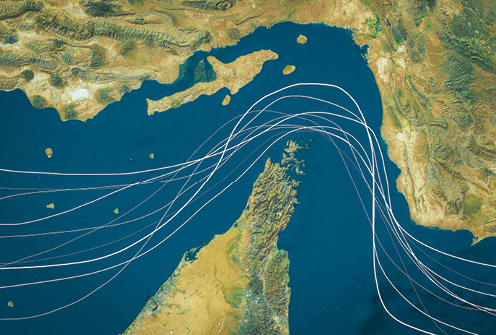
But the Iranian masterstroke was the blocking of the Straits of Hormuz, the 104-mile corridor leading from the Persian Gulf into the Indian Ocean, where a fifth of the world’s oil and natural gas and over a third of its fertiliser passes. The Straits are just 50 miles wide at the mouth and tapers to around 30 miles across at its narrowest point, allowing it to be easily dominated by Iran from the north. It does not even need a strong naval presence for that. Just using missiles, fast attack boats and sowing it with mines (or even creating a fear of likely mines) enabled it to slow the maritime traffic from 100-120 ships to just 8-10 per day, with the passage of each ship regulated by Iran. The US had responded by imposing its own naval blockade around the Persian Gulf to throttle Iranian shipping going to and from its ports – grandiosely named OP PROJECT FREEDOM. ThIS sent oil prices rocketing from $69 per barrel over $100 a barrel (touching $156 at its peak) and put global economies in turmoil.
An enraged Donald Trump warned Iran to “Open the f***ing Straits or an entire civilisation will die tonight, never to return.” Fortunately, just hours before his obliterating strike on Iran, he agreed to a Pakistani brokered ceasefire on 07 April. The two-week ceasefire was extended by two more weeks, and then pushed forward indefinitely, as the two sides prepared for talks.
Yet, the talks scheduled on 26 April at Islamabad did not materialise. The Iranian delegation arrived dressed in black, carrying photographs and school bags of 168 school children who were killed in a US attack on a school in Minab (Incidentally, the aircraft carrying the delegation had the callsign MINAB – 168). At the last moment, Trump refused to send the US delegation stating that the Iranian proposals were inadequate. Even as the two sides sent fresh proposals for consideration, the ceasefire still held – fortunately – even though skirmishing continued.
It seems difficult to break the impasse given the incompatibility of the proposals put up by both sides. Iran demands an immediate end to the war on all fronts, including Israel’s campaign in Lebanon. It also demands acceptance of its sovereignty over the Straits of Hormuz, removal of sanctions and the release of funds frozen in US banks. They also demand compensation for damage caused by the war – estimated at around $300 billion, and guarantees against future attacks by USA and Israel. In return, they agreed to keep the Straits of Hormuz open, while discussions on its nuclear program would continue thereafter. This proposal was turned down by the US, whose prime demand is Iranian acceptance of the closure of nuclear program and the handing over of approximately 450 kgs of 60 percent enriched uranium which is believed to be held by them. Hopefully, there will be some sort of compromise. But, the crux of the issue is whether Iran will give up its nuclear and missile capabilities, especially when that appears to be its only defence against an unpredictable USA.
The Outcome
In spite of his bombast and bluster, it is unlikely that Trump will launch his ‘devastating and obliterating’ strikes on Iran. There would be attacks, but the ground invasion is unlikely to materialise. The war is hugely unpopular in the USA, and the US Senate has voted to force Trump to end the war, unless he receives congressional approval. It has also raised the price of gas at the pumps, and of groceries in the stores. Inflation is rising and he simply cannot afford to have his ratings drop any further before the crucial midterm elections of November.
So hopefully, some sort of compromise deal would be stuck in which Iran agrees to keep the Straits of Hormuz open, while the USA agrees to stop strikes and lift its own naval blockade. Iran would provide guarantees that it will never produce nuclear weapons, while being allowed to do so for peaceful energy, in return for promises of non-aggression by USA and Israel. This can be presented as a ‘Win’ by both sides. In effect, it will be merely be a return to the status quo that existed before the war.
But the war has changed global dynamics in more ways than one. It has exposed the limits of US power in its inability to subdue Iran. It is expended over 30% of its stocks of air defence and long-range cruise missiles, which will take 3-4 years to recoup. It has lost an estimated 30 aircraft and seen its bases come under attack. It has expended over $27 billion on the war so far, but the cost goes far deeper than that.
The ripples were most visible in the Trump-Xi Summit at Beijing this May, and also in the Xi-Putin meeting that followed just a week later. The US weaknesses in Iran also indirectly exposed the US position on Taiwan. “I will not travel 9500 kms to fight a war over Taiwan” as Trump posted. The weakening of the USA in both Europe and the Middle East has strengthened China in the Indo- Pacific. It could well capitalise on it by pushing ahead with the reunification of Taiwan, “by military force, if required.”
The rift in NATO has also come out in the open. Spain, UK, Germany and France refused to enter the war and even denied transit facilities to US military aircraft and ships. UK and Germany have agreed to send a minesweeper each to keep the Straits of Hormuz open, but that seems more a sweetener than anything else. This dangerous distraction in Iran has played right into Putin’s hand as Russia tries to close the Ukraine war on its own terms.
The war has also brought out drastic realignments within the Middle East. Israel has been the beneficiary and has been the unseen hand that instigated the US attack. The weakening of its arch-enemy Iran, has allowed Israel to press ahead with own actions in Lebanon. And as Iran lashed out at its neighbours, it isolated itself even further. All Gulf countries hosting US troops came under attack – which also struck critical infrastructure like power plants, desalination plants and energy sources. Saudi Arabia and UAE especially bore the impact, with a recent drone strike hitting UAE’s Barakah nuclear plant. But all that has pushed UAE closer to Israel. Saudi Arabia too invoked a mutual Défense pact with Pakistan to get it to station 8000 troops, a squadron of JF-17 fighters, a squadron of drones and a HQ-9 Air Defence battery on its soil. The weakening of Iran suits Israel, Saudi and UAE – who perhaps hope that the war would continue till it is weakened completely. But Iran is not likely to succumb, and China and Russia too, will not permit it to be destabilised completely. All this has made the Middle East even more fragmented and turmoiled than before.
India, like the rest of the world, has been hit hard by the economic churn. Its oil basket has almost doubled, its foreign exchange reserves are depleting, the rupee is in freefall, inflation has risen, and the shortage of fertiliser will impact the summer crop. The economy has taken a beating which will take a long time to recover. Fortunately, our independent ties with Israel, Iran, UAE, Saudi and other Middle Eastern states are still strong. This will help us regain our footing once this needless war is over.
At the time of going to print, the wall is still in a ‘Pause’ mode. The USA has not attacked, in spite of Trump’s daily threats. Hopefully, there will be some sort of a deal struck – a compromise which allows both sides to declare victory. After that, Iran will limp on, maybe under the same Ayatollahs. But the economic and geopolitical tremors of the war are likely to remain long after the firing actually stops.
Ajay Singh is the author of 8 books and over 250 published articles. A renowned writer and public speaker, he is the recipient of the Rabindranath Tagore International Award for Art and Literature and a regular contributor to DEFSTRAT.
