

 Login
Login
Articles
Waging a Dangerous Peace
Sub Title : The proposed Peace agreement by the US may not really usher in peace in Ukraine
Issues Details : Vol 19 Issue 5 Nov – Dec 2025
Author : Ajay Singh
Page No. : 44
Category : Military Affairs
: December 5, 2025
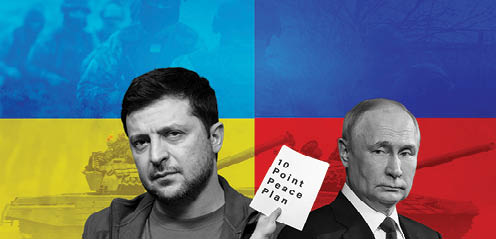
The question confronting the world today is stark: Is the new American “peace plan” for Ukraine truly peace, or merely a piece of Ukraine handed to Russia? Washington’s proposal, crafted without Kyiv or Europe, resembles a coerced settlement that legitimises conquest and reshapes the global order in troubling ways.
The 28-point peace plan unveiled by the USA to stop the four-year-old Russia-Ukraine war was not so much a balanced deal as an instrument of surrender for Ukraine. The prime stakeholders – Ukraine, and to some extent Europe – had not even been consulted. The plan seemed a rehash of the Russian proposal put up in the Trump-Putin meeting at Anchorage earlier this year. In a nutshell, it proposed that Ukraine ‘Swap land for peace.’ In that land grab, Russia would keep the four regions of Kherson, Zaporizhzhia, Luhansk and Donetsk in Southern and Eastern Ukraine, which they have captured so far. Ukraine would also have to concede the area of the Donbass which Russia has still not been able to capture. This comprises over 15 percent of the Donbas, including the cities of Sloviansk and Kramatorsk, which they have held on grimly in spite of repeated Russian assaults. All four provinces, including Crimea which was annexed in 2014, would thus be officially recognised as a permanent part of Russia, even by the USA.
Even the Zaporizhzhia nuclear plant has been conceded to Russia, with the premise that it would supply 50 percent of its generated electricity to Ukraine – something almost impossible to implement. Ukraine would have to cap its army to just six lakh troops, abjure all claims to join NATO and amend its constitution to reflect that. NATO would agree to never permit Ukraine to join, and not to expand any further. In return, all that Ukraine would receive is a cessation of hostilities, and vague ‘security guarantees’ which have not been specified.
The plan has been described as ‘a betrayal dressed up as peace’ and is a virtual sell-off of Ukraine. It paves the way for the next round by hampering Ukraine’s ability to defend itself, and legitimises Russian battlefield gains. Even the $340 billion of Russian funds frozen in US banks would be returned with just around $100 billion, being retained by the USA for ‘rebuilding Ukraine.’ There are no prizes for guessing which companies would secure the lucrative contracts for reconstruction and repair of its shattered cities.
The plan has been followed by familiar US arm-twisting for Ukraine to accept the deal or the US would cut off all intelligence and arms supplies to the country, virtually making it impossible to continue fighting. To add insult to injury, Trump in typical block capitals, accused Ukraine of “ZERO GRATITUDE FOR OUR EFFORTS.” Ukraine has been virtually thrown under the bus, and so has Europe which now has the spectre of a reinvigorated Russia, inching westwards and being left increasingly to fend for itself.
Ukrainian and European protests could lead to a refined plan that incorporates some of their concerns. But at the end of the day, it is still a peace plan that endorses Russia’s complete victory. Europe too, has no option but to come on board or risk antagonising Trump even further. The deal marks an end of the accepted international order based on respect for national boundaries and is a throwback to an earlier era when smaller nations could be carved up with impunity to suit big-power ambitions.
Peace in the Middle East
The proposed Ukrainian peace plan comes close on the heels of another war that Trump claims to have halted – Gaza. The 20-point Comprehensive Plan to end the Gaza conflict called for a cessation of Israeli military actions and the resumption of aid into Gaza in exchange for the return of 48 hostages held by Hamas along with the remains of the deceased ones. This was to be the first phase of the plan. It would be followed by a phased Israel withdrawal from Gaza, which would be replaced with an International Stabilisation Force to oversee the reconstruction and stabilisation of Gaza.
It seemed like a workable one on paper, but one has to only see the manner in which it has panned out to realise its shortcomings. Once the hostages were released by Hamas, the ceasefire has predictably broken down and Israel resumed its offensive both in Khan Younis and Gaza City which has killed an estimated 300 Gazans so far. They also followed it up with an escalation of attacks against Hezbollah, with a strike on Beirut killing its newly appointed Chief of Staff. Peace in the beleaguered enclave seems a far cry, and all actions point to a gradual takeover and the displacement of the local population. The Trump family will undoubtedly get lucrative deals for reconstruction, the Israelis will carve out a buffer zone and the Palestinian cause will recede even further into the background.
More so, since Trump has courted the Saudi Crown Prince Mohammed Bin Salman, with a red carpet welcome to the White House, and washed away his involvement in the Khashoggi killing in return for a $1 Trillion investment promise. Weaning the Saudis ensures that opposition to Israel remains muted, and tilts the Middle East security equations firmly towards the USA and Israel.
The Dangerous US Recalibration
These ‘Peace Plans’ could be part of Trump’s desperate attempts to eventually get a Nobel Peace Prize, but they have dangerous connotations. In his attempt to be seen as a peacemaker, he has alienated traditional allies like Europe, India, Japan, and Taiwan, and courted unlikely ones such as Pakistan, Russia and China. He has also made another flip-flop on China, overturning almost two decades of US policy which recognised it as the main global threat – by formally accepting it as an equal and an ally. After his tariff war against China rebounded, he announced his meeting with the Chinese President Xi Jinping in Busan, in bold capitals as “THE G2 WILL BE CONVEYING SHORTLY,” a tacit admission that the USA now sees a bipolar world with the US and China as the two superpowers calling the shots.
It is significant that even during the meeting – which saw an end to the trade war, and the resumption of the supply of rare earths to USA – China announced that “Taiwan’s return to China is an integral part of the post-war international order” – a position seemingly accepted by Trump. Xi Jinping, like Putin before him, seemed to have got the better of Trump during their discussions, and earned a tacit acceptance of their stance. China will now be emboldened to up the ante for the reunification of Taiwan. Seeing the manner in which both Russia and Israel have been allowed to get away with battlefield successes, China could well decide to exercise the military option in Taiwan, betting on the fact that a US administration which sends aircraft carriers to counter alleged drug smugglers in Venezuela, and urges its troops to be prepared to fight in its own cities ‘as training grounds’ is unlikely to have the gumption to intervene. More so, given Trumps record of backing down when confronted with strength.
Trump’s disavowal of traditional alliances such as NATO and QUAD, has weakened them considerably. Even the next meeting of QUAD now seems unlikely. The fraying of these alliances will further embolden China in its actions in the China Sea and elsewhere. Its allies are fast realising that they would have to depend upon themselves and not a transactional USA, to look after their strategic interest. Europe is closing ranks around the E3 – Germany, France and UK – as a hedge against future Russian aggression. Japan, another ally caught in Trump’s prevarications, is rearming frantically and has stated that it could intervene militarily in case China attacks Taiwan, (which is just 70 miles away), realising that should China invade, Taiwan could go the Ukraine way.
India is also caught in this whirlwind of change. India’s refuting of Trump’s boasts to have brokered peace between India and Pakistan during the four-day exchange of OP SINDOOR, led to a major rift in Indo-US ties. The damage and break of trust is unlikely to be repaired soon. The US tilt towards Pakistan is also disquieting. But we too, would hope for a lasting peace in Ukraine and the Middle East. In the meantime, we must build our strengths, bide our time, and continue with our time-honoured policy of strategic autonomy.
Trump’s peace-making spree seems to cause more problems than it resolves. More often than not, it involves the selling of an ally for short-term personal gains. Ukraine seems to be its latest victim and its repercussions will be felt by Europe and across the world. To paraphrase Henry Kissinger, it just goes to show that, ‘It is dangerous if the USA wages war upon you; but if it imposes a peace, it could be fatal.’
Ajay Singh is the author of eight books and over 200 published articles. His books include “Ukraine, Gaza, Taiwan…A World at War.” He is a recipient of the Rabindranath Tagore International Award for Art and Literature and a regular contributor to DEFSTRAT.
