

 Login
Login
Articles
War Aims and Outcomes – ‘A Pernicious Drift’
Sub Title : When political objectives become blurred, even military success can fail to deliver strategic victory.
Issues Details : Vol 20 Issue 3 Jul – Aug 2026
Author : Lt Gen Sanjiv Langer PVSM, AVSM (Retd)
Page No. : 14
Category : Geostrategy
: July 28, 2026
War is not judged by battles won or territory captured, but by whether it achieves its political objectives. Drawing lessons from conflicts spanning the American Civil War to Ukraine and West Asia, this article examines why clearly defined war aims remain the cornerstone of strategic success.
“…..Na taron arso jab jaye larun, Nischay kar apni jeet karon” – Guru Gobind Singh
I have taken the liberty of quoting the Tenth Sikh Guru, at the outset, and not offering any translations. No translation meets the necessary standard of true understanding. I am also confident many readers will be familiar with these lines. A true understanding involves studying the life, mission and convictions of the Guru.
As a lodestone, however, for politico-military decision making and General Staffs in particular, given the overall wisdom of the Guru, war must be an absolute last resort. In the Indian context war is warranted only as a ‘Dharm Yudh’. That said, once the decision to go to war is taken, all measures and stratagem must be ensured to enter battle resolved on victory. Does history inform us of the fulfilment of this meditation?
I have on several occasions stated that an appreciation of military history cements the fact that the commencement of modern war began with the American Civil War. Centred in the prevention of Extension of Slavery, on July 06, 1854 the new Republican Party was formed in the then USA. Soon Abraham Lincoln rose to its centre. On 20th of December 1860 at 1:15 PM in Charleston South Carolina, an Ordinance was voted in, which dissolved the Union, compacted under the Constitution of the US. Several States followed, and formed the Confederate States.
The Confederate States elected Jefferson Davis as President. Lincoln and Davis were inaugurated within months of each other. The war aims flowed very definitely from the vision and conviction of these two democratically elected Presidents. On 04 March 1861 President Lincoln declared, that the Union of the USA, was Unbroken, what lay ahead was war. Consequent War aims were deceptively simple. The Confederacy would fight for independence. The North for reestablishment of the Union. The South would defend and the North had to invade and capture all.
Lincoln had to change 4 Army Chiefs, while the South benefitted from the brilliance of Robert E Lee and excellent politico-military convergence. The North and Lincoln prevailed at the cost of 360-365,000 total deaths, thousands wounded and maimed. The South had an assessed 395-490,000 casualties. The unforgiving concept of an Unconditional Surrender was engraved. President Lincoln paid with his life on 14 April 1865, for this war. In the narrow spectrum of Aims and Outcomes, this is an example of fulfilment of war aims. We do not have the mandate here to examine the second, third and continuing order of outcomes.
Between 1865 and World War I (1914), there were 14 Wars/Conflicts globally, and 3 / 4 US centered wars. These led to consolidation of the US; Prussian/German State; and the disintegration of Ottoman territories. A stellar war was the Russio-Japanese War, where in the Naval Battle of Tsushima Straits, 25 -27 May 1905, the Japanese Navy annihilated the Russian Baltic Fleet. These 24 hours changed the power equations in the world. They also sent a wave of awakening through Asia. Many Asians realised the European powers were neither invincible, nor destined to rule indefinitely. Like the Civil War, it is really doubtful what lessons Europe took from Tsushima. The prelude to 1914 in Europe, saw a huge rush for large battle ships, most of which were never put to use. The main Naval Battle of the World War, at Jutland was at best an inconclusive draw.
Indian Interlude
In Europe, Armies fought each other in colonial wars. In the colonies, European gunpowder armies fought colonial entities. Despite their courage and ferocity these were horribly disadvantaged against the post Renaissance European warcraft. Indian military history on the contrary, provides a penetrating view of Colonial British capabilities. While the British were masters at creation and sustaining finances at our cost, their much-touted military capability was unable to stand alone.
Indian leadership of Mysore, the Mahrattas and the Sikhs who saw the outstanding potential of the European model of war, spread terror among the British. In this the French Generals in India played a central role. Colonial wars with Hyder and Tipu Sultan raged from 1767 to 1799; against the Mahratta’s from 1775 to 1818, and with the Sikhs from 1845-1849. While the duration is significant, for such overhyped superior British armies, the fine print is even more revealing.
In the opening rounds against Mysore and the Mahrattas, British power was inconclusive. Tipu succeeded Hyder Ali and slowed down the transition to French trained troops. He fell in tenacious battle to poor finance, incomplete changeover and masterly intrigue, ably supporting the British. Scindia created a European style Army with large elements under De Boine. De Boine controlled the Ganga-Jamuna Doab from Aligarh, till 1796. The British avoided all conflict, and only had the resolve to venture towards the Mahrattas again in 1803. They finally prevailed in 1818. The Sikhs remained, untouched and unmolested as well as dominant till the demise of Maharajah Ranjit Singh in 1839. It is very doubtful whether the British could have prevailed over the Sikhs militarily, if not for enormous financial availability, prodigious machinations and profound intrigue.
Now some quick conclusions. Indian leaders always lost out on the ability to maintain meaningful finance to support their reborn armies. The British were masters of finance, intrigue and institutional disingenuity. Alls fair in war, undoubtedly, but we are looking here at military capability unable to prevail on its own. British generalship in Crimea (1853- 1856) and Afghanistan (1839 to 1880), was calamitous. How could anyone expect any better, in the First World War? Incompetence, superciliousness and disdain for human losses, was coupled with complete paralysis of political leadership, and lack of any statesmanship, in the European powers of the time. (War Aims and Outcomes).
There were changes by the Second World War, but neither World War could have been won without the US, and in case of the Second, Russia. Britain retained its ability and visceral tendencies to play down successful commoner generals, and celebrate mediocre and pedantic generals of high birth. It is from this cauldron that Indian Army leadership was born. Denied progression as well as exposure, despite disingenuity at the level of the British origin Chief on Independence, the Indian Army exceeded expectations, from the moment it landed on Srinagar Airfield 27 Oct, 1947.
Our Army was ready to take the battle across into territory occupied by Pakistan in Kashmir. 1962 outcomes were due to a convergence of deleterious factors. A critical, unbiased and objective analysis of the 1962 War, is still awaited. Little attention is given to consider those who stood and fought and those who remained willing to fight on. 1965, ‘67 and 1971 are exemplars of War Aims achieving mandated Outcomes. Like 1962, Op Pawan also needs a full analysis to defeat common perception. The capture of Saltoro Heights Siachen, Kargil War and Op Sindhoor, rank exceptionally in Aims and Outcomes. Op Sindhoor is also an exceptional high mark, of General Staffs (all services), wisdom on when to agree and recommend a call off of conflict, in an unstable 21st Century environment. It is consequently no small wonder why Indians were transported across the Globe, to fight and win in wars. To date they are inn high demand internationally for UN Peacekeeping.
The recent wars commenced in Ukraine Feb ‘22 2022. The Russian three-pronged invasion, `with strategic objectives of Regime Change, Denazification, capture and forced capitulation, elimination of NATO from Ukraine, stumbled in the first 72 Hours. The lunge on Kiev executed by a diffused armour thrust, and a failed coup de main effort on Hostamel Airport withered away. Ukrainians did not rise to greet the Russians as liberators. Russia fell back to renewed offensives from its firm bases earlier acquired in the East and South of Ukraine.
On the Ukrainian side it’s difficult to believe the full implications of a war with Russia was not appreciated. Flow of western aid is one thing but to sustain a war on your own territory, with your own population, indefinitely, is another. Despite this Ukraine has displayed a rare tenacity, commitment to identity and enormous ingenuity in the conduct of a multidimensional, multidomain war. NATO and the West are firmly embedded in Ukraine. It has struck back with counter offensives, and along the Eastern front territory has exchanged hands over the past four years.
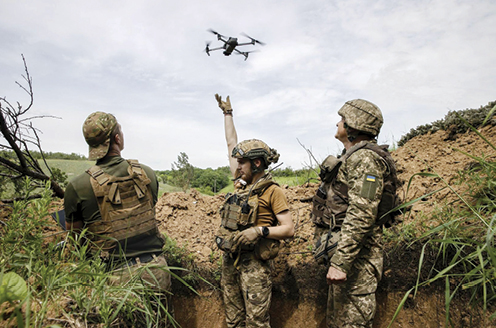
A strategic design created for a 72 hour collapse, is not even close 4 years later. Imprinted in the battlespace is tactics that hark back to 1914-18, with drones establishing a regime, as mines did. Gains are by meters and building blocks. There is no defined battlespace, with assets and populace all over Ukraine and Russia open to attack. Infrastructure has become a prime target. How could professional General Staffs and political leaderships, lead millions into this abyss of a night without end? With all the best intelligence and situational awareness? This conflict has also brought forth several dangerous ‘new normals’, that can freely manifest in other conflicts yet unborn.
The conflagration in West Asia, commenced on 07 Oct 2023 with an unprecedented attack out of the Gaza Strip by Hamas. Some of the objectives of Hamas commencing with this spectacular attack, were to derail Israeli and Gulf States normalisation, Bring the Palestinian cause to international centre stage, obtain release of maximum prisoners, and marginalise the PLO. As the Hamas leadership set about this, did they for even a moment, not realise, that they were risking destruction? There was Nil, Zero, possibility that Israel would not retaliate with superior power. Hamas has no Air Force, Navy, tanks and artillery. Precipitating this attack was tantamount to exposing the whole populace to destruction. This was apparent before the event. Could Hamas ever presume that the US would not support Israel?
Israel has chosen the strategy of the Raging Inferno. An inferno fed with combustion does not stop. Its war aims are yet to be achieved. And then a sequence of dystopian events plunges the Gulf into a most painful, and internationally damaging war. Central to this is Iran, and a US centred strategic push. Did all the concerned General Staffs and polity not study Iran? A nation that has overcome coup attempts, internal turmoil, a 5-year war with Iraq, and displayed tenacious internal control, from the time of the Islamic Revolution. How could the possibility of Iranian retaliation, interdiction and emasculation of the Persian Gulf, escape attention?
Let’s recall the first control and domination of the Persian Gulf was by the Colonial British, through its Gulf Residency. This for a major part operated out of Bushire in Iran. For nearly 150 years all trade, foreign and maritime policies, flagging of ships, was controlled and regulated by the British. During the war with Iran, Iraq had enforced a maritime exclusion zone in the Persian Gulf. On the 17 of May 1987, the USS Stark a Perry Class Frigate was struck reportedly by two Exocet Missiles and severely damaged, while reportedly being in a forbidden zone. There could consequently, have been no doubt that Iran had the ability to interdict the Gulf, as it has done. War aims in this Gulf conflagration for the multiple players, are far from attaining any finality.
So it seems as articulated by Cassius (in the play Julius Casaer), “ the fault dear Brutus, is not in the Stars, but in ourselves….” Politico-Military decision making for War, is a very tough domain. To ensure success when all else has failed, assessments, appreciations and scenario visualisation have to follow very strict and demanding sequences. There is no room for notions of truth, curation of truth or inventive thinking. Any such deviations will result in large casualties, destruction, and more significantly a clear drift from successful outcomes.
War by definition is a domain riddled with unpredictability. The worst outcome possible is a haemorrhaging unending conflict. This is exactly what we are witnessing in Russia-Ukraine, and are fearful of in the Gulf and West Asia. When agendas, personalities and grandstanding become central, outcomes of war will be deleterious. What is an interesting phenomenon is the 21st century which imparts so much more pre-cognition and transparency, has demonstratively produced conflicts that have continued to flounder for years.
Viewed at its core war aims and outcomes, seem to be remarkably successful in Revolutionary Wars. The Wars post the Russian Revolution of 1917, Struggle of the Communist Party of China, and inspirational war of independence in Viet Nam, are fine examples. Of course, Revolutionary wars cannot be confined in time due to their nature. Outcomes however seem well aligned with aims. The unbroken quest of the Afghan entities for their own freedom and national consolidation, must also be acknowledged. The domain of what we term Conventional Wars remain maimed in Aims and Outcomes. In fact, many wars display prominently the fact that there was no wisdom, in teetering over into such an unforgiving domain.
‘War is the unfolding of Miscalculations’, wrote the military historian Barbara Tuchmann. It is the task of Politico-Military planning to reduce and safeguard against miscalculations. But this does not work if miscalculations are meant to happen, or are meant for a pernicious advantage. If this continues, we will continue to see thousands killed and maimed, millions displaced and destruction setting back development by decades. Further the only one Planet Home that we have cannot sustain such an onslaught indefinitely.
